
South African Reserve Bank Says Retail CBDC Not a Priority, Focus Shifts to Payment System Upgrade

Quick Breakdown
- SARB says there is no immediate need for a retail CBDC, prioritizing payment system upgrades instead.
- The bank warns that crypto and stablecoins pose risks and may be used to evade capital controls.
- Globally, CBDC development is accelerating, with 49 countries currently running pilots.
SARB pushes modernization over digital currency rollout
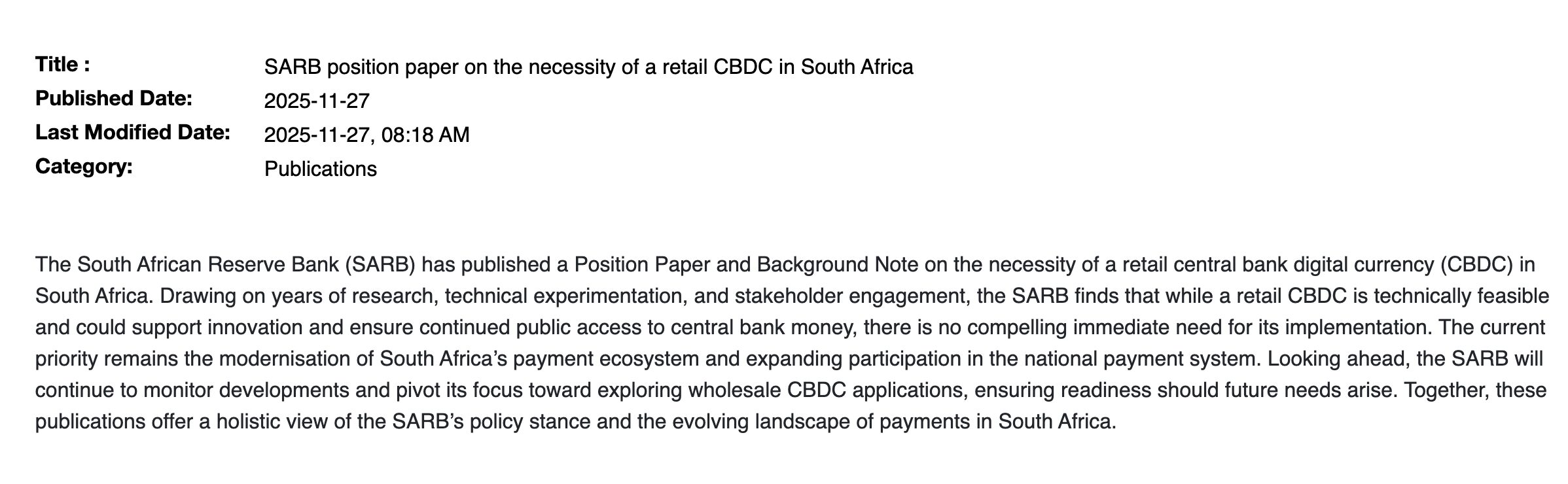
The South African Reserve Bank (SARB) says it does not see an urgent need to launch a retail central bank digital currency (CBDC), arguing instead that the country should focus on upgrading its existing payments infrastructure.
 Source:
Resbank
Source:
Resbank
In a paper released on Thursday, the central bank noted that while a retail CBDC is “technically feasible,” there is currently no strong or immediate justification for deploying one. Ongoing initiatives, such as payment system modernization and expanding access for non-bank players, remain the bank’s primary focus.
“While the SARB does not currently advocate for the implementation of a retail CBDC, it will continue to monitor developments and will remain prepared to act should the need arise,”
the bank stated.
Shift toward wholesale CBDC and cross-border experiments
Instead of pursuing a consumer-facing digital currency, SARB will focus on exploring wholesale CBDC use cases and improving cross-border payment efficiency, areas it sees as offering more immediate value.
SARB’s findings also highlighted unresolved challenges in South Africa’s financial system, with nearly 16% of adults still unbanked. The bank stressed that any future retail CBDC must provide benefits equal to or better than cash, including low costs, offline functionality, privacy, and universal acceptance.
The central bank has recently taken a tougher stance on the crypto sector. In a separate report released earlier this week, SARB listed crypto assets and stablecoins as new risks within technology-driven financial innovation, warning that digital assets can be used to bypass the country’s Exchange Control Regulations, which govern capital flows.
Global CBDC efforts are gaining pace
Globally, only Nigeria, Jamaica, and The Bahamas have fully launched CBDCs, according to the Atlantic Council. Another 49 countries are running pilots, 20 are developing, and 36 are researching digital currency models. The United States, meanwhile, has paused its CBDC exploration under the Trump administration.
Disclaimer: The content of this article solely reflects the author's opinion and does not represent the platform in any capacity. This article is not intended to serve as a reference for making investment decisions.
You may also like
Here’s why BlackRock believes autonomous AI systems will drive next stablecoin boom
BlackRock expects exchange-traded compute futures as it pitches stablecoins for AI agents
Report: TSMC to Raise Wafer Foundry Prices by 3% to 6% Starting January Next Year, Order Visibility Extended to 2030
According to media reports, TSMC's advanced and high-priced processes such as 2nm and 3nm have seen the largest price increases; mature and specialty processes are subject to individual negotiation based on products, capacity utilization, and customer conditions. Currently, TSMC's 8-inch fabs have a capacity utilization rate exceeding 100%, and processes below 45nm are at full capacity. The construction of AI data centers is not only driving demand for GPU and HBM, but also boosting orders for mature processes such as PMIC, MCU, and analog ICs.
U.S. Treasury plans to repurchase up to $6 billion in long-term bonds, 30-year yield hits highest since 2007
This is the second round of enhanced long-term bond buybacks by the Treasury, this time focusing on 20- to 30-year government bonds. After the announcement of the planned upper limit, the yield on 30-year U.S. Treasury bonds continued to rise, at one point exceeding 5.4%. In the first round of enhanced buybacks two weeks ago, the upper buyback target was also $6 billion, which was lower than some market participants had expected, and the actual buyback amounted to only $5.2 billion due to insufficient competitive bidding, according to the Treasury.
Crypto prices
More


