
The largest IPO in history! SpaceX reportedly seeks to go public next year, aiming to raise over 30 billion and targeting a valuation of 1.5 trillion.

SpaceX is advancing its IPO plan, aiming to raise significantly more than $30 billion, which could make it the largest public offering in history.
According to reports, SpaceX plans to go public as early as mid-to-late 2026. If SpaceX sells 5% of its shares as planned, the fundraising scale will reach about $40 billion, far surpassing the record of $29 billion set by Saudi Aramco in 2019. After the news broke, EchoStar, which agreed to sell spectrum licenses to SpaceX, surged as much as 12% intraday before retreating to close up about 6%.
Written by: Bao Yilong
Source: Wallstreetcn
SpaceX is advancing its IPO plans, with a proposed fundraising scale far exceeding $30 billion, potentially becoming the largest IPO in history.
On December 9, according to Bloomberg, Elon Musk's SpaceX plans to go public as early as mid-to-late 2026, with financing expected to far exceed $30 billion. The report, citing people familiar with the matter, said the company is targeting a valuation of about $1.5 trillion.
If SpaceX sells 5% of its shares as planned, the fundraising scale will reach about $40 billion, far surpassing the record set by Saudi Aramco. In 2019, Saudi Aramco raised $29 billion, becoming the world's largest IPO. It is worth noting that Saudi Aramco only sold 1.5% of its equity at the time, much lower than the float ratio of most listed companies.
After the news broke, other space company stocks rose on Tuesday. EchoStar, which has agreed to sell spectrum licenses to SpaceX, surged as much as 12% intraday before retreating to close up about 6%. Space transportation company Rocket Lab rose 3.6%.
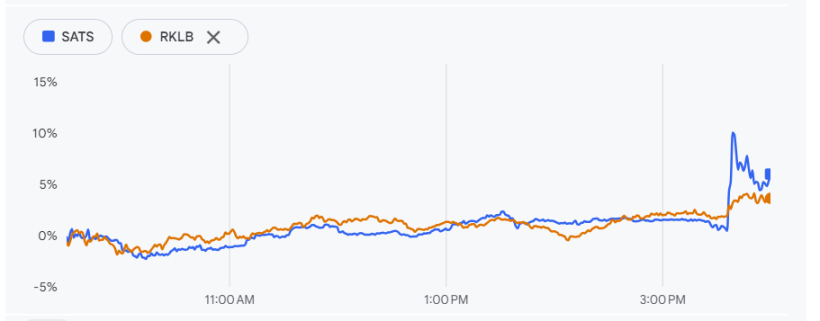
(Space concept stocks rise)
SpaceX is expected to use part of the IPO proceeds to develop space-based data centers, including purchasing chips needed for operations. However, the report points out that the listing timeline may be adjusted due to market conditions and could be postponed to 2027.
Rapidly Growing Revenue Supports Valuation
According to people familiar with the matter cited in the report, SpaceX expects revenue of about $15 billion in 2025, increasing to $22 billion to $24 billion in 2026, with most of the revenue coming from the Starlink business.
The company's accelerated IPO pace is partly due to the strong growth momentum of the Starlink satellite internet service, including the prospects of direct-to-mobile business and the development progress of the Starship rocket for lunar and Mars missions.
On December 6, Musk posted on social platform X:
SpaceX has maintained positive cash flow for many years, conducting regular stock buybacks twice a year to provide liquidity for employees and investors.
He stated that the valuation growth is the result of progress in Starship and Starlink, as well as securing global direct-to-mobile spectrum, all of which have significantly expanded the company's potential market size.
SpaceX executives have previously raised the idea of spinning off the Starlink business as an independent public company. Company President Gwynne Shotwell first proposed this concept in 2020.
The advancement of the overall company IPO plan this time means that the spin-off listing plan may be shelved.
Internal Share Transactions Take the Lead
While advancing its IPO plans, SpaceX has recently finalized the latest round of internal share sales.
According to people familiar with the matter cited in the report, in current secondary market transactions, SpaceX has set the per-share price at about $420, giving it a valuation higher than the previously reported $80 billion.
The company allows employees to sell about $2 billion worth of shares, and SpaceX will participate in repurchasing some of the shares. According to reports, this valuation strategy aims to set the company's fair market value before the IPO.
SpaceX's major long-term investors include Peter Thiel's Founders Fund, 137 Ventures led by Justin Fishner-Wolfson, and venture capital firms such as Valor Equity Partners.
Fidelity Investments is also a key investor, and Google's parent company Alphabet also holds shares.
Disclaimer: The content of this article solely reflects the author's opinion and does not represent the platform in any capacity. This article is not intended to serve as a reference for making investment decisions.
You may also like
The ultimate bottleneck for AI is not just electricity, but also the electricity bill! As data centers become a focus in the US elections, AI infrastructure investment faces a "ballot stress test"
In 2026, data center spending, as the backbone of the artificial intelligence industry, will reach a record high. However, alongside the boom in infrastructure construction, opposition to data centers has risen sharply this year. What started as a localized issue has quickly evolved into a key topic for the November midterm elections.

Eurozone Bond Yields Rise as Brent Touches $100; 10-Year Bund Yield Hits 15-Year High -- Update
From AI to gold and U.S. Treasury bonds: almost everything is surging to new highs, the market welcomes “Everything High”
AI capital expenditure and corporate earnings expectations continue to rise, while energy, gold, US Treasury yields, and market positions are also climbing. On the surface, this suggests a comprehensive increase in growth and risk appetite; however, when inflation, interest rates, and crowded trades are all at high levels, the market's tolerance for the sustainability of the AI boom is also narrowing.
Trump pushes Fed to cut rates, but Waller may go the opposite way: Next week’s meeting faces a “three-way choice”
Bloomberg columnist Claudia Sahm believes that as Trump continues to pressure for rate cuts while inflation remains well above the 2% target, raising rates is becoming an option again, leaving Waller facing a tough decision next week. The Federal Reserve has three paths: raising rates without Waller’s support, which could trigger rare internal divisions; holding steady, which may invite criticism of political interference; or Waller leading a rate hike, which could withstand White House pressure and defend policy independence.
Crypto prices
More


