
MSCI’s crypto treasury rules could spur $15B of forced selling

Crypto treasury companies could be forced to sell as much as $15 billion in crypto if the Morgan Stanley Capital International Index (MSCI) goes ahead and excludes them from its indexes.
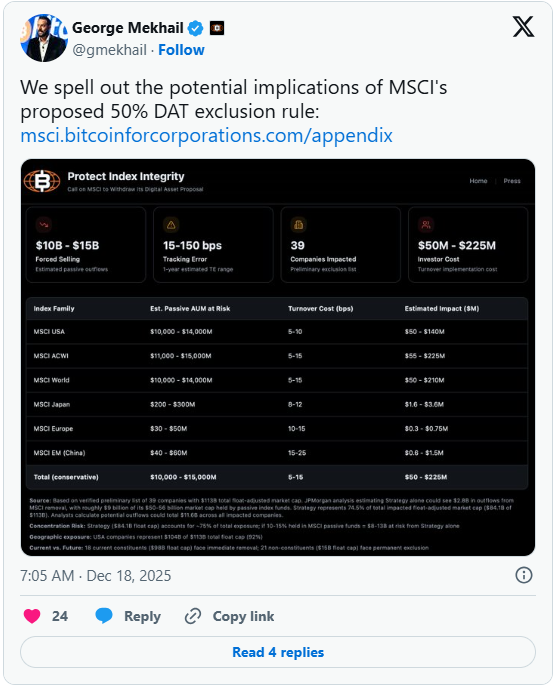
BitcoinForCorporations, a group campaigning against MSCI’s proposal, projected outflows of between $10 and $15 billion based on a “verified preliminary list” of 39 companies with $113 billion in total float-adjusted market capitalization.
It added that JPMorgan’s analysis estimated that Michael Saylor’s Strategy could see $2.8 billion in outflows if it were removed from the MSCI. The Bitcoin treasury firm represents 74.5% of the total impacted float-adjusted market cap.
Analysts calculated potential outflows could total $11.6 billion across all impacted companies. Such a large outflow would put more selling pressure on crypto markets, which have already been trending downward for almost three months.
The BitcoinForCorporations petition letter had 1,268 signatures at the time of writing.
Balance sheet not a fair metric
The MSCI announced in October that it was consulting with the investment community about whether to exclude crypto treasury companies that have the majority of their balance sheet in crypto.
MSCI’s indexes serve as critical benchmarks that determine which companies passive investment funds must hold, making inclusion decisions highly consequential for companies’ access to capital.
However, BitcoinForCorporations said that a balance sheet metric is unfair for judging a company.
“A single balance sheet metric cannot reflect whether a company is an operating business. The rule would remove companies even when their customers, revenue, operations, and business model remain unchanged.”
They added that MSCI should “withdraw the proposal and continue to classify companies based on their actual business model, financial performance, and operational characteristics.”
MSCI’s final conclusions will be announced by Jan. 15, and proposed implementation will be included in the February 2026 Index Review.
Growing objections to the proposal
Several large industry players have recently voiced their objections to the MSCI proposal.
On Dec. 5, Nasdaq-listed Strive urged the MSCI to “let the market decide” whether they want to include Bitcoin-holding companies in their passive investments.
A few days later, Strategy stated in a letter that the proposed policy change would bias the MSCI against crypto as an asset class, rather than the index company acting as a neutral arbiter.
Disclaimer: The content of this article solely reflects the author's opinion and does not represent the platform in any capacity. This article is not intended to serve as a reference for making investment decisions.
You may also like
Valuation drops to a ten-year low! Jensen Huang calls Nvidia the "world's first growth-value stock", but investors don't seem convinced
Nvidia's price-to-earnings ratio has dropped below 17 times, which is only about half of its projected 2025 level. Although revenue and net profit for fiscal year 2027 are expected to grow by 90% and 99% respectively, the company's stock has risen only about 20% this year, significantly lagging behind the Philadelphia Semiconductor Index. Meanwhile, gross margin is expected to decline from 75% in the second quarter to below 72% in the fourth quarter. Rising memory costs and continued pressure from customers developing their own chips, as well as uncertainty over future AI capital expenditures, have become key factors for the market to reassess Nvidia's valuation.
Bitcoin Hashrate Stalls at 934 EH/s — Miners Are Leaving for AI
XRP price prediction splits traders as $27 black swan target ignites debate

Luxury sector profit expectations are "overly optimistic"! Multiple major banks turn bearish within a month, luxury stocks head for worst year since 2008
RBC downgraded LVMH and Burberry ratings to "market perform," stating that luxury goods profit expectations are overly optimistic; the sector has dropped 15% this year, marking its worst performance since 2008.

Crypto prices
More


