
UBS Research Report: Netflix—Why Accelerate Investment at This Point?

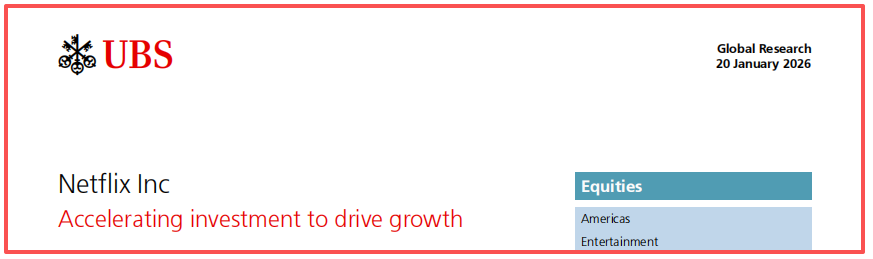
UBS released an analyst report on January 20. Through this report, we will break down three things today:
Netflix’s actual current business status
Why the short-term “noisy” margin isn’t worrying institutions
Where future growth truly comes from
I. The Results Aren’t Bad — The Issue Is with the “Pace,” Not the “Direction”
Looking at the results, Netflix’s business performance is not weak:
Q4 2025 revenue grew 18% year-on-year
Operating profit grew 30% year-on-year
Performance was obviously better than prior guidance
What really caused market divergence is the outlook for 2026:
Revenue guidance of 12–14%, within an acceptable range
But margin expansion is clearly slowing down
UBS’s judgment is clear:
This is not a demand issue, nor a deterioration in the business model, but a phased result of the company proactively accelerating investment.
II. The Core Reason for “Noisy” Margins: Active Expansion, Not Passive Pressure
Breaking down the pressure on the profit side, it mainly comes from three types of investment:
Content investment continues to rise
2026 content budget approaches $20 billion
Covering film/TV, live streaming, licensing, and more
Accelerated advertising business development
Including ad tech, sales system, and content adaptation
Short-term costs are front-loaded, but scale effects are still forming
Regional and compliance costs
Tax and transaction costs are rising in Latin America, EMEA, and other regions
These are structural costs, not a decline in operational efficiency
UBS clearly points out:
The noise in margin comes from the investment pace, not from a weakening fundamental.
III. Where Does Growth Come From? The Answer Is Still Subscriptions + Ads
1️⃣ Subscriptions Remain the “Chassis” of Growth
Expected new subscribers in 2026: around 22 million
ARM (average revenue per member) expected to grow about 5% year-on-year
Management remains restrained about price increases, but hasn’t given up long-term potential
Institutional view:
Netflix’s pricing power has not disappeared, they are just choosing to delay using it.
2️⃣ Ad Business Enters the Second Stage
Advertising is repeatedly emphasized in this report:
2025 ad revenue has already increased significantly
UBS expects ad revenue in 2026 to potentially double again
No longer just “supplemental income,” but an important mid-term growth variable
This means Netflix’s business model is shifting from
“Single-subscription driven”
to
“Dual engine of subscriptions + ads.”
IV. Several Market Concerns — What Do Institutions Think?
Content copyright uncertainty
→ Seen as a short-term disturbance, not affecting long-term competitive landscape
Margin fluctuations
→ Clearly a phased phenomenon, not a trend reversal
Capital return capacity
→ Free cash flow in 2026 is expected to exceed $11 billion
→ Buybacks and capital flexibility remain ample
UBS’s core stance is:
These concerns do not change Netflix's long-term model assumptions.
My Understanding:
What Netflix is doing now is not “betting on growth,” butactively extending the growth curve on the premise that its advantages are still in place.
Short-term profits aren’t pretty — that’s a fact;
But from the perspective of institutional models, this looks more like aproactive shift in pace, not a forced concession.
When content, ads, and user scale are all still rising,
the market’s final discussion won’t be about margins in a particular year,
but about how high Netflix’slong-term ceiling can still be raised.
Disclaimer: The content of this article solely reflects the author's opinion and does not represent the platform in any capacity. This article is not intended to serve as a reference for making investment decisions.
You may also like
NEAR Protocol Chain Signatures connect 30+ blockchains, skip bridges
Overnight US Stock Market | Federal Reserve Raises Interest Rates by 25 Basis Points as Expected, All Three Major Indexes Close Lower, SpaceX (SPCX.US) Rises Over 5%
At market close, the Dow Jones Industrial Average fell by 630.56 points, or 1.21%, to 51,462.55 points; the S&P 500 Index dropped 33.51 points, or 0.44%, to 7,552.22 points; and the Nasdaq Composite Index declined 3.15 points, or 0.01%, to 25,978.42 points.

Overseas investors reduced their holdings of U.S. Treasury bonds by $50.4 billion in July; both Japan and China cut holdings, while the UK increased holdings against the trend
Data released by the U.S. Treasury on Wednesday shows that in July, the amount of U.S. Treasury bonds held by overseas investors significantly decreased, dropping by $50.4 billion from June to $9.25 trillion, marking the lowest level since October last year.

Federal Reserve raises interest rates for the first time in three years! Waller sends a hawkish signal, another 25 basis point hike possible this year
The Federal Reserve raised its benchmark interest rate by 25 basis points to a range of 3.75%-4.00% on Wednesday, marking the first rate hike since July 2023.

Crypto prices
More


