
India’s US Treasury Holdings Hit Five-Year Low, Another Major Player Joins the Global Central Bank “Gold Buying Alliance”

India's holdings of US Treasury bonds have dropped to a five-year low, as the country works to support its currency and diversify its foreign exchange reserves, joining a broader trend of major economies reducing exposure to the world’s largest bond market—the US Treasuries.
According to US government data released last week, India's holdings of long-term US Treasuries have fallen to $174 billion, a 26% decrease from the 2023 peak. Data from the Reserve Bank of India shows that US Treasuries now account for a third of India’s foreign exchange assets, compared to 40% a year ago.
With gold and other alternative assets taking a larger share in India’s reserves, this shift echoes moves by larger holders, rekindling questions about American exceptionalism and the role of its government bonds as reserve assets. Trump’s renewed trade threats over the Greenland issue have only deepened these concerns, raising the possibility that European governments might also start reducing their US Treasury holdings.
Win Thin, chief economist at Nassau 1982 Bank with nearly forty years of market experience, stated that this shift is largely a reflection of countries reducing dollar assets to minimize sanctions risk. “India still has room to cut its US Treasury positions.”
The Reserve Bank of India did not respond to requests for comment on its reduced holdings of US Treasuries. India’s Finance Minister Nirmala Sitharaman said in September last year that the central bank was making “very prudent decisions” to achieve reserve diversification.
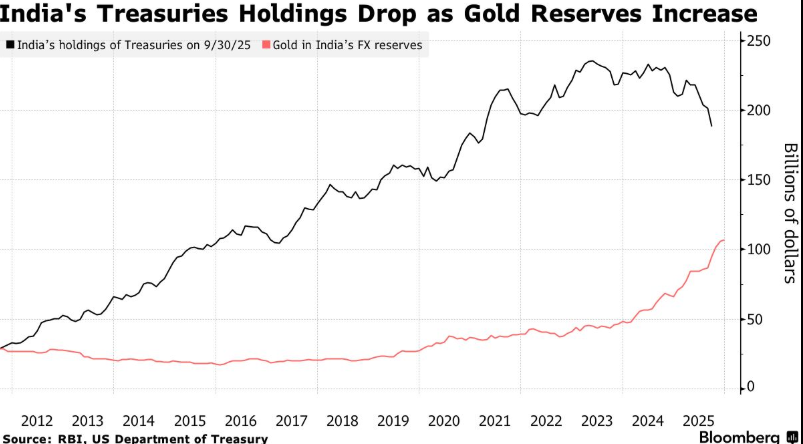 India increases gold holdings as it reduces US Treasuries
 For Mumbai (financial markets) and beyond, the lesson comes from the US freezing Russia’s foreign reserves following the outbreak of the Russia-Ukraine conflict in February 2022. Since then, India’s continuous purchases of Russian oil have become a point of contention with US President Trump, resulting in the US imposing hefty tariffs on the Asian nation.
“The speed of deterioration in US-India relations last year surprised many and prompted policymakers to reduce their vulnerabilities,” said Shilan Shah of Capital Economics, who was ranked by Bloomberg as the most accurate forecaster of the rupee exchange rate last quarter.
Part of the reasoning behind this move stems from the Reserve Bank of India’s efforts to defend the battered rupee. With US tariffs on Indian exports reaching as much as 50% (the highest in Asia), US-India trade agreements have been delayed and the rupee has fallen to record lows. By selling US Treasuries, the Reserve Bank of India can use the proceeds to buy rupees and support its value.
Within the investment community, Trump’s global trade tariffs and the weaponization of the dollar through sanctions have raised questions over whether US Treasuries remain the best choice. Recent US raids on Venezuela have further heightened these concerns.
As of November last year, the Reserve Bank of India was not a major holder of US Treasuries, with its holdings just a quarter of China’s nearly $683 billion and far below Japan’s $1.2 trillion. Moreover, the total amount of US Treasuries held by foreign entities remains near record highs. Nevertheless, India’s sell-off has intensified the debate over the role of US sovereign bonds in global portfolios.
Buying Gold
Central banks around the world now have to navigate an increasingly complex policy landscape, putting greater pressure on reserve allocation. While the dollar (and by extension US Treasuries) remains the world’s primary reserve asset, the search for alternatives is undoubtedly gaining traction.
The Reserve Bank of India’s selling comes as it continues to ramp up gold purchases. In October last year, Brazil slashed its long-term US Treasury holdings to the lowest level since at least 2011. Just this week, Poland’s central bank—the world’s largest disclosed gold buyer—approved a plan to purchase another 150 tons of gold.
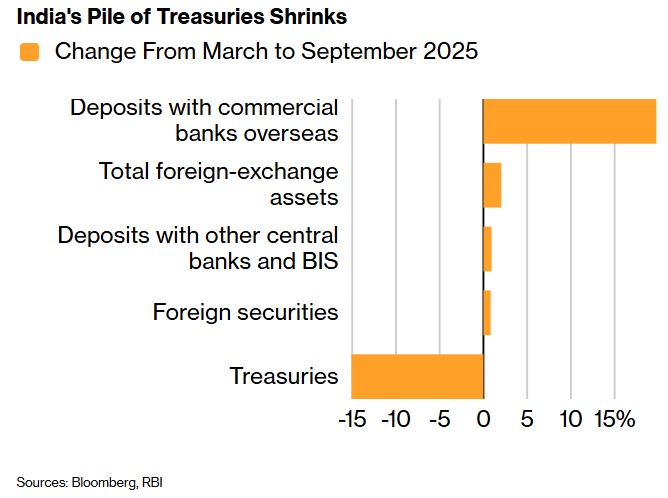 India’s US Treasury reserves shrink
 There are also reasons to believe that India’s pace of selling US Treasuries may slow, such as rupee stabilization reducing intervention needs, or if stalled trade agreements are finally reached, easing tensions.
“If a trade agreement is reached, the need to aggressively defend the currency may diminish,” said Krishna Bhimavarapu, Asia-Pacific economist at State Street Global Advisors.
However, more and more market observers say that the shift to other assets is underway. A survey by the think tank Official Monetary and Financial Institutions Forum (OMFIF) in November last year found that the vast majority of central banks still hold dollars, but nearly 60% plan to seek alternatives in the next year or two.
“The trend is now very clear,” said Michael Brown, Senior Research Strategist at London’s Pepperstone, referring to India’s sell-off of US Treasuries. A trade agreement “would only stabilize (India’s) holdings of US Treasuries, rather than trigger some kind of large-scale buying spree.”
Disclaimer: The content of this article solely reflects the author's opinion and does not represent the platform in any capacity. This article is not intended to serve as a reference for making investment decisions.
You may also like
Markets Brace for a Volatile Week as U.S. Data Drops: 5 Altcoins That Could Rally if Momentum Returns

ECB Presidential Contest Centers on Crisis Management: French Debt Risk Becomes the Touchstone
The competition for the position of President of the European Central Bank is increasingly centered on a key question: which candidate is best equipped to deal with the "vigilantes" of the bond market? As France's debt issues revive memories of turmoil in the Eurozone and the current president, Christine Lagarde, prepares to step down early, Dutchman Klaas Knot and Spaniard Pablo Hernández de Cos may soon take over amid financial turbulence.
Peter Schiff’s ‘$75K Bitcoin call’ meets a vital week: Fed, inflation, and ETF outflows loom
Deutsche Bank, which "accurately called the top" two weeks ago: Tech stocks need to "fall another 5%" to reach the "long-term trend bottom"
After Deutsche Bank downgraded its rating on US tech and large-cap growth stocks two weeks ago, tech stocks have underperformed the rest of the S&P 500 components by 12 percentage points. However, Deutsche Bank noted that tech stocks still have about 5 percentage points of downside before reaching the bottom of their long-term trend channel. Institutional positions have been quickly cooling, and signs of outflows from the $30 billion bottom-fishing funds are beginning to appear. Going forward, earnings performance, capital flows, and external risks will determine whether the adjustment stops at structural rotation.
Crypto prices
More


