
Banks Could Lose $500B After Fidelity's Official Token Launch on Ethereum

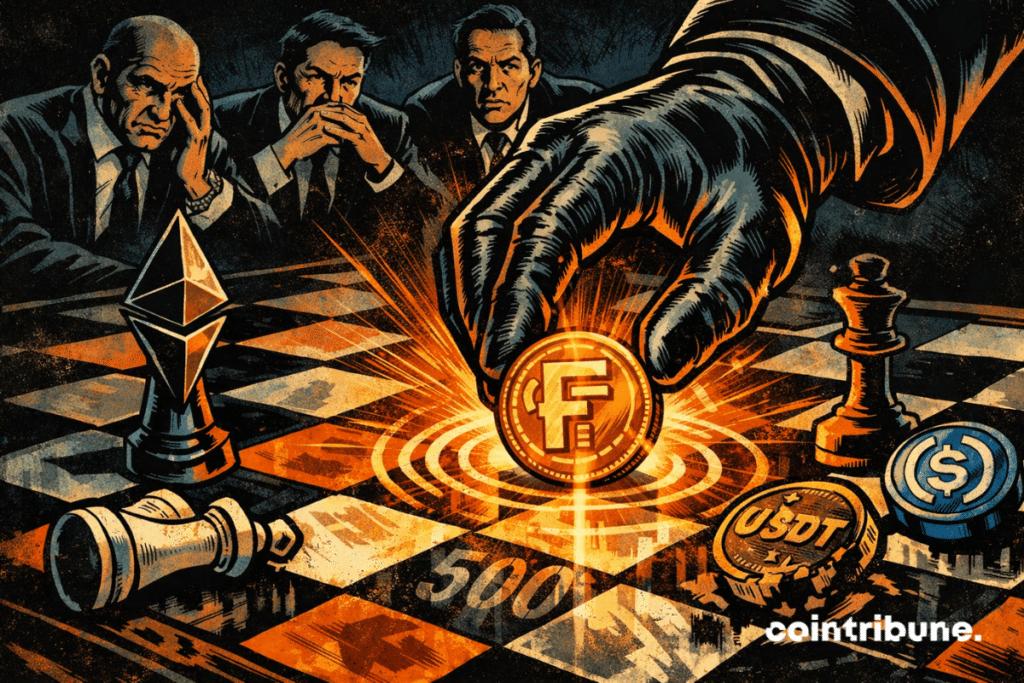
Fidelity launches a digital dollar on Ethereum. This compliant, freezable token controlled by a fiduciary bank could cause banks to lose 500 billion dollars by 2028. A monetary shock during the crypto transformation!
In Brief
- Fidelity launches a digital dollar on Ethereum, capable of freezing funds and heavily regulated.
- This stablecoin threatens up to 500 billion dollars of bank deposits by 2028, according to Standard Chartered.
A digital dollar on Ethereum controlled by Fidelity
The Fidelity Digital Dollar (FIDD) arrives on the Ethereum blockchain. Created by a regulated banking subsidiary, this stablecoin is intended for Fidelity clients via its brokerage, wealth management, and exchange channels.
The token remains transferable on-chain. Fidelity, however, retains full control. It can therefore freeze wallet funds, monitor transactions, and restrict access.
This heavily regulated architecture makes Ethereum a regulated playground. FIDD holds a reserve composed of cash and US Treasury bonds, with daily publication of net asset value. The idea? To offer a solid, compliant stablecoin suited for institutional markets.
Ethereum becomes the battlefield for bank stablecoins
Behind this launch lies a colossal stake: the deposits war. According to Standard Chartered, US banks could lose up to $500 billion by 2028 to stablecoins. As an open infrastructure, Ethereum thus becomes a strategic battlefield.
FIDD does not seek to compete with Circle or Tether, but to establish itself as a on-chain settlement tool for Fidelity clients. Choosing Ethereum rather than a private blockchain also highlights an ambition for interoperability with the DeFi.
This model rests on five levers:
- distribution;
- compliance;
- redemption rails;
- portability;
- treasury strategy.
Regulation becomes a competitive advantage here. Fidelity bets on a future where trust, traceability, and integrated monitoring will prevail over anonymity or raw speed.
In any case, FIDD could well become a central token in the future financial landscape. If other institutions follow, Ethereum could crystallize the shift from fiat currencies to supervised digital assets. The question remains whether the public will accept such a level of control!
Maximize your Cointribune experience with our "Read to Earn" program! For every article you read, earn points and access exclusive rewards. Sign up now and start earning benefits.
Disclaimer: The content of this article solely reflects the author's opinion and does not represent the platform in any capacity. This article is not intended to serve as a reference for making investment decisions.
You may also like
After the investor frenzy subsides, the Korean stock market falls into a stalemate! Trading volume drops to a yearly low, struggling to hold the 7,000-point threshold
As investor enthusiasm gradually wanes, the trading volume of the Korean stock market has dropped to its lowest level this year, indicating that the AI-driven Korean stock market may find it difficult to return to previous highs.

Under Trump's tariff pressure, "banding together for warmth"? EU proposes making Canada the first "associate member country"
European Commission President Ursula von der Leyen has proposed that Canada become the EU's first "quasi-member state."

Chainlink trades at $11.28 as LINK eyes breakout above $11.50 resistance
"The Big Short" Burry: Cracks appear in the US housing market, still betting on Fannie Mae (FNMA.US) and Freddie Mac (FMCC.US)
Share prices of Fannie Mae (FNMA.US) and Freddie Mac (FMCC.US) have plunged, but "The Big Short" Michael Burry continues to hold shares in both companies.

Crypto prices
More


