

Ethereum’s short-term outlook remains fragile as traders weigh technical pressure against improving on-chain balance. On the 4-hour chart, ETH continues to respect a downward structure after a steep decline from the $3,400 region. Price now trades near $2,050, where participants appear cautious rather than confident.
Recent market behavior suggests consolidation, not recovery, as sellers continue to defend overhead levels. Consequently, analysts see limited upside unless ETH proves strength above nearby resistance zones.
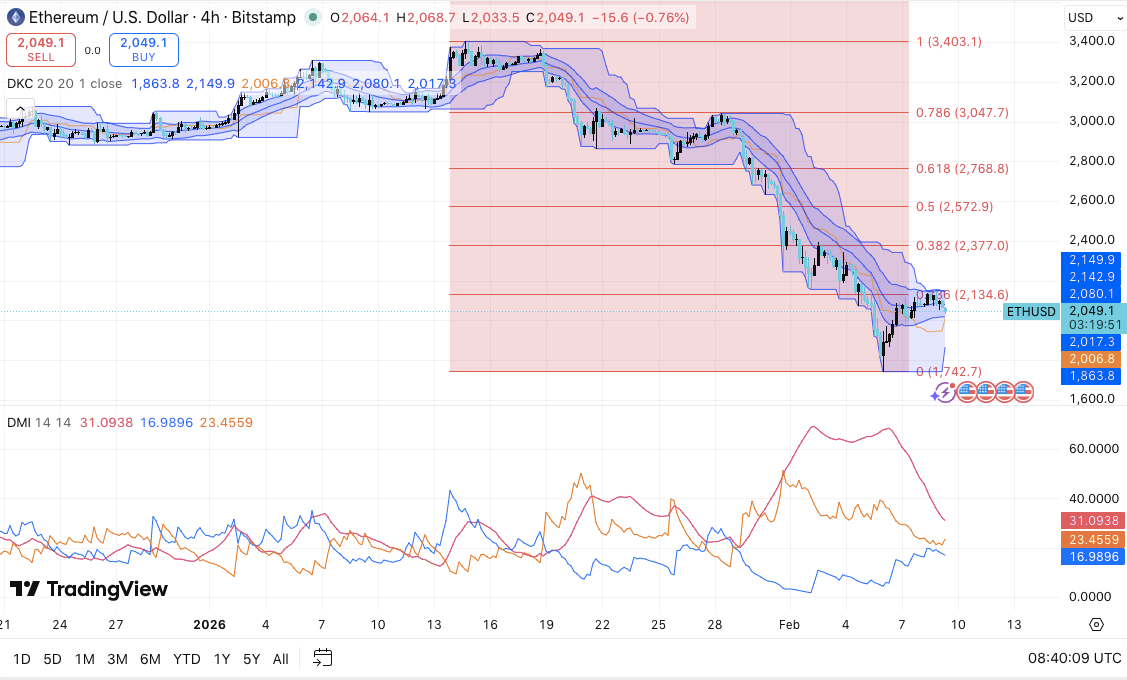
Ethereum’s 4-hour structure shows a controlled downtrend with price holding below key channel bands. The rebound from the $1,860 low lacks strong follow-through and resembles a corrective move.
Moreover, ETH continues to stall below the mid-channel zone, which signals weak demand during rallies. This behavior suggests traders still sell into strength rather than chase breakouts. Hence, the broader structure favors sellers while price remains capped under $2,150.
 Ethereum Price Dynamics (Source: Trading View)
Resistance levels remain well defined and technically important. The $2,135 to $2,150 area continues to act as an immediate rejection zone. Additionally, the 0.382 Fibonacci level near $2,377 marks the first meaningful barrier for momentum improvement.
Above that, $2,573 aligns with the 0.5 retracement and previous supply. Significantly, the 0.618 retracement near $2,768 remains the key level bears must lose to shift control.
Related: Bitcoin Price Prediction: BTC Trapped in Correction Despite Dip Buying Signs
On the downside, ETH holds short-term support between $2,000 and $2,020. This zone carries psychological importance and intraday relevance. A failure here could expose the recent swing low near $1,863.
Moreover, $1,740 stands as the final major demand zone from this decline. A move toward that level would confirm trend continuation.
Momentum indicators continue to support the bearish case. DMI data shows ADX near 31, which reflects a strong trend environment.
However, the negative directional index remains above the positive line. Consequently, sellers still control momentum despite recent sideways price action.
 Source:
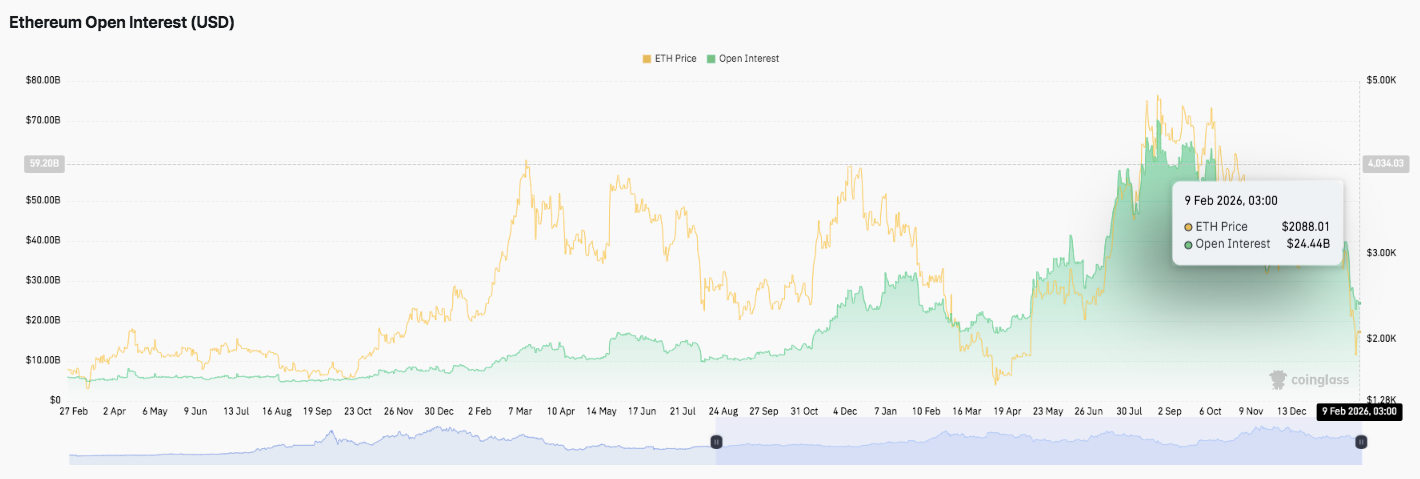
Ethereum’s open interest data shows a familiar expansion-and-reset cycle. Open interest expanded during rallies, which reflected growing leverage. Sharp pullbacks then forced liquidations and rapid position exits.
Related: Cardano Price Prediction: ADA Holds $0.27 As Hoskinson’s $3B Loss Highlights Cycle Stress
Recently, open interest dropped sharply from elevated levels. This decline suggests a broader deleveraging phase rather than panic. Hence, liquidation risk appears lower in the short term.
 Source:
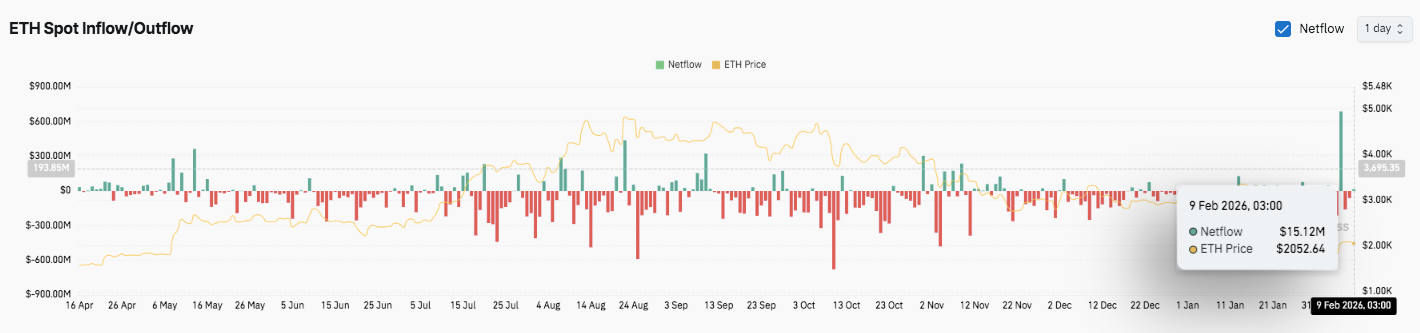
Spot flow data adds a contrasting layer. Sustained exchange outflows dominated most of the period. These withdrawals point to holding behavior and tighter circulating supply. However, netflows recently compressed near neutral. This shift suggests balance rather than aggressive accumulation. Additionally, the latest inflow remains modest, signaling caution at current prices.
Key levels remain clearly defined for Ethereum as the market navigates a fragile recovery phase.
Upside levels sit at $2,135 and $2,150 as immediate hurdles. A confirmed break above this zone could open room toward $2,377, followed by $2,573 if momentum improves. The critical resistance ceiling remains $2,768, which must flip to signal a broader trend shift.
On the downside, $2,000–$2,020 acts as short-term support and a key psychological zone. A loss of this area would likely send ETH back toward $1,863. Below that, $1,740 stands as the final major demand zone on this leg.
The technical structure suggests Ethereum remains in a corrective phase within a broader downtrend. Price continues to trade below key Fibonacci levels and descending channel resistance, keeping upside attempts vulnerable. Momentum indicators still favor sellers, although recent consolidation hints at slowing downside pressure.
Ethereum’s near-term direction depends on whether buyers can defend the $2,000 zone and reclaim $2,150 with conviction. A successful breakout could trigger a move toward $2,377 as volatility expands.
However, failure to hold support risks renewed downside toward $1,860–$1,740. For now, ETH sits at a pivotal level where confirmation, not anticipation, will define the next move.
Related: Aster (ASTER) Price Prediction: ASTER Rebound Meets Supply Zone as Leverage Continues to Drop


