Bitget App
Trade smarter
Buy cryptoMarketsTradeFuturesEarnAISquareMore
$33B U.S. equity sell-off looms – How will it affect Bitcoin?

$33B U.S. equity sell-off looms – How will it affect Bitcoin?

AMBCryptoAMBCrypto2026/02/09 15:03
By:AMBCrypto

Markets feel shaky again because money is moving in force. Automated selling, low liquidity, and hedging flows are starting to matter more than fundamentals.

With U.S. stocks under pressure, the risk of stress spreading to other assets (like crypto) is growing.

Systemic selling and a liquidity-driven market

Financial giant Goldman Sachs recently warned that the U.S. equity sell-off is far from over.

Trend-following CTAs have already triggered sell signals in the S&P 500, and the firm estimated that these funds could sell up to $33 billion this week! Total selling will reach upto $80 billion over the next month, if weakness continues.

$33B U.S. equity sell-off looms – How will it affect Bitcoin? image 0

Source: X

What’s important is that this selling isn’t dependent on bad news. Even in flat or slightly higher markets, CTAs are still expected to reduce exposure.

Markets remain unsettled, making it difficult to trade without moving prices, and this season is typically weak. If volatility persists, many automated funds may continue selling, which could drag prices even lower.

Technical positioning is making the situation worse

When the S&P 500 fell below 6,900, options traders had to sell more as prices dropped to stay hedged. That’s why a small 1% move can feel much bigger.

Forced selling and low liquidity make different assets move together, so there’s a chance that the stock market stress spreads to crypto, bonds, and commodities.

Is Bitcoin closer to its bottom?

While risk markets struggle, some analysts see a different path. According to Michael van de Poppe, Bitcoin’s weekly RSI is at its lowest level since the 2018 and 2022 cycle bottoms. This zone is usually associated with capitulation.

At the same time, Bitcoin’s valuation relative to gold is at its lowest level ever. Gold appears to be stalling after a strong run, and this has so far come before BTC rotations in 2011, 2016, and 2020.
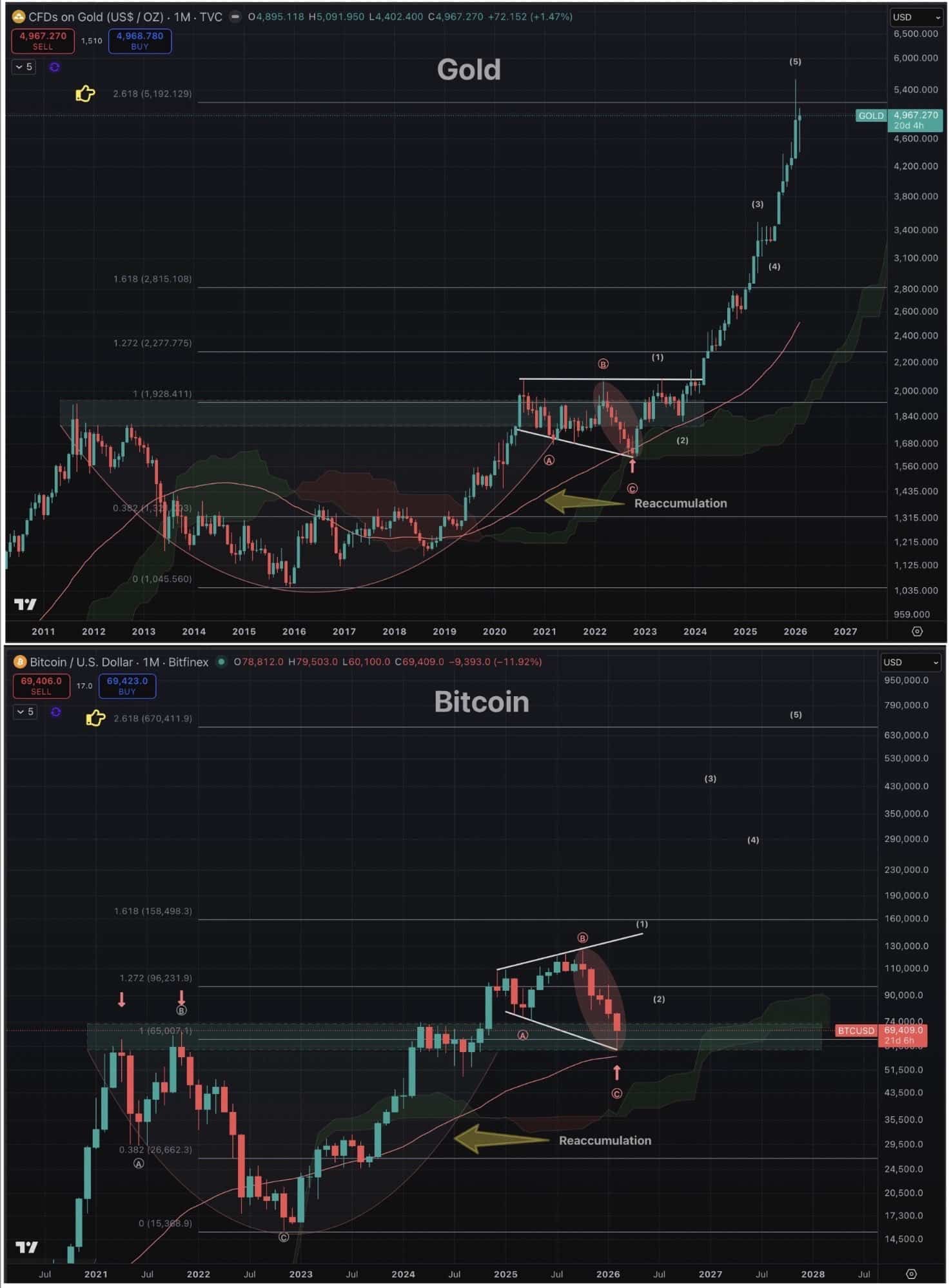
$33B U.S. equity sell-off looms – How will it affect Bitcoin? image 1

Source: X

U.S. economic data is calmer, and there are some policy updates (CLARITY ACT) coming soon. That could help close the gap between how scared markets feel and what fundamentals actually look like.

Volatility is still a risk in the short term. But, big picture? Bitcoin may be closer to the bottom than many people think.

Final Thoughts

  • Forced flows are driving market moves.
  • Downside risk remains for BTC, but capitulation may already be forming.
0
0

Disclaimer: The content of this article solely reflects the author's opinion and does not represent the platform in any capacity. This article is not intended to serve as a reference for making investment decisions.

Understand the market, then trade.
Bitget offers one-stop trading for cryptocurrencies, stocks, and gold.
Trade now!

You may also like

Tonight, a "dovish rate hike"?

The Federal Reserve is almost certain to raise interest rates tonight, but the key issue is "what will be said after the hike." Citi characterizes this move as a "fine-tuning" adjustment, suggesting there is no inevitable future rate hike, yet warns that if Chairman Powell does not provide clear forward guidance, it will trigger significant market volatility. Goldman Sachs bluntly stated that there is insufficient economic foundation for this rate hike, with inflation being merely a one-off factor, and expects this to be a "signal-less rate hike."

华尔街见闻2026/09/16 04:01

JPMorgan: "Open source disruption" and "AI safety" are not issues, there is still room for capital expenditure in the next two years, semiconductor equipment will become the "new bottleneck"

JPMorgan believes that open-source models are not a threat, regulatory disruptions are only short-term, and cloud vendors’ leverage remains low—the fundamentals of computing power investment have not changed. It forecasts that the capital expenditure of the seven major tech giants will soar from $443 billion in 2025 to $1.577 trillion in 2027, with semiconductor equipment becoming the core bottleneck of the supply chain and a new round of price increases expected in wafer foundry and advanced packaging.

华尔街见闻2026/09/16 03:46

Micron executive: Storage determines AI limits, substantial new capacity will come after 2028

Micron executive Sumit Sadana stated that memory bandwidth and capacity have become the core factors determining the performance ceiling of AI systems. In the face of structural imbalances between supply and demand, Micron expects to increase capital expenditure to over $45 billion in fiscal year 2027, but due to process complexity, substantive new capacity will not be released until 2028. Additionally, long-term supply agreements are reshaping the industry's business model, and humanoid robots will trigger the next wave of massive demand.

华尔街见闻2026/09/16 03:46

Goldman Sachs warns top clients: AI momentum trading shows unprecedented cracks, recommends hedging

Goldman Sachs has issued a rare warning to top clients: deep structural cracks are emerging in AI momentum. The AI-themed basket has dropped nearly 45% from its peak, with the one-day performance gap between short-term and long-term momentum reaching a five-year high. Capital is accelerating its shift from semiconductors to software. Goldman Sachs explicitly recommends that investors with AI exposure start hedging.

华尔街见闻2026/09/16 03:46