Bitget App
Trade smarter
Buy cryptoMarketsTradeFuturesEarnAISquareMore
Jupiter (JUP) Price Slides Close to October 2025 Lows — Is a Rebound Forming?

Jupiter (JUP) Price Slides Close to October 2025 Lows — Is a Rebound Forming?

CoinpediaCoinpedia2026/02/10 20:30
By:Coinpedia
Story Highlights
  • Jupiter has slipped to multi-month lows, with technical indicators signaling elevated price exhaustion and tight compression.

  • The consolidation is believed to end, and if it resolves to the upside, a bullish breakout could lift prices toward the $0.50 level.

Jupiter (JUP) price has entered a make-or-break zone after months of steady decline, which is now slowly gaining attention. Currently trading around $0.1464, the crypto is down by more than 4% in the past 24 hours, and more than 90% from the highs. The chart suggests that the token has been under persistent distribution phase, which is believed to be fading. With this, the JUP price is pressing up against an area where reactions have mattered in the past. 

With volatility compressing and technicals heading towards the reversal zone, Jupiter is believed to be entering a decisive phase. Now, traders are wondering whether this consolidation will result in a rebound or begin another leg lower.

On the weekly timeframe, it shows a transition from expansion to contraction. Price previously broke down from a major supply zone between $0.55 and $0.65, an area that has since flipped into firm resistance. Since that rejection, JUP has followed a clean bearish structure, printing a sequence of lower highs and lower lows. The trading activity has steadily thinned out, suggesting waning participation often appears when a market is waiting for its next catalyst.
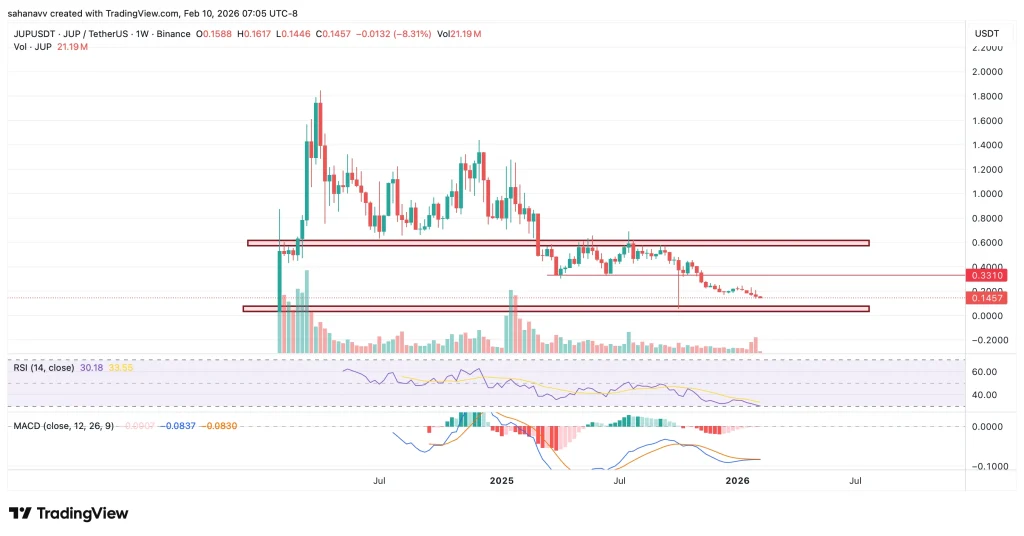
Jupiter (JUP) Price Slides Close to October 2025 Lows — Is a Rebound Forming? image 0

The RSI is hovering around 30–33, close to oversold but without a clear bullish divergence, which means downside pressure hasn’t fully burned off yet. MACD remains below the zero line and is beginning to flatten, hinting at stabilization rather than an outright reversal. Price is currently holding just above the $0.13–$0.15 demand zone, an area that previously acted as a base during early consolidation. A clean weekly close below $0.14 would weaken that structure and likely expose JUP to a deeper slide toward $0.10–$0.08, where liquidity is thinner but historically reactive.

On the upside, any bounce is likely to face resistance near $0.20–$0.24, with heavier supply waiting closer to $0.33. Only a sustained reclaim above $0.35 would meaningfully neutralize the broader bearish structure.

Jupiter (JUP) price is still in a range-to-breakdown environment, not a confirmed bottoming phase. Holding above $0.14 keeps short-term relief bounces on the table, but a loss of that level would likely accelerate downside toward $0.10.   

0
0

Disclaimer: The content of this article solely reflects the author's opinion and does not represent the platform in any capacity. This article is not intended to serve as a reference for making investment decisions.

Understand the market, then trade.
Bitget offers one-stop trading for cryptocurrencies, stocks, and gold.
Trade now!

You may also like

Tonight, a "dovish rate hike"?

The Federal Reserve is almost certain to raise interest rates tonight, but the key issue is "what will be said after the hike." Citi characterizes this move as a "fine-tuning" adjustment, suggesting there is no inevitable future rate hike, yet warns that if Chairman Powell does not provide clear forward guidance, it will trigger significant market volatility. Goldman Sachs bluntly stated that there is insufficient economic foundation for this rate hike, with inflation being merely a one-off factor, and expects this to be a "signal-less rate hike."

华尔街见闻2026/09/16 04:01

JPMorgan: "Open source disruption" and "AI safety" are not issues, there is still room for capital expenditure in the next two years, semiconductor equipment will become the "new bottleneck"

JPMorgan believes that open-source models are not a threat, regulatory disruptions are only short-term, and cloud vendors’ leverage remains low—the fundamentals of computing power investment have not changed. It forecasts that the capital expenditure of the seven major tech giants will soar from $443 billion in 2025 to $1.577 trillion in 2027, with semiconductor equipment becoming the core bottleneck of the supply chain and a new round of price increases expected in wafer foundry and advanced packaging.

华尔街见闻2026/09/16 03:46

Micron executive: Storage determines AI limits, substantial new capacity will come after 2028

Micron executive Sumit Sadana stated that memory bandwidth and capacity have become the core factors determining the performance ceiling of AI systems. In the face of structural imbalances between supply and demand, Micron expects to increase capital expenditure to over $45 billion in fiscal year 2027, but due to process complexity, substantive new capacity will not be released until 2028. Additionally, long-term supply agreements are reshaping the industry's business model, and humanoid robots will trigger the next wave of massive demand.

华尔街见闻2026/09/16 03:46

Goldman Sachs warns top clients: AI momentum trading shows unprecedented cracks, recommends hedging

Goldman Sachs has issued a rare warning to top clients: deep structural cracks are emerging in AI momentum. The AI-themed basket has dropped nearly 45% from its peak, with the one-day performance gap between short-term and long-term momentum reaching a five-year high. Capital is accelerating its shift from semiconductors to software. Goldman Sachs explicitly recommends that investors with AI exposure start hedging.

华尔街见闻2026/09/16 03:46