
Dutch House of Representatives advances controversial 36% tax law

The Netherlands’ House of Representatives advanced a legislative proposal on Thursday to introduce a 36% capital gains tax on savings and most liquid investments, including cryptocurrencies.
The legislation reached the 75-vote threshold required to advance, with 93 lawmakers voting in favor of it, according to the House tally.
Under the proposal, savings accounts, cryptocurrencies, most equity investments and gains made from interest-bearing financial instruments are subject to the tax, whether or not the assets are sold.
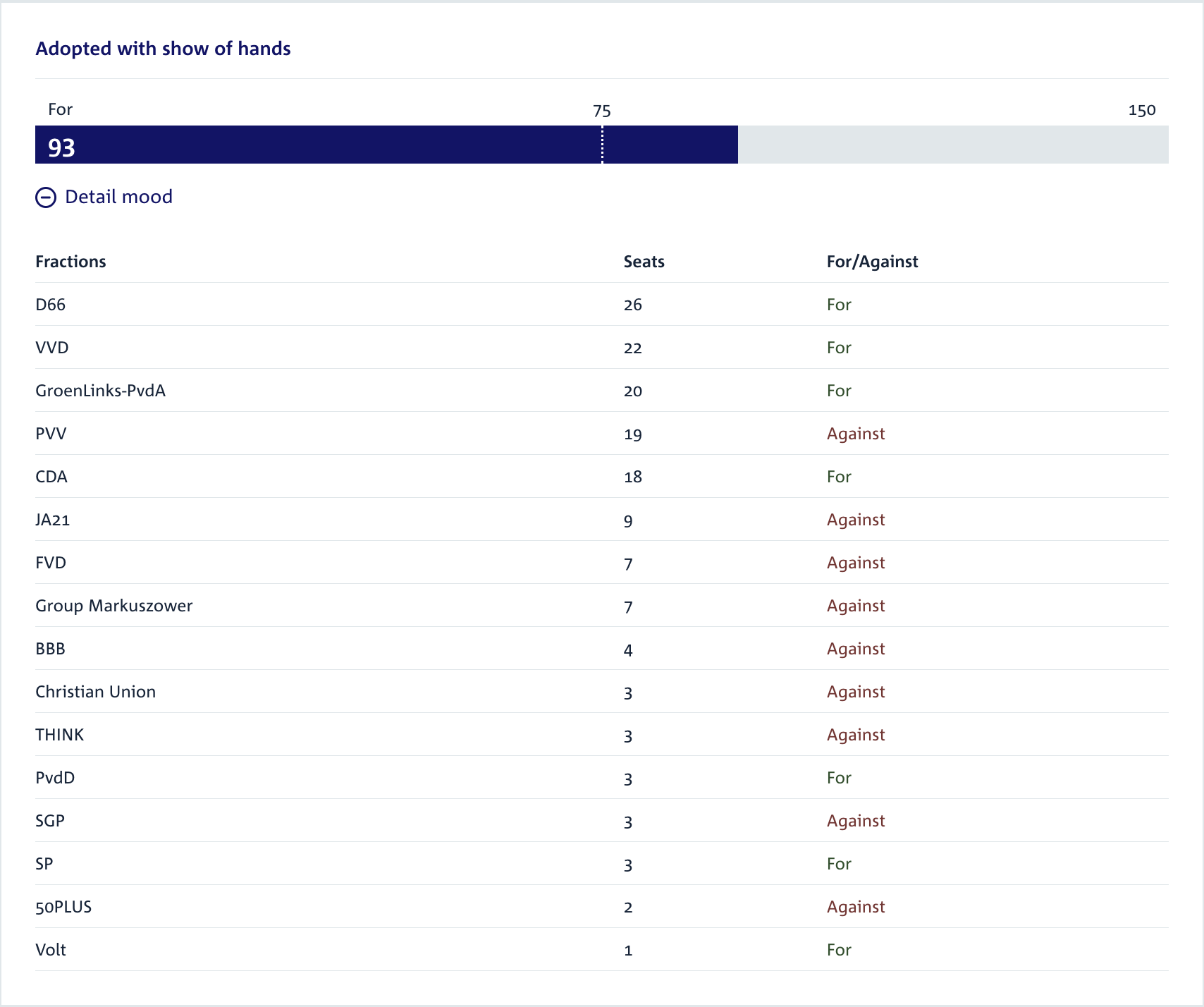 The vote tally for the 36% capital gains tax bill. Source:
Dutch House of Representatives
The vote tally for the 36% capital gains tax bill. Source:
Dutch House of Representatives
Critics say the bill will drive capital out of the Netherlands and into jurisdictions with more favorable tax laws, as investors seek a flight to safety from confiscatory taxation.
The Dutch Senate must also pass the bill before it is signed into law, which will take effect in the 2028 tax year, if it is passed, but many investors in the crypto community are already sounding the alarm and predicting capital flight from the country.
Related: European Commission calls on 12 countries to implement crypto tax rules
Investors say the tax is out of touch and will backfire
“France did this in 1997 and saw a massive exodus of entrepreneurs leaving the country,” Denis Payre, co-founder of logistics company Kiala said.
Crypto market analyst Michaël van de Poppe said the proposal is “the dumbest thing I've seen in a long time.”
“The number of people willing to flee the country is going to be bananas,” he added, echoing the calls of other industry analysts and executives.
An investor starting with 10,000 euros ($11,871) who contributes 1,000 euros per month over 40 years would end up with about 3,320,000 euros by the end of the 40 years, according to Investing Visuals.
However, the new 36% tax reduces the total amount after 40 years to about 1,885,000 euros, a difference of 1,435,000 euros, Investing Visuals said.
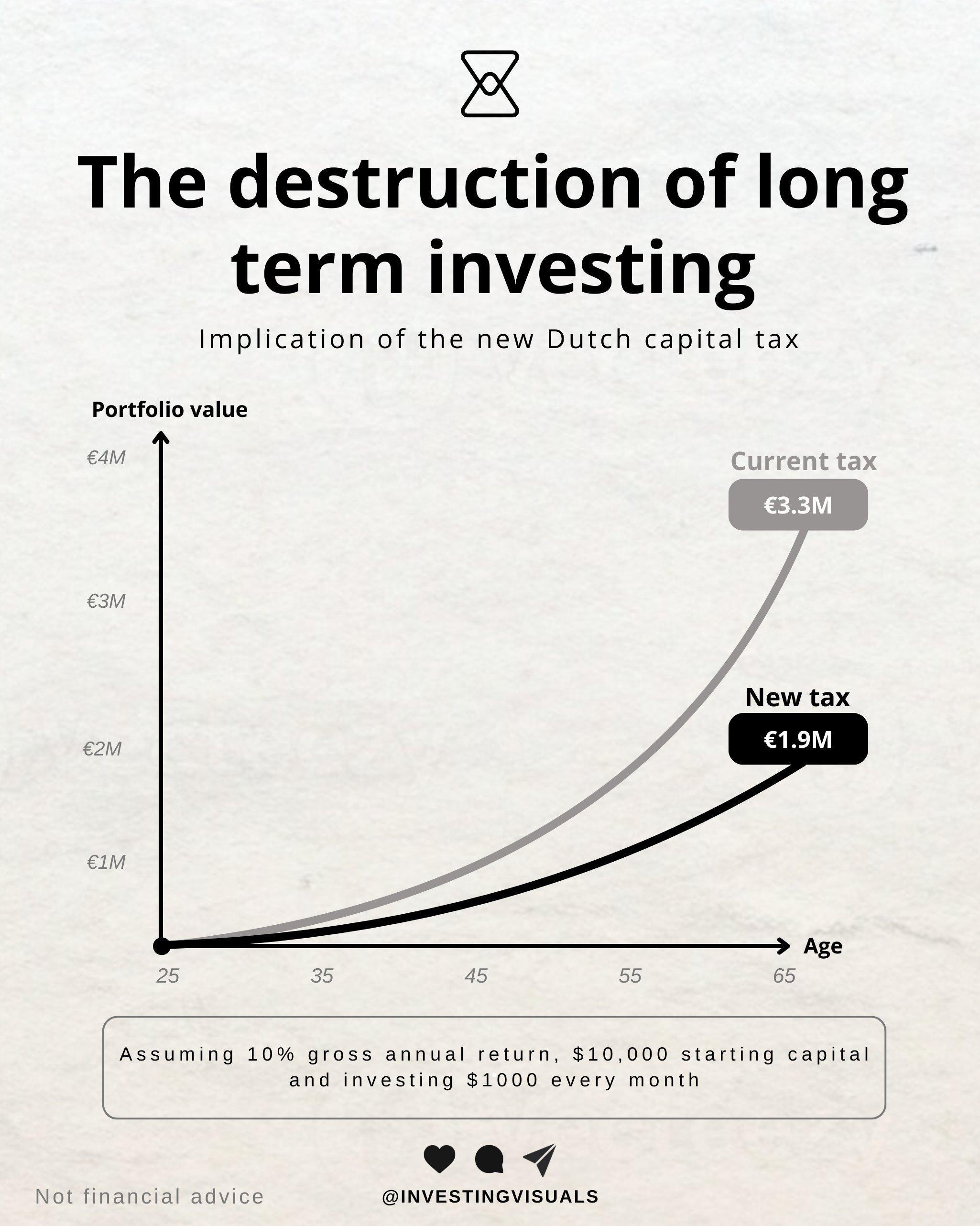 A comparison of an investment compounded over 40 years without the 36% unrealized gains tax and with the tax. Source:
Investing Visuals
A comparison of an investment compounded over 40 years without the 36% unrealized gains tax and with the tax. Source:
Investing Visuals
Crypto industry and tech executives in the United States voiced similar concerns about California’s proposed wealth tax on billionaires.
The proposal outlined a 5% tax on an individual’s net worth above the $1 billion threshold, igniting a torrent of backlash and tech entrepreneurs announcing that they were leaving the state of California.
Magazine: Best and worst countries for crypto taxes — plus crypto tax tips
Disclaimer: The content of this article solely reflects the author's opinion and does not represent the platform in any capacity. This article is not intended to serve as a reference for making investment decisions.
You may also like
Wall Street giants’ trading operations show a tale of two extremes: JPMorgan (JPM.US) expects a surge in Q3 performance, while Bank of America (BAC.US) warns of a slowdown
JPMorgan predicts that trading and investment banking income will see double-digit growth in Q3, triggering a rebound in its stock price. Previously, Bank of America warned of flat revenue due to a pullback in financing, leading to a sell-off in the sector.

Trillion-dollar defense budget in sight, Guggenheim strongly recommends defense stocks, L3Harris Technologies (LHX.US) is the top large-cap pick
Guggenheim Securities recently initiated coverage of 22 aerospace and defense companies, with an overall positive outlook on defense contractors and aircraft manufacturers, but a cautious attitude toward commercial aviation aftermarket suppliers.

Tokenized funds expand across chains, yet liquidity remains fragmented – Why?

Japan Reportedly Plans to Double Defense Spending to 3.5% of GDP, Ministry of Defense Denies, Yet Japanese Bond Yields Hit 30-Year High
According to reports, Japanese defense officials have expressed their willingness to significantly increase defense spending during meetings with the United States. One proposal is to raise defense spending to 3.5% of GDP within ten years, while another, lower target is 3%. Japanese officials previously stated that this fiscal year's defense and related expenditures are approximately $68.8 billion, equivalent to about 1.9% of Japan's nominal GDP in 2022.
Crypto prices
More


