
LendingTree Shares Hit 52-Week Low: How to Approach the Stock Now?

Shares of LendingTree, Inc. TREE fell to a 52-week low of $32.97 in yesterday’s trading session, before closing slightly higher at $33.24. Over the past six months, TREE has plunged 52.3% compared with the industry’s decline of 18.3%. It also underperformed its peers, CNFinance Holdings Limited CNF and Rocket Companies, Inc. RKT during the same period.
The recent weakness follows the rollout of new U.S. tariffs of 10% on imported goods and materials, which has sparked investor concern about rising costs. For companies like LendingTree, Rocket Companies, and CNFinance Holdings, these tariffs can increase operational expenses and reduce consumer activity in lending and mortgage markets. As import costs increase, lenders may face slower loan demand, higher servicing costs and tighter profitability, making tariff policies a significant near-term headwind for these companies.
Price Performance
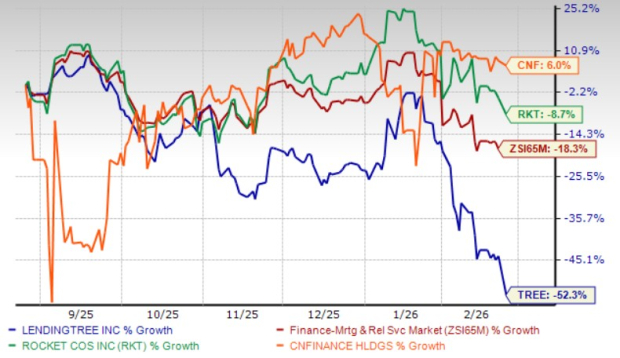
Image Source: Zacks Investment Research
The question now is whether the stock has potential to rebound from its recent low or is the stock poised for a further decline? Let us find out.
Other Headwinds for LendingTree
Weak Liquidity Position: The company’s limited cash position raises concerns about its ability to fund operations and meet debt obligations during economic downturns. As of Sept. 30, 2025, the company had $68.6 million in cash and cash equivalents, significantly lower than its long-term debt of $383.4 million. This large gap indicates that TREE may struggle to meet obligations or respond to unexpected expenses, limiting near-term financial flexibility.
Unsustainable Capital Distribution: Although TREE has historically returned capital to shareholders through stock repurchases, its current financial position makes such moves appear risky. The company’s stock repurchase programs authorized in February 2018 and February 2019 allowed for $100 million and $150 million, respectively, with $96.7 million still available as of Sept. 30, 2025. In addition, inconsistent quarterly performance and a high debt-to-equity ratio raise concerns about the sustainability of future buybacks.
Rising Costs Despite Cost-Control Efforts: Although the company has implemented cost-control strategies, its expenses continued to rise in the first nine months of 2025. Further, restructuring and severance costs, product development, and marketing expenses are likely to keep operating costs elevated in the near-term.
Expense Trend
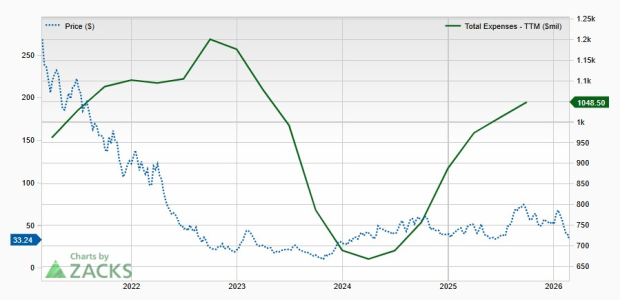
Image Source: Zacks Investment Research
LendingTree’s Long-Term Prospects Look Bright
Revenue Growth in Insurance and Consumer Segments: The company’s Insurance segment has delivered strong revenue growth, with a CAGR of 13.4% over the past four years, continuing in the first nine months of 2025. Its efforts to increase wallet share with lending partners are yielding positive results. The expanding offerings for consumers, small businesses and network partners are expected to diversify revenue streams and support profitability. Management expects continued momentum in Insurance and Small Business segments, with a focus on AI-enabled operational improvements and concierge sales expansion in 2026. For 2025, management expects total revenues in the range of $1.08–1.09 billion, reflecting continued growth in Insurance and Consumer segments.
Diversified Consumer Offerings: The company is committed to boosting revenues by expanding its non-mortgage products, particularly in the Consumer segment. In recent years, it has added services such as credit cards, personal, auto, small business, and student loans. With the launch of the LendingTree WinCard in partnership with Upgrade in February 2023, the company introduced its first branded consumer credit offering. The initiatives like SPRING (formerly MyLendingTree) and TreeQual are expected to enhance cross-selling opportunities, supporting long-term profitability.
Earnings Strength: Over the next three to five years, the company's earnings per share are expected to witness growth of 50.16%, outperforming the industry’s growth of 40.96%. Additionally, TREE has surpassed estimates in each of the trailing four quarters, with an average earnings surprise of 75.5%. The Zacks Consensus Estimate for earnings indicates a rise of 50.2% and 5.7% for 2025 and 2026, respectively. Over the past month, the Zacks Consensus Estimate for earnings for 2025 and 2026 have remained unchanged.
Estimate Revision Trend

Image Source: Zacks Investment Research
Does TREE Stock Deserve a Place in Your Portfolio?
LendingTree’s initiatives to diversify revenues, improve operational efficiency and expand consumer offerings will be critical in determining financial health and stock performance in the coming quarters.
In terms of valuation, TREE stock appears inexpensive relative to the industry. The company is currently trading at a 12-month trailing price-to-earnings P/E ratio of 10.55X, lower than the industry’s 18.63X. Meanwhile, CNFinance Holdings holds a P/E ratio of 2.81X, while Rocket Companies’ P/E ratio stands at 22.51X.
Price-to-Earnings F12 M
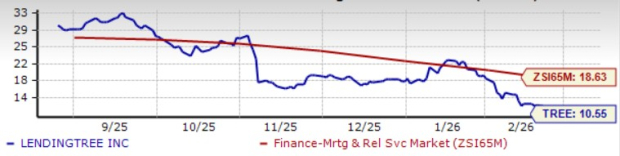
Image Source: Zacks Investment Research
However, near-term risks remain high. Limited liquidity, rising expenses, and uncertain capital distribution continue to pose challenges. Thus, TREE stock remains a cautious bet for investors at the moment. Those who own the stock can hold it for now. TREE currently carries a Zacks Rank #3 (Hold).
Disclaimer: The content of this article solely reflects the author's opinion and does not represent the platform in any capacity. This article is not intended to serve as a reference for making investment decisions.
You may also like
Silver Price Forecast: XAG/USD breaks $55 as bears target $50

Southern Copper weighs $680M Cuajone mine expansion

Researcher States What Would Drive XRP Price

Crypto prices
More


