
Commodity Support and Resistance Overview in One Chart: Gold, Silver, Oil, Gas + Platinum, Palladium, Copper, Agricultural Futures (May 21, 2026)

FX678 May 21— A chart illustrating commodity support and resistance: gold, silver, oil, gas + platinum, palladium, copper + agricultural futures. Updated at 07:00 (UTC+8) on Thursday, May 21, 2026, covering a total of 14 varieties including gold, silver, platinum, palladium, copper, crude oil, natural gas, fuel oil, wheat, corn, and cotton. For more details, see the exclusive chart by FX678 Analysis.
A chart illustrating commodity support and resistance: gold, silver, oil, gas + platinum, palladium, copper + agricultural futures. Updated at 07:00 (UTC+8) on Thursday, May 21, 2026, covering a total of 14 varieties including gold, silver, platinum, palladium, copper, crude oil, natural gas, fuel oil, wheat, corn, and cotton. For more details, see the exclusive chart by FX678 Analysis.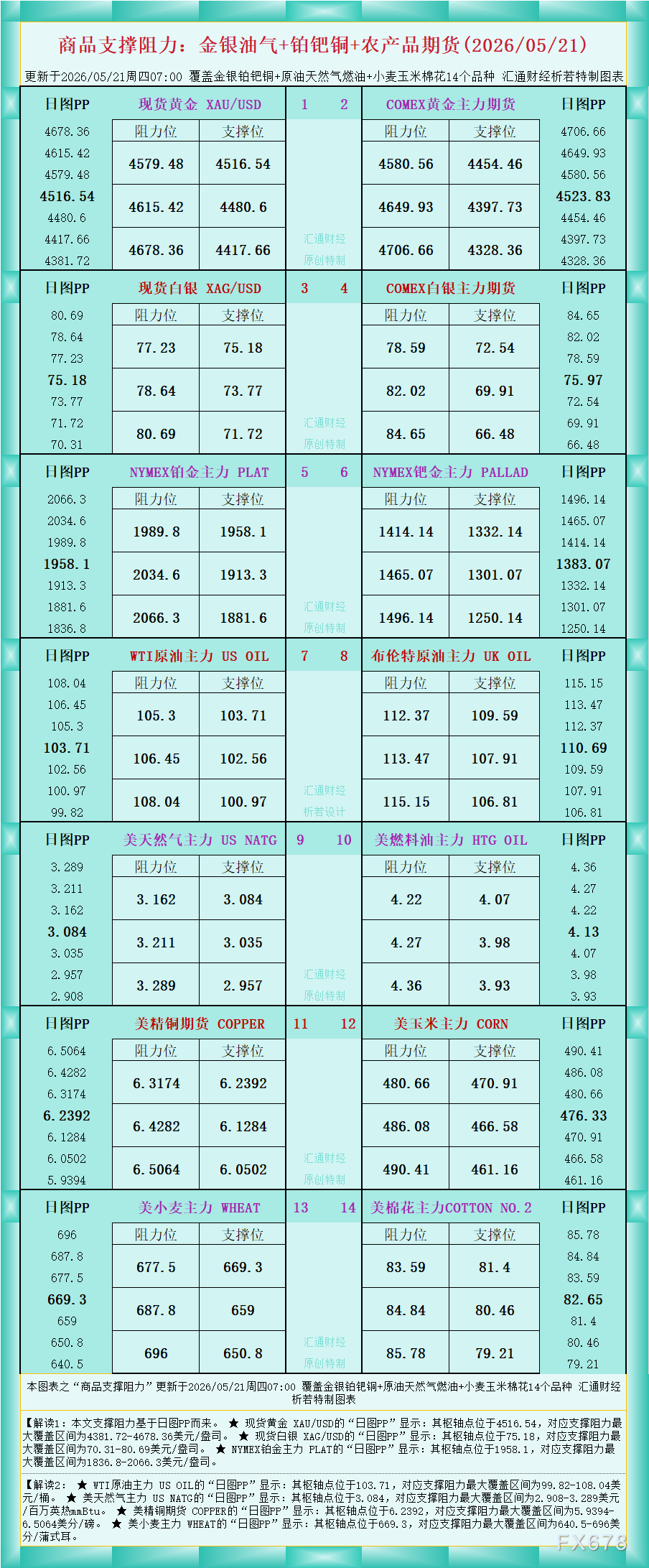
According to the data shown in the chart, Interpretation 1: The support and resistance in this article are based on the daily chart PP.
★ The “Daily Chart PP” for spot gold XAU/USD shows: The pivot is at 4516.54, with the maximum support and resistance range between $4381.72 and $4678.36 per ounce.
★ The “Daily Chart PP” for spot silver XAG/USD shows: The pivot is at 75.18, with the maximum support and resistance range between $70.31 and $80.69 per ounce.
★ The “Daily Chart PP” for NYMEX Platinum Main Contract PLAT shows: The pivot is at 1958.1, with the maximum support and resistance range between $1836.8 and $2066.3 per ounce.
Interpretation 2:
★ The “Daily Chart PP” for WTI Crude Oil Main Contract US OIL shows: The pivot is at 103.71, with the maximum support and resistance range between $99.82 and $108.04 per barrel.
★ The “Daily Chart PP” for US Natural Gas Main Contract US NATG shows: The pivot is at 3.084, with the maximum support and resistance range between $2.908 and $3.289 per million British thermal units (mmBtu).
★ The “Daily Chart PP” for US Copper Futures COPPER shows: The pivot is at 6.2392, with the maximum support and resistance range between 5.9394 and 6.5064 cents/pound.
★ The “Daily Chart PP” for US Wheat Main Contract WHEAT shows: The pivot is at 669.3, with the maximum support and resistance range between 640.5 and 696 cents/bushel.
For more interpretations on other varieties, please refer to the chart.
Disclaimer: The content of this article solely reflects the author's opinion and does not represent the platform in any capacity. This article is not intended to serve as a reference for making investment decisions.
You may also like
Another dot removed from the Fed dot plot; Waller continues to refuse giving the market a roadmap
In the latest dot plot released on September 16, only 18 dots appeared. The missing one belongs to Federal Reserve Chairman Kevin Walsh. This is the second consecutive time that Walsh has refused to leave his prediction on the dot plot.

After 15 Years, Apple (AAPL.US) Plans to Reenter the Server Market: How Ambitious Is Its AI Computing Power? Major Institutions Debate "Distant Water" vs. "Immediate Thirst"
According to sources reported by tech media The Information, Apple (AAPL.US) is considering entering the enterprise server market, planning to use its self-developed M series Ultra chips in combination with Nvidia (NVDA.US) networking equipment.

Trump’s Rate-Cut Demand Meets a New Crypto Tax Push: 5 Altcoins Worth Risking Before the Market Reprices

Nineteen out of twenty, Chair Waller again failed to deliver the Fed dot plot “assignment”
Federal Reserve Chairman Waller has twice refused to enter his interest rate forecasts on the dot plot, bluntly stating that the tool is "of no use for policy implementation." The dot plot, which has been in operation since 2011 and is published four times a year to show officials' interest rate expectations, is an important reference for the market to assess the direction of monetary policy. However, its lack of consensus, anonymity, and the participation of non-voting governors have long been criticized. Previous chairs have had varying attitudes toward the tool, but Waller's stance is the toughest.
Crypto prices
More


