u.today

A classic cryptocurrency fakeout may already be developing from Toncoin's explosive rally earlier this month.
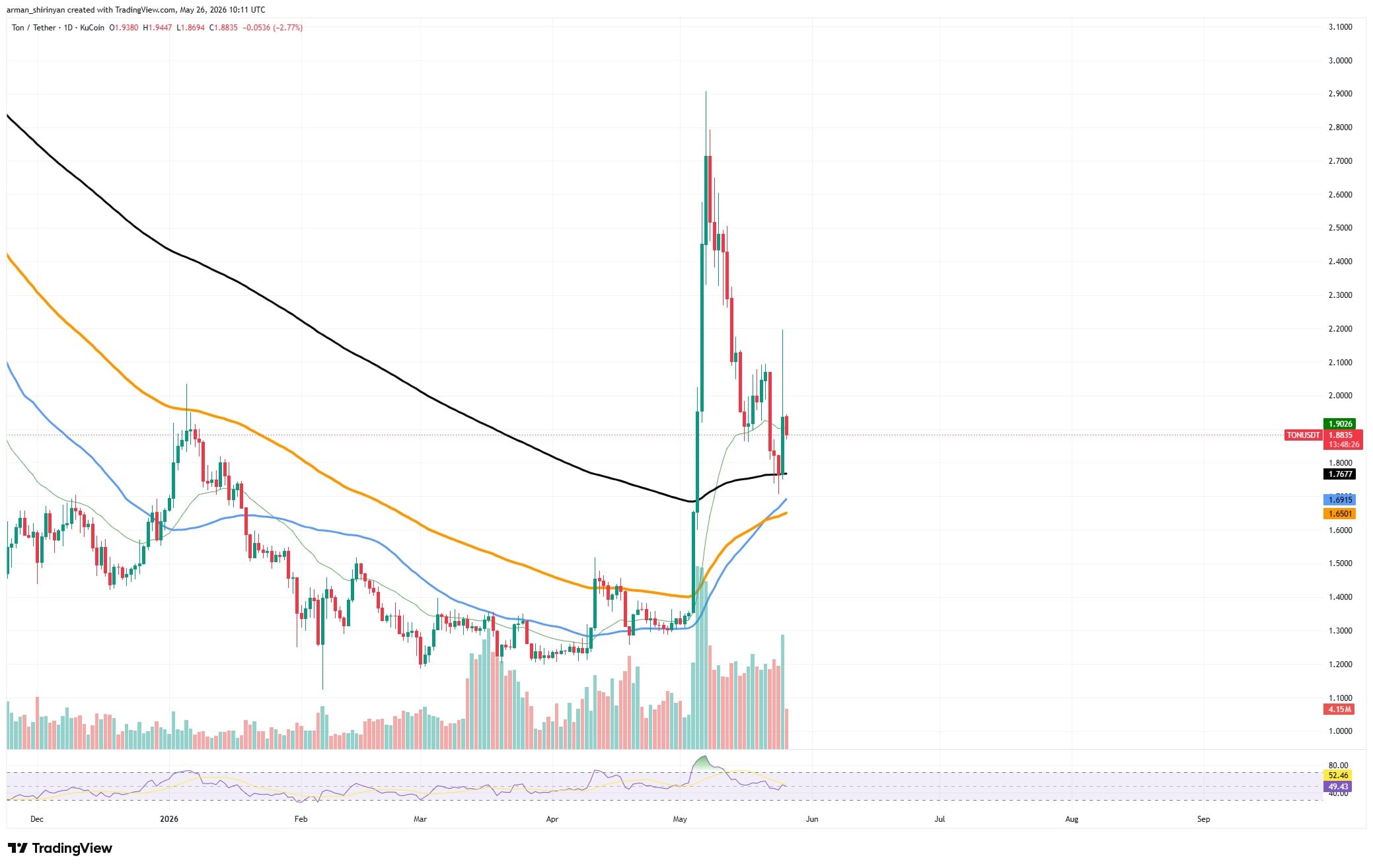
$TON has now erased a significant portion of the move and returned straight into a crucial technical support zone, after rising almost vertically from the $1.30 region to nearly $3.00 in just a few days.
Potentially fake recovery
The question that traders are currently asking is straightforward: was the rally a true reversal of the trend, or was it merely a dead cat bounce within a larger bearish structure? The second interpretation is increasingly supported by the chart.
 $TON/USDT Chart by TradingView
At first, $TON's breakout appeared to be very optimistic. Volume skyrocketed, momentum picked up speed, and price cut through several moving averages almost immediately. But very quickly, the move became unsustainable.
$TON immediately began rejecting from the highs, with violent upper wicks and increasingly erratic price action, rather than consolidating above resistance and creating support. Exhaustion rallies frequently exhibit such behavior.
Toncoin's recovery potential
After failing to hold above the breakout range, $TON is now trading back close to the 200-day moving average in the $1.75-$1.80 range. The survival of this zone is essential to the recovery structure as a whole. The recent rally could be completely reclassified as a brief short squeeze, rather than the beginning of a more extensive bullish reversal, if buyers lose it decisively.
Cooling speculation is also evident in market data. Coinglass metrics reveal that while spot momentum significantly decreased following the initial spike, open interest remained high. During the breakout phase, futures volume skyrocketed, but follow-through buying never completely stabilized.
However, on a number of exchanges, $TON's long/short ratios remain bullish. That would typically encourage upside continuation, but when price action falters beneath significant resistance, crowded long positioning becomes risky. Those leveraged longs have the potential to quickly increase downside pressure if support fails.
The fact that $TON never completely fixed its higher-timeframe structure strengthens the dead cat bounce argument. On broader charts, the asset is still below the declining 200-day trend resistance, even after the rally. Although the breakout generated excitement, the larger bearish cycle that had dominated $TON for months prior was not entirely invalidated.