
Cross-Chain Protocol Gravity Bridge Falls To $5.4 Million Attack — Details

By:Newsbtc
Bitget offers one-stop trading for cryptocurrencies, stocks, and gold. Trade now!
A welcome pack worth 6200 USDT for new users! Sign up now!
Gravity Bridge, a Cosmos-native cross-chain protocol, was the target of a compromised-key attack, which led to the theft of roughly $5.4 million over the weekend. This latest security breach joins the growing list of exploits suffered in the decentralized finance (DeFi) space so far in 2026.
Gravity Bridge Hack Traced To Signing Key Compromise: Investigator
On Saturday, May 31st, blockchain sleuth Specter highlighted that Gravity Bridge might have been exploited through what he described as a signing key compromise. For context, a signing key compromise refers to the unauthorized disclosure or theft of a cryptographic key, allowing an attacker to then use it to decrypt sensitive information, forge digital signatures, or gain unauthorized access to systems and, as in this case, funds.

The analyst disclosed that the loot included crypto assets worth about $5..4 million, including $4.3 million in USDC, 274 wrapped Ether valued at roughly $553,000, $434,000 in USDT, and 14.16 PAXG tokens priced at about $64,000. According to security firm PeckShield, the bad actor has laundered a portion of the stolen funds through the ChangeNOW and Binance exchanges, but still holds over 2,100 Ether (worth approximately $4.23 million).
var rnd = window.rnd || Math.floor(Math.random()*10e6); var pid607465 = window.pid607465 || rnd; var plc607465 = window.plc607465 || 0; var abkw = window.abkw || ''; var absrc = 'https://servedbyadbutler.com/adserve/;ID=172179;size=0x0;setID=607465;type=js;sw='+screen.width+';sh='+screen.height+';spr='+window.devicePixelRatio+';kw='+abkw+';pid='+pid607465+';place='+(plc607465++)+';rnd='+rnd+';click=CLICK_MACRO_PLACEHOLDER'; document.write('
');
if (!window.AdButler){(function(){var s = document.createElement("script"); s.async = true; s.type = "text/javascript";s.src = "https://servedbyadbutler.com/app.js";var n = document.getElementsByTagName("script")[0]; n.parentNode.insertBefore(s, n);}());}
var AdButler = AdButler || {}; AdButler.ads = AdButler.ads || []; var abkw = window.abkw || ""; var plc366606 = window.plc366606 || 0; (function(){ var divs = document.querySelectorAll(".plc366606:not([id])"); var div = divs[divs.length-1]; div.id = "placement_366606_"+plc366606; AdButler.ads.push({handler: function(opt){ AdButler.register(172179, 366606, [728,90], "placement_366606_"+opt.place, opt); }, opt: { place: plc366606++, keywords: abkw, domain: "servedbyadbutler.com", click:"CLICK_MACRO_PLACEHOLDER" }}); })();
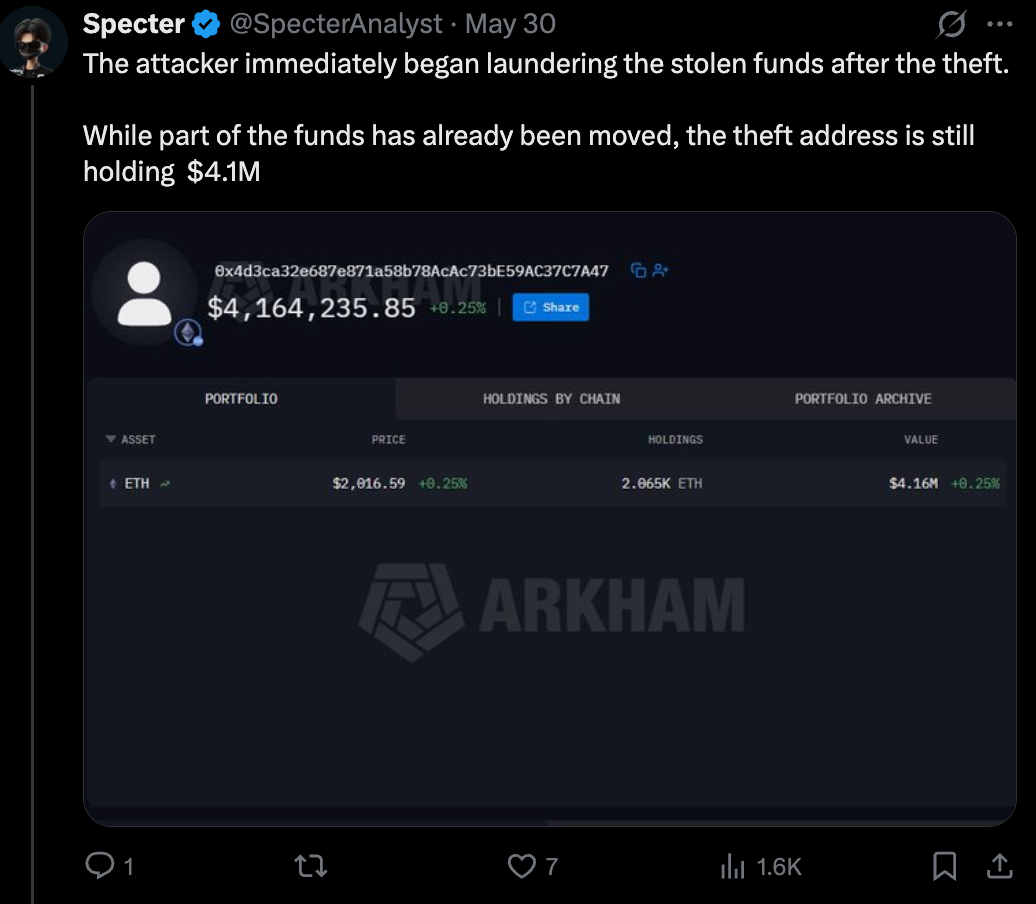 Source: @SpecterAnalyst on X
The team behind Gravity Bridge confirmed the attack on Saturday, saying that validators and orchestrators should halt their operations while they investigate the exploit. “Thanks to the swift action of validators, the bridge is currently halted while investigations continue,” the protocol announced in a subsequent post on social media post.
Gravity Bridge is a cross-chain protocol that works by locking tokens on the Ethereum network and creating direct replicas of the crypto assets on the Cosmos network, relying on validator signatures to authorize each transfer. Hence, the protocol would treat even forged transactions as legitimate if a bad actor gets the appropriate signing keys.
If confirmed as a key compromise, this Gravity Bridge incident would align with the ongoing pattern of crypto bridge attacks, in which breaches are typically embedded in access controls rather than in the underlying smart contract code. This pattern can be observed in the majority of the recent exploits, with Kelp DAO’s $292 million attack a notable incident.
var rnd = window.rnd || Math.floor(Math.random()*10e6); var pid607472 = window.pid607472 || rnd; var plc607472 = window.plc607472 || 0; var abkw = window.abkw || ''; var absrc = 'https://servedbyadbutler.com/adserve/;ID=172179;size=0x0;setID=607472;type=js;sw='+screen.width+';sh='+screen.height+';spr='+window.devicePixelRatio+';kw='+abkw+';pid='+pid607472+';place='+(plc607472++)+';rnd='+rnd+';click=CLICK_MACRO_PLACEHOLDER'; document.write('
');
if (!window.AdButler){(function(){var s = document.createElement("script"); s.async = true; s.type = "text/javascript";s.src = "https://servedbyadbutler.com/app.js";var n = document.getElementsByTagName("script")[0]; n.parentNode.insertBefore(s, n);}());}
var AdButler = AdButler || {}; AdButler.ads = AdButler.ads || []; var abkw = window.abkw || ""; var plc452518 = window.plc452518 || 0; (function(){ var divs = document.querySelectorAll(".plc452518:not([id])"); var div = divs[divs.length-1]; div.id = "placement_452518_"+plc452518; AdButler.ads.push({handler: function(opt){ AdButler.register(172179, 452518, [728,90], "placement_452518_"+opt.place, opt); }, opt: { place: plc452518++, keywords: abkw, domain: "servedbyadbutler.com", click:"CLICK_MACRO_PLACEHOLDER" }}); })();
Crypto Hacks Continue To Pile In 2026
As mentioned earlier, Gravity Bridge’s $5.4 million hack joins the growing list of hacks that have rocked the crypto industry, especially the DeFi sector, in 2026. Specifically, bridges appear to have been a soft target for attackers in this period.
Specifically, a TRM Labs report identified April 2026 as the most hacked month, with the highest number of incidents in crypto history. These attacks included the aforementioned $292 million Kelp DAO hack and Drift Protocol’s $285 million loss.

Can Ripple’s Fed Master Account Approval Trigger A New XRP Bull Run? AI Model Says $80 Is Possible
The total crypto market cap on the daily timeframe | Source: TOTAL chart on
Featured image from Shutterstock, chart from TradingView
var rnd = window.rnd || Math.floor(Math.random()*10e6); var pid607473 = window.pid607473 || rnd; var plc607473 = window.plc607473 || 0; var abkw = window.abkw || ''; var absrc = 'https://servedbyadbutler.com/adserve/;ID=172179;size=0x0;setID=607473;type=js;sw='+screen.width+';sh='+screen.height+';spr='+window.devicePixelRatio+';kw='+abkw+';pid='+pid607473+';place='+(plc607473++)+';rnd='+rnd+';click=CLICK_MACRO_PLACEHOLDER'; document.write('
');
if (!window.AdButler){(function(){var s = document.createElement("script"); s.async = true; s.type = "text/javascript";s.src = 'https://servedbyadbutler.com/app.js';var n = document.getElementsByTagName("script")[0]; n.parentNode.insertBefore(s, n);}());}
var AdButler = AdButler || {}; AdButler.ads = AdButler.ads || []; var abkw = window.abkw || ''; var plc452519 = window.plc452519 || 0; (function(){ var divs = document.querySelectorAll(".plc452519:not([id])"); var div = divs[divs.length-1]; div.id = "placement_452519_"+plc452519; AdButler.ads.push({handler: function(opt){ AdButler.register(172179, 452519, [728,90], 'placement_452519_'+opt.place, opt); }, opt: { place: plc452519++, keywords: abkw, domain: 'servedbyadbutler.com', click:'CLICK_MACRO_PLACEHOLDER' }}); })();
0
0
Disclaimer: The content of this article solely reflects the author's opinion and does not represent the platform in any capacity. This article is not intended to serve as a reference for making investment decisions.
Understand the market, then trade.
Bitget offers one-stop trading for cryptocurrencies, stocks, and gold.
Trade now!
You may also like
Morgan Stanley declares that physical AI and space will become the “new electricity” of the economy! Increases holdings of SpaceX (SPCX.US), target price $300
Morgan Stanley has released a research report on physical AI, space, and SpaceX (SPCX.US), stating that robotics and the space industry will reshape the global economic landscape, with their impact comparable to that of electricity in modern economies.
智通财经•2026/09/15 06:56

ECB Vice President sounds the "bubble alarm": AI asset valuations are "very high," stock markets are prone to corrections
European Central Bank Vice President Vujičić warns: Asset rallies driven by artificial intelligence are prone to correction risks.
智通财经•2026/09/15 06:56

Broadcom (AVGO.US) CEO Responds to "AI Brakes" Theory: AI Semiconductor Revenue Target Remains Unchanged, Aiming for $230 Billion by 2028
Chen Fuyang recently addressed concerns during an interview about the potential impact of slowing frontier AI model development on the chip manufacturer's business, emphasizing that the company remains committed to its long-term revenue targets.
智通财经•2026/09/15 06:56

10-year U.S. Treasury yield breaks above 5% to nearly a 20-year high, Fed's anti-inflation credibility faces major test
The yield on the US 10-year Treasury has risen to its highest level in nearly 20 years, marking the latest milestone in the global bond sell-off.
智通财经•2026/09/15 06:46

Crypto prices
More
Bitcoin
BTC
$77,239.2
-0.56%

Ethereum
ETH
$2,482.84
-1.50%

Tether USDt
USDT
$0.9997
+0.02%

BNB
BNB
$717.75
-0.81%

XRP
XRP
$1.4
+1.05%

USDC
USDC
$0.9999
+0.00%

Solana
SOL
$100.94
-0.60%

TRON
TRX
$0.3376
-0.50%

Hyperliquid
HYPE
$79.17
-0.86%

Zcash
ZEC
$1,148.3
+0.62%
How to buy BTC
Bitget lists BTC – Buy or sell BTC quickly on Bitget!
Trade now
Become a trader now?A welcome pack worth 6200 USDT for new users!
Sign up now