
Dash Says Crypto Forgot Its Original Killer App: Digital Cash

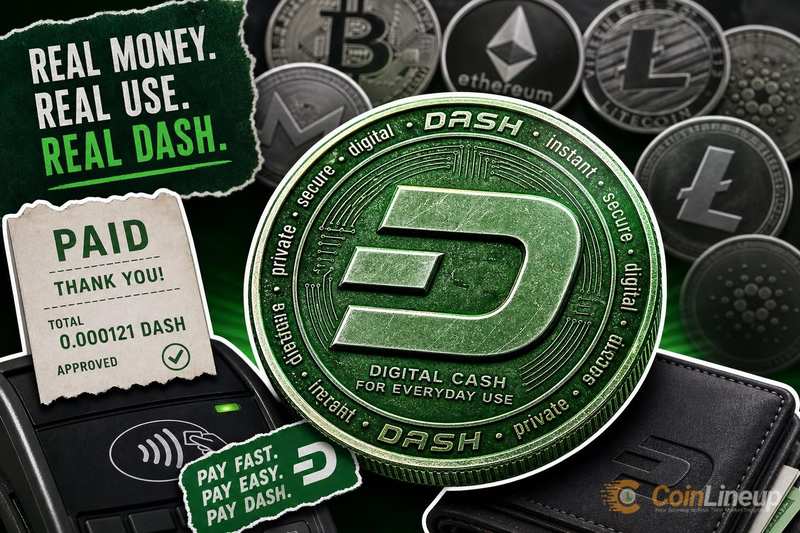
Dash, the cryptocurrency project built around fast peer-to-peer payments, has argued that the broader crypto industry has lost sight of its founding purpose: serving as digital cash for everyday transactions.
The project made the case in a stating that digital cash remains crypto’s key use case. The message frames the current landscape as one dominated by speculation and passive holding, with few projects still focused on practical payment utility.
The argument was further outlined in a which noted Dash’s position that the industry has drifted from the original vision laid out in Bitcoin’s 2008 whitepaper, a “peer-to-peer electronic cash system.”
Why Dash Says Digital Cash Is Crypto’s Original Killer App
Digital cash, in this context, refers to cryptocurrency that functions like physical money: instant transfers, low fees, and usability at the point of sale. Dash argues this was the entire premise of cryptocurrency before narratives around store-of-value, DeFi yields, and meme tokens took center stage.
The distinction matters because payment-focused use cases require different technical priorities than speculative ones. Speed, finality, and user experience at checkout take precedence over smart contract complexity or staking rewards.
Dash’s timing aligns with a period where crypto lobbying and regulatory battles have consumed industry attention. While groups have spent heavily on political influence and regulators have pursued enforcement actions, relatively little public discourse has centered on whether crypto actually works as money.
How Dash Positions Itself Around Fast, Practical Crypto Payments
Dash’s own architecture reflects this philosophy. According to the project’s official FAQ, the network uses a two-tier system with masternodes that enable features like InstantSend, which locks transactions in under two seconds.
This positions Dash apart from projects where confirmation times stretch to minutes or where high gas fees make small purchases impractical. The project’s messaging explicitly contrasts itself with tokens driven mainly by hype or designed primarily for holding rather than spending.
The digital cash framing also separates Dash from newer layer-1 chains competing on programmability. Rather than chasing DeFi or NFT ecosystems, the project doubles down on the simplest possible transaction: sending value from one person to another.
What the Digital Cash Argument Means for Crypto Adoption
Dash’s claim carries an implicit critique: if crypto cannot outperform existing payment rails for ordinary people, its long-term relevance narrows to trading and speculation. The “killer app” framing suggests that mass adoption depends on solving the payment problem first.
This perspective challenges current industry priorities, where venture funding flows toward infrastructure layers, AI integrations, and tokenized assets. Meanwhile, governments are exploring their own approaches to digital money through CBDCs, and unified tax frameworks suggest regulators view crypto primarily as an asset class rather than a payment system.
Whether Dash’s argument gains traction depends on whether users prioritize spending crypto over holding it. The project is betting that practical utility, not financial engineering, will ultimately drive the next wave of real-world adoption.
Disclaimer: The content of this article solely reflects the author's opinion and does not represent the platform in any capacity. This article is not intended to serve as a reference for making investment decisions.
You may also like
The “American Mining Dream” of Bitcoin Mining Firms Shattered! Miners Shift to AI Data Center Construction, Scarce Electricity Becomes Key to Valuation Reshaping
Due to the rapid development of artificial intelligence and the crash in cryptocurrencies, Donald Trump's plan to concentrate bitcoin mining activities in the United States is collapsing. Compared to October last year, the computing power consumed by bitcoin mining has decreased by 18%.

The "tax-free dividend" for data centers changes! Over ten US states reassess tax incentives, AI computing power expansion faces new obstacles
For AI computing power investment themes, policy changes primarily affect where to build, at what cost, and when investment returns can be realized. Ohio's data center incentives cover computing equipment, cooling systems, power equipment, and some building materials, so adjustments could impact the entire facility.

86% of S&P 500 Components Beat Earnings Expectations! AI Boom Fuels S&P 500 Profit Growth, Full-Year Growth Forecast Raised to 32%
The full-year profit expectations for the S&P 500 Index are rising, supported by the artificial intelligence boom and stronger-than-expected earnings performance in the first half of the year.

From daily leverage to hourly leverage! The lesson from South Korea is still fresh, Wall Street is once again testing even more extreme retail trading tools
Defiance ETFs has filed documents with the U.S. Securities and Exchange Commission (SEC), planning to launch a series of leveraged funds that aim to double the gains or losses of certain individual stocks—not on a daily basis, but calculated hourly.

Crypto prices
More


