
Strategies for Export Enterprises in the 6.7 Era

In mid-May, the USDCNY exchange rate entered the 6.7 era. Reviewing the past decade's exchange rate trends, 6.7 has been an important dividing line between strong and weak yuan cycles, serving as a critical cyclical reference. Once the 6.7 level is broken through, it is difficult to quickly reverse in the short term, with at least a quarterly trend likely to form. During recent visits to export companies, I could feel that as 6.7 approaches, these companies are experiencing increasing pressure to hedge.
USDCNY moving closer to 6.7
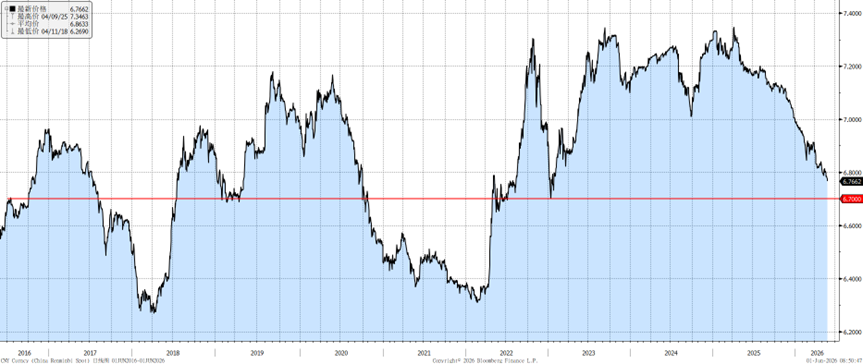
Where is the pressure for export companies? During visits to businesses, I found that since order costs are dynamically adjusted based on FX rates, the USDCNY spot rate itself isn't the most critical factor; the core demand among business owners is for exchange rate stability. To cope with FX volatility, swap-based hedging is a natural strategy. However, given the current deep negative swap points, it's not cost-effective for exporters, putting them in a dilemma.
1Y US-China interest rate differential remains at a relatively high level above 2%
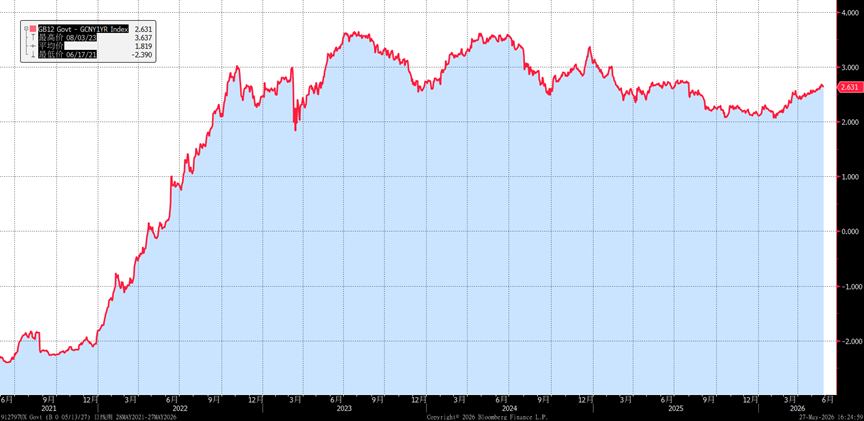
With the shift in market expectations for the Federal Reserve's monetary policy from rate cuts at the beginning of the year to possible hikes, the backdrop of an inverted interest rate differential is expected to persist for quite some time. From the 6.7 level, here are several tools I recommend for exporters' FX risk management:
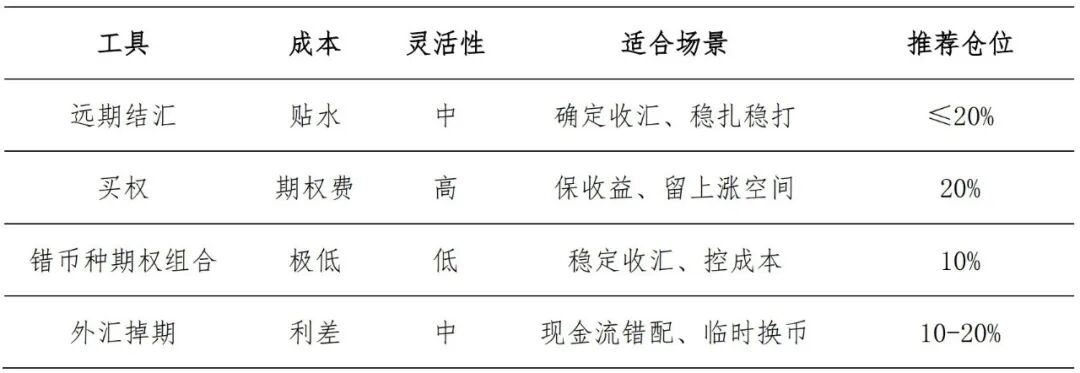
Tool 1: Forward FX Settlement, a product that is easy to understand and has a low learning curve for exporters.
Under the current negative swap environment, it’s important to change from previous one-time large scale hedging. Companies need refined management—especially coordination between business and finance departments—to carry out short-term rolling forwards based on their FX exposure, thus avoiding the increased cost of long-dated forwards due to greater negative points.
Tool 2: Call Option Purchase, which allows you, for a fee, to secure a minimum exchange rate, with no upside limit.
In the article “CNY: Solutions in Low Volatility,” we noted that volatility is expected to remain low or even decline further. Low volatility makes buying call options more cost-effective. For example, a 1M call option with a strike price of 6.75 costs only 200 PIPS more than a forward, with annualized costs below 0.3%, significantly lower than the near-1% cost in the past. For companies concerned about appreciating CNY but unwilling to miss a potential rebound, this is a cost-effective choice.
Tool 3: Cross-currency Option Combinations: Use non-USD puts to lower hedging costs.
Previously, to lower the cost when buying options, we used to write short options of the same tenor and currency. However, due to persistent RMB strength expectations and declining volatility, the cost-saving effect is now limited. In the article “RMB Strategy Choice: Sell EURCNY Call”, we offer the idea of selling euro-yuan options. Currently, a combination of buying USDCNY put + selling EURCNY call at appropriate price ranges can achieve a zero-cost solution.
Tool 4: Yuan Swaps
For companies with mismatched cash flows in FX, swaps are naturally the most suitable cash flow management tool. For those with only FX receipts, in the current environment of an inverted US-China interest rate differential plus low RMB volatility, some companies have relied on swap discounts to offset FX volatility, which is essentially similar to a carry trade. However, I must remind you to avoid formulaic approaches; these strategies must be dynamically adjusted according to market conditions and a company’s own cash management needs.
To summarize today's discussion:
This round of yuan appreciation is like boiling a frog slowly—the 6.7 watershed is approaching, FX risk management is becoming more challenging, and the effective use of products is increasingly demanding. I believe that instead of asking whether to hedge, companies should ask how. Every product has its advantages and limitations, and as market conditions change, so do the appropriate usage scenarios. The optimal approach is to understand your own situation and choose suitable tools accordingly.
Disclaimer: The content of this article solely reflects the author's opinion and does not represent the platform in any capacity. This article is not intended to serve as a reference for making investment decisions.
You may also like
Balancer eyes wind-down after restructuring fails to revive revenue
Is a new wave of sell-offs approaching? The ultimate rival of the AI bull market emerges—The "global anchor of asset pricing" breaks through the 5% super threshold
After the 10-year US Treasury yield breaks back above the critical 5% mark, it is more likely to usher in a period of high-level tug-of-war and accelerated asset differentiation. Especially before energy shocks and the significantly eased large-scale expansion of the US fiscal deficit, the conditions to quickly replicate the sharp yield decline seen at the end of 2023 are not yet fully in place.

Anthropic releases another article: What will the economy look like in the AI era?
Anthropic's economics team has released an AI economic scenario model, centered around three scenarios: moderate and gradual growth, transformative changes with GDP doubling, and an extreme situation with 15% annual growth but massive job losses among knowledge workers. The model treats work as "bundles of tasks" and analyzes AI’s enhancement and substitution effects on different types of tasks. Anthropic emphasizes that the economic outlook for 2030 is not predetermined; the key lies in how the dividends from AI are widely shared.
"New Federal Reserve News Agency": Waller's Rate Hike "Has No Way Back", Trump's "Trust" Faces Test
Nick Timiraos believes that after the higher-than-expected August CPI, the probability of the Federal Reserve raising interest rates this week has surged, while Waller’s hawkish stance on inflation has left himself almost "no leeway." With seven weeks before the election, whether or not Waller raises rates will directly test how long Trump's “trust” in him can last. Previously, Waller maintained a balance between the White House and the Federal Reserve by “talking less and avoiding provocation,” but after this meeting, silence will no longer serve as his shield.
Crypto prices
More


