
Nonfarm payrolls greatly exceed expectations; geopolitical tensions arise; gold prices experience turmoil

FXstreet, June 5th—— Resilient to the Point of Suffocation: May Nonfarm Payrolls Soar by 172,000, Fed's "Higher for Longer" Almost a Foregone Conclusion
U.S. Bureau of Labor Statistics (BLS)
Data shows,
Amid this dual-month surge, the U.S. unemployment rate remained steady at a low 4.3% for the third month in a row.
This explosive report sent a clear and unmistakable signal to financial markets: After last year’s trough, the U.S. labor market is regaining momentum in an almost robust manner,
"Low Layoffs" Forge Ironclad Barrier; Geopolitical Oil Price Shock Yet to Emerge
Previously, the market was extremely concerned that the Iran war that broke out on February 28 (causing retail gasoline to surge over 40% and diesel to spike 55%) and negative events such as the Spirit Airlines bankruptcy would trigger a cascade of layoffs.
However, the actual data for May refuted these fears. Prominent Wall Street economists noted that the current U.S. labor market is in a rare state of “low hiring, low layoffs” with remarkable resilience:
No widespread layoffs:
The four-week moving average of initial unemployment claims also remains near historical lows, indicating that even in the face of elevated energy costs, companies still tend toward “labor hoarding”.
The hiring diffusion index improved notably: April’s prior figure was revised up by an impressive 64,000, directly overturning the earlier assumption that “the medical sector alone was propping up the job market”.
In May, hiring across more cyclical private sector industries (such as construction, manufacturing, trade, and transportation) showed broad-based recovery, proving that the economy is not being artificially propped up but carries genuine endogenous momentum.
Wages and Inflation Face Off at High Levels, "Real Purchasing Power" Undercurrent Surges
On the wage front, May’s average hourly earnings rose 3.4% year-on-year (month-on-month +0.3%). Although this pace has eased somewhat from post-pandemic highs, under the current high-inflation environment, it is seen as a “double-edged sword” in the eyes of the Fed.
On one hand,
On the other hand, hawkish officials like Fed Governor Cook and Cleveland Fed President Mester argue that, with trillions in AI investments driving up chips and data centers and geopolitical crises lifting oil prices, wage growth as high as 3.4% can easily resonate with imported inflation—triggering the market’s greatest fear, the “wage-inflation spiral”.
Policy Space Fully Open—The Fed Hawks Hold All the Leverage
This blowout nonfarm report undeniably sets a decisively hawkish tone for the Fed’s upcoming June policy meeting.
It not only fully dismisses any near-term prospect of a “rate cut”, but even pushes the market onto the ironclad path of “higher for longer” interest rates.
Economic “resilience” provides the Fed with a broader moat: Robust job growth confirms that the real economy has not been crushed by high interest rates.
This means that, as the Fed embarks on a “protracted war” against Iran-war-driven imported inflation, it has more than enough room to keep rates high for longer without fearing an abrupt economic downturn.
The invisible door to renewed rate hikes is ajar: Following the data release, Wall Street swap markets quickly repriced the policy path. Some aggressive macro hedge fund analysts suggest that if next week’s May CPI inflation reading also strengthens (following PPI), this “superheated” jobs data will not just support a “hold” on rates but could force the Fed to revisit the question of “whether further rate hikes are needed” in the second half.
Conclusion & Market Outlook: Gold Bull Run Hit by "Hawkish Blitz", Resilient Nonfarm Topples Bulls' Defenses
This blowout result of 172,000 (with a major upward revision to the previous figure) directly slashed gold’s near-term upside potential.
“Heavy blow” from surging real rates: Strong job growth has utterly shattered the Fed’s recent rate cut hopes, and swap markets’ expectations for “higher for longer” rates have been pushed out again.
This has directly lifted U.S. Treasury real yields and strongly boosted the dollar, putting enormous selling pressure on zero-yield assets—namely, gold.
Looking ahead, gold is now locked in a tug-of-war between “geopolitical premium” and “the Fed’s iron fist”.
Although the supply chain crisis and wholesale inflation (PPI at 6%) from the Iran war still provide long-term inflation-hedge support for gold, in the summer of 2026, as long as this exuberant jobs report keeps the Fed glued to its “fighting inflation to the end” hiking cycle, there will always be a sword hanging over gold’s upside.
Whether gold bulls can mount an effective counterattack will depend on the May CPI data to be released next week—if it triggers the Fed’s “rate hike restart” ultimate alarm.
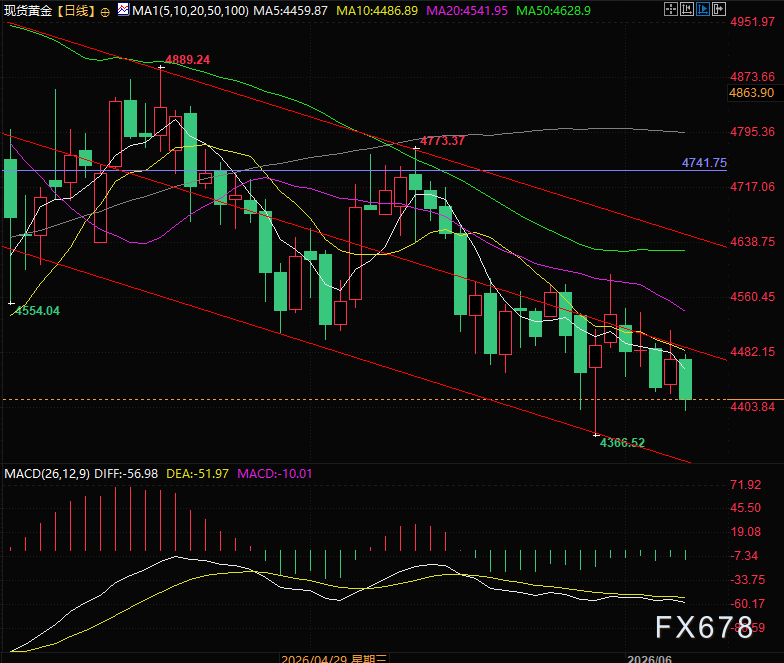
(Spot gold daily chart, source: Easy Forex)
Beijing Time (UTC+8) 21:17: Spot gold currently at $4,416/oz.
Disclaimer: The content of this article solely reflects the author's opinion and does not represent the platform in any capacity. This article is not intended to serve as a reference for making investment decisions.
You may also like
Is a new wave of sell-offs approaching? The ultimate rival of the AI bull market emerges—The "global anchor of asset pricing" breaks through the 5% super threshold
After the 10-year US Treasury yield breaks back above the critical 5% mark, it is more likely to usher in a period of high-level tug-of-war and accelerated asset differentiation. Especially before energy shocks and the significantly eased large-scale expansion of the US fiscal deficit, the conditions to quickly replicate the sharp yield decline seen at the end of 2023 are not yet fully in place.

Anthropic releases another article: What will the economy look like in the AI era?
Anthropic's economics team has released an AI economic scenario model, centered around three scenarios: moderate and gradual growth, transformative changes with GDP doubling, and an extreme situation with 15% annual growth but massive job losses among knowledge workers. The model treats work as "bundles of tasks" and analyzes AI’s enhancement and substitution effects on different types of tasks. Anthropic emphasizes that the economic outlook for 2030 is not predetermined; the key lies in how the dividends from AI are widely shared.
"New Federal Reserve News Agency": Waller's Rate Hike "Has No Way Back", Trump's "Trust" Faces Test
Nick Timiraos believes that after the higher-than-expected August CPI, the probability of the Federal Reserve raising interest rates this week has surged, while Waller’s hawkish stance on inflation has left himself almost "no leeway." With seven weeks before the election, whether or not Waller raises rates will directly test how long Trump's “trust” in him can last. Previously, Waller maintained a balance between the White House and the Federal Reserve by “talking less and avoiding provocation,” but after this meeting, silence will no longer serve as his shield.
Trump Opposes AI "Guardrails": Congress Pushes Legislation for Restrictions, Deepening Bipartisan Divide
U.S. President Trump opposes setting guardrails for artificial intelligence (AI), putting him at odds with a growing number of bipartisan lawmakers. As the midterm elections approach, voters' concerns about AI safety have intensified their doubts about this technology.

Crypto prices
More


