
Bitget App
Trade smarter
Buy cryptoMarketsTradeFuturesEarnAISquareMore
Did Shiba Inu (SHIB) Really Lose 1418% on the Futures Market? Analyzing the Volatility Surge

Did Shiba Inu (SHIB) Really Lose 1418% on the Futures Market? Analyzing the Volatility Surge

CryptoNewsNetCryptoNewsNet2026/06/05 20:27
By:CryptoNewsNet
Back to the list

Did Shiba Inu (SHIB) Really Lose 1418% on the Futures Market? Analyzing the Volatility Surge

Did Shiba Inu (SHIB) Really Lose 1418% on the Futures Market? Analyzing the Volatility Surge image 0  u.today 35 m
Did Shiba Inu (SHIB) Really Lose 1418% on the Futures Market? Analyzing the Volatility Surge image 1

Another round of selling pressure is being applied to Shiba Inu, but one metric has caught traders' attention with its magnitude and arithmetic impossibility.

Futures flows flip

Derivatives data claims that $SHIB's futures flow fell by as much as 1,418 percent over the course of eight hours. This is a striking figure that, at first glance, seems nearly impossible.
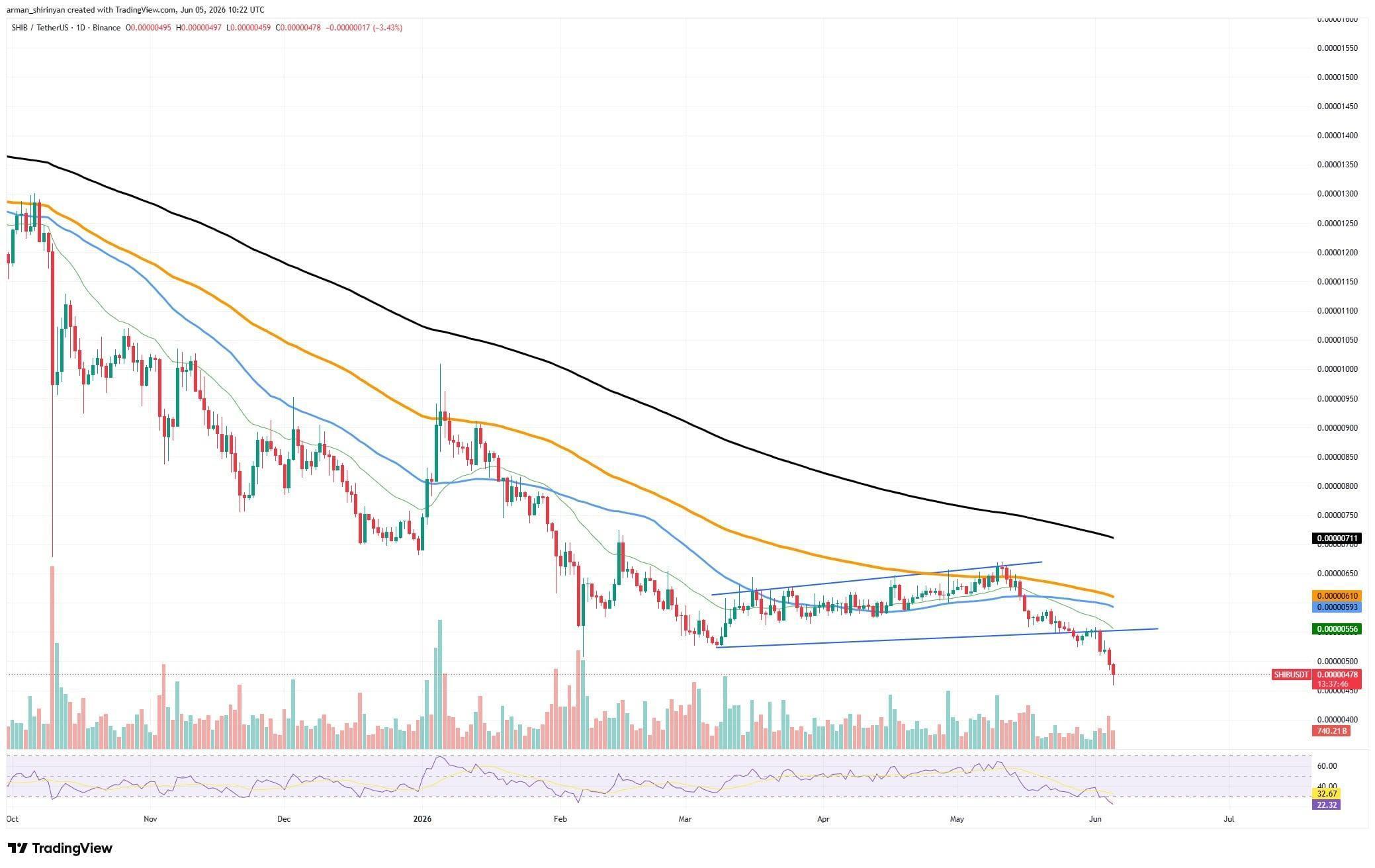
Did Shiba Inu (SHIB) Really Lose 1418% on the Futures Market? Analyzing the Volatility Surge image 2 $SHIB/USDT Chart by TradingView

The important point is that price performance is not determined by percentage changes in futures flow. Rather, they monitor the movement of net capital into and out of derivatives markets. Percentage calculations can yield seemingly ridiculous numbers that surpass 100%, 500%, or even 1,000% when the flow from the previous period was relatively small and the most recent reading swung significantly negative.

Rather than a direct loss of value, the figure in $SHIB's case indicates a sharp change in trader positioning. Net flow statistics sharply declined as futures traders quickly shifted from increasing exposure to aggressively lowering it.

This interpretation is supported by more comprehensive market data. Spot flows are still negative, and futures outflows continue to dominate over a number of tracked timeframes. Five-day and three-day spot flows are still firmly in the red, and seven-day spot flows show net outflows of over $4.4 million. This suggests that spot investors and speculative traders have been lowering their exposure at the same time.

Trend is under bear's control

Metrics from on-chain exchanges present a similar image. The total exchange outflows exceeded the inflows by about 586 billion $SHIB, totaling over 802 billion $SHIB. Although significant exchange outflows may occasionally be seen as accumulation, the current situation indicates that investors are repositioning in the face of uncertainty rather than actively purchasing the decline.

The chart is still in the negative zone. $SHIB is still trading below its important moving averages after breaking below the lower boundary of a multi-month consolidation structure. While sellers continue to control the trend, momentum indicators are still weak, with the RSI hovering close to oversold territory.

Extreme futures flow readings frequently appear close to times of increased volatility despite the pessimistic outlook. Even a small catalyst can cause abrupt short-term reversals when positioning becomes overly one-sided.

But for the time being, spot and derivatives markets show that $SHIB risk appetite has sharply declined. Although the reported 1,418% decline in futures flow may seem startling, it mainly illustrates how quickly traders have left leveraged positions, as the market is still dominated by bearish sentiment.

0
0

Disclaimer: The content of this article solely reflects the author's opinion and does not represent the platform in any capacity. This article is not intended to serve as a reference for making investment decisions.

Understand the market, then trade.
Bitget offers one-stop trading for cryptocurrencies, stocks, and gold.
Trade now!

You may also like

Is a new wave of sell-offs approaching? The ultimate rival of the AI bull market emerges—The "global anchor of asset pricing" breaks through the 5% super threshold

After the 10-year US Treasury yield breaks back above the critical 5% mark, it is more likely to usher in a period of high-level tug-of-war and accelerated asset differentiation. Especially before energy shocks and the significantly eased large-scale expansion of the US fiscal deficit, the conditions to quickly replicate the sharp yield decline seen at the end of 2023 are not yet fully in place.

智通财经2026/09/15 03:26
Is a new wave of sell-offs approaching? The ultimate rival of the AI bull market emerges—The "global anchor of asset pricing" breaks through the 5% super threshold

Anthropic releases another article: What will the economy look like in the AI era?

Anthropic's economics team has released an AI economic scenario model, centered around three scenarios: moderate and gradual growth, transformative changes with GDP doubling, and an extreme situation with 15% annual growth but massive job losses among knowledge workers. The model treats work as "bundles of tasks" and analyzes AI’s enhancement and substitution effects on different types of tasks. Anthropic emphasizes that the economic outlook for 2030 is not predetermined; the key lies in how the dividends from AI are widely shared.

华尔街见闻2026/09/15 03:26

"New Federal Reserve News Agency": Waller's Rate Hike "Has No Way Back", Trump's "Trust" Faces Test

Nick Timiraos believes that after the higher-than-expected August CPI, the probability of the Federal Reserve raising interest rates this week has surged, while Waller’s hawkish stance on inflation has left himself almost "no leeway." With seven weeks before the election, whether or not Waller raises rates will directly test how long Trump's “trust” in him can last. Previously, Waller maintained a balance between the White House and the Federal Reserve by “talking less and avoiding provocation,” but after this meeting, silence will no longer serve as his shield.

华尔街见闻2026/09/15 03:26

Trump Opposes AI "Guardrails": Congress Pushes Legislation for Restrictions, Deepening Bipartisan Divide

U.S. President Trump opposes setting guardrails for artificial intelligence (AI), putting him at odds with a growing number of bipartisan lawmakers. As the midterm elections approach, voters' concerns about AI safety have intensified their doubts about this technology.

智通财经2026/09/15 02:46
Trump Opposes AI "Guardrails": Congress Pushes Legislation for Restrictions, Deepening Bipartisan Divide