
AVAX price crashes to early 2021 support, is a bottom forming?

AVAX price crashed to levels last seen in early 2021 after a market-wide liquidation wave erased support near $8 and left traders heavily bearish.
- AVAX price has fallen to levels last seen in early 2021 after a crypto-wide liquidation event wiped out key support zones.
- Open interest dropped to $159 million while more than 70% of derivatives positions remained short, highlighting bearish market sentiment.
- Traders are watching the $6.25 “Ultimate Support” level, with a break below potentially exposing AVAX to further downside toward $5.46 and $4.68.
According to data from crypto.news, Avalanche (AVAX) fell 14% to an intraday low of $6.26 on Saturday, June 6, its lowest level since January 2021, before stabilizing at $6.64 at press time.
The sharp decline came after Bitcoin (BTC) briefly fell below the key $60,000 support level and touched nearly $59,000, prompting traders to reduce risk as leveraged long positions were liquidated, and the Crypto Fear & Greed Index fell to 12 and remained in Extreme Fear territory, underscoring the deteriorating sentiment across the digital asset market.
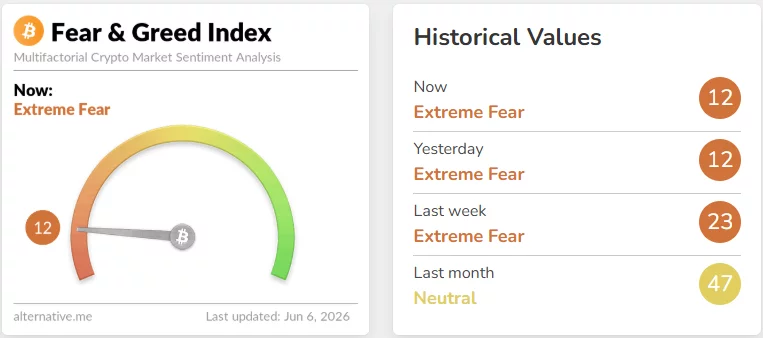
Leverage flush leaves AVAX near early 2021 range
The move was not driven by a clear Avalanche-specific network failure. Before the selloff, Avalanche had seen stronger institutional and on-chain activity, including more than $1.16 billion in on-chain real-world assets and the launch of regulated AVAX futures by CME Group.
Those developments offered little protection once the market entered a forced deleveraging cycle. The additional context showed more than $1.86 billion in long liquidations across crypto derivatives, with high-beta layer-1 tokens such as AVAX absorbing sharper losses than Bitcoin.
Derivatives positioning also weakened. Open interest in AVAX fell to about $159 million, showing fewer traders were willing to keep capital in active positions during the decline. At the same time, more than 70% of positions were shorts, leaving the market tilted toward further downside rather than a fast recovery.
CoinGlass liquidation heatmap data shows heavy leverage above the current price, especially around $7.00, $7.50, $8.00, $8.50, and the $8.80–$9.20 zone. A rebound into those levels could trigger short liquidations, but current price action has not yet shown enough spot demand to force that squeeze.
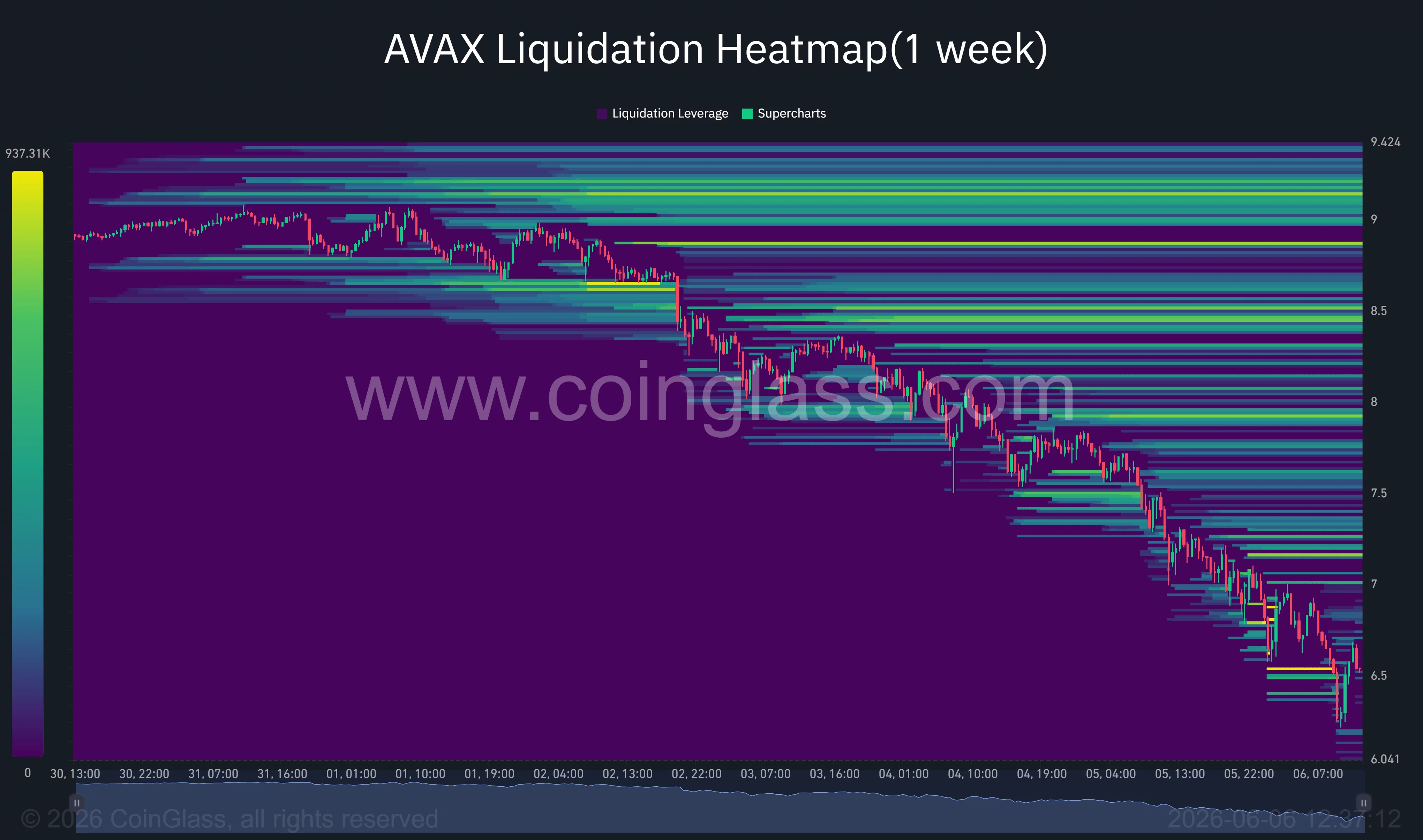 AVAX liquidation heatmap
According to an earlier X post by analyst Dr. Chart MAZEN, AVAX still carries downside continuation risk unless buyers reclaim higher levels. “I have a classic continuation pattern for the downside in case the 8.20$ area breaks,” the analyst wrote, adding that he was watching “6.53” and “5.77” as lower areas.
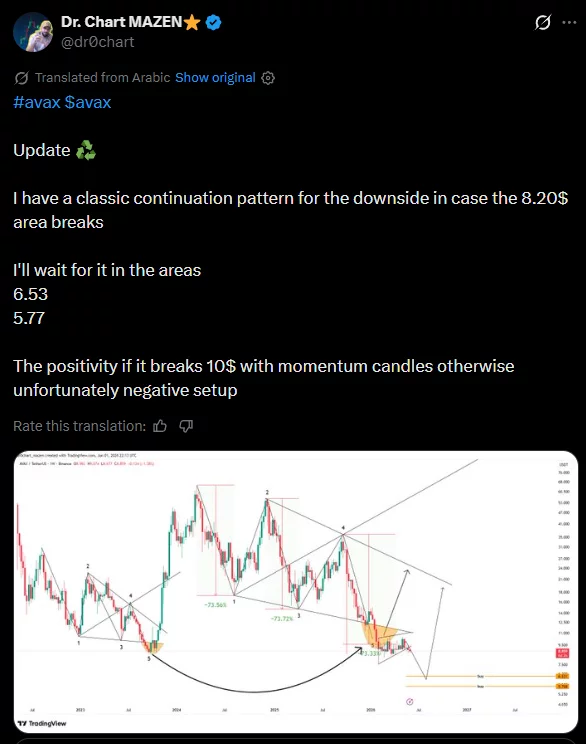
Technical setup keeps the bottom case fragile
AVAX fell close to its final major Murrey Math support zone near $6.25 earlier today, a level labeled ‘Ultimate Support’ on the daily chart. The token previously lost the $7.81 and $7.03 support bands during the liquidation-driven selloff, leaving the $6.25 area as the key line bulls must defend to prevent a deeper decline toward the oversold region near $5.46.
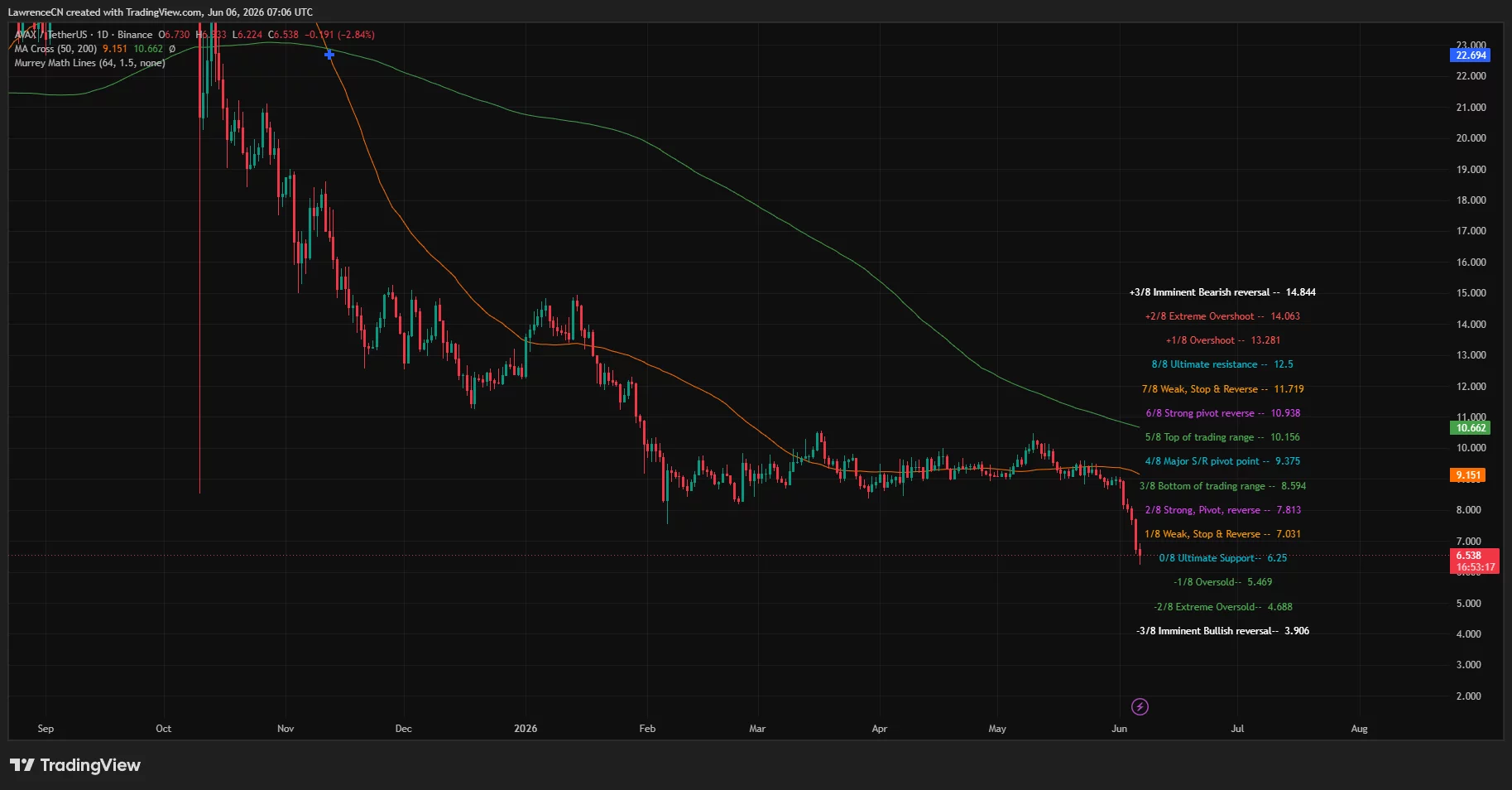 AVAX daily price chart — June 6
At press time, AVAX was trading below both the 50-day moving average at $9.15 and the 200-day moving average at $10.66.
Reclaiming those levels would be necessary to restore a bullish market structure, although the token’s defense of the $6.25 support zone has begun attracting attention from traders looking for signs of a longer-term bottom.
Resistance now sits near $7.03, followed by $7.81 and $8.59. A close above $8.20 would weaken the downside continuation setup described by Dr. Chart MAZEN, while a stronger move above $10 would bring the 200-day average and major trend resistance back into focus.
Downside risk remains clear. A daily close below $6.25 would keep sellers in control and expose AVAX to the -1/8 Murrey level near $5.46. Below that, the next major downside area sits near $4.68, while Dr. Chart MAZEN’s $5.77 level may act as the first test before deeper capitulation.
AVAX can still form a bottom if buyers defend the $6.25–$6.50 range and force shorts to unwind above $7.50. Until price reclaims $8.20 with strong volume, the chart favors a damaged recovery attempt rather than a confirmed reversal.
Disclaimer: The content of this article solely reflects the author's opinion and does not represent the platform in any capacity. This article is not intended to serve as a reference for making investment decisions.
You may also like
Is a new wave of sell-offs approaching? The ultimate rival of the AI bull market emerges—The "global anchor of asset pricing" breaks through the 5% super threshold
After the 10-year US Treasury yield breaks back above the critical 5% mark, it is more likely to usher in a period of high-level tug-of-war and accelerated asset differentiation. Especially before energy shocks and the significantly eased large-scale expansion of the US fiscal deficit, the conditions to quickly replicate the sharp yield decline seen at the end of 2023 are not yet fully in place.

Anthropic releases another article: What will the economy look like in the AI era?
Anthropic's economics team has released an AI economic scenario model, centered around three scenarios: moderate and gradual growth, transformative changes with GDP doubling, and an extreme situation with 15% annual growth but massive job losses among knowledge workers. The model treats work as "bundles of tasks" and analyzes AI’s enhancement and substitution effects on different types of tasks. Anthropic emphasizes that the economic outlook for 2030 is not predetermined; the key lies in how the dividends from AI are widely shared.
"New Federal Reserve News Agency": Waller's Rate Hike "Has No Way Back", Trump's "Trust" Faces Test
Nick Timiraos believes that after the higher-than-expected August CPI, the probability of the Federal Reserve raising interest rates this week has surged, while Waller’s hawkish stance on inflation has left himself almost "no leeway." With seven weeks before the election, whether or not Waller raises rates will directly test how long Trump's “trust” in him can last. Previously, Waller maintained a balance between the White House and the Federal Reserve by “talking less and avoiding provocation,” but after this meeting, silence will no longer serve as his shield.
Trump Opposes AI "Guardrails": Congress Pushes Legislation for Restrictions, Deepening Bipartisan Divide
U.S. President Trump opposes setting guardrails for artificial intelligence (AI), putting him at odds with a growing number of bipartisan lawmakers. As the midterm elections approach, voters' concerns about AI safety have intensified their doubts about this technology.

Crypto prices
More


