
Banking giant warns: Global stock markets are in the most "bubble-like" state since the 2008 financial crisis

U.S. multinational investment bank Citi has warned that global stock markets are currently in the most “bubble-like” state since the 2008 financial crisis.
In an investor report released on June 5, Citi analyst Beata Manthey pointed out that Citi’s proprietary “Bear Market Checklist” currently has 10 out of 18 indicators triggered worldwide.
Specifically, the U.S. market scores 11.5/18, while the European market scores 5/18. Manthey said that historically, when this indicator exceeds 10, it tends to accelerate. For comparison, during the dot-com bubble in 2000, this indicator reached as high as 17.5 warning signals.
Manthey wrote: “However, we note that once the number of warning signals hits double digits, historically they often increase faster, meaning risk may be accumulating at an accelerating pace. If more indicators are triggered in the future, whether it's worth buying the dip when the market falls will become more and more questionable.”
Nevertheless, Manthey also acknowledged that the current market conditions have not yet reached an “overexuberant” level. Therefore, while the indicator does reflect rising risks, Citi as a whole still maintains a relatively positive outlook on the market.
The stock market is in the most bubble-like phase since 2008
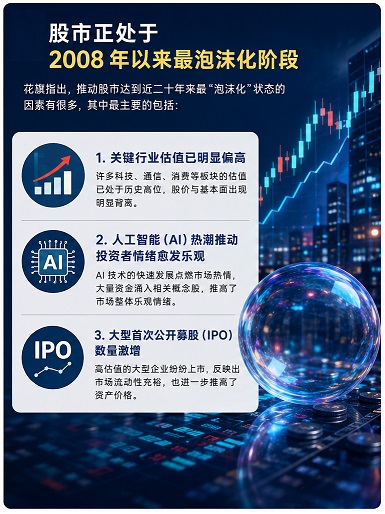
There are numerous factors driving stock markets to the most “bubble-like” state of the past two decades. The main reasons include:
Key sector valuations have become significantly overextended;
The artificial intelligence (AI) boom has led to increasingly optimistic investor sentiment;
A surge in the number of large initial public offerings (IPOs).
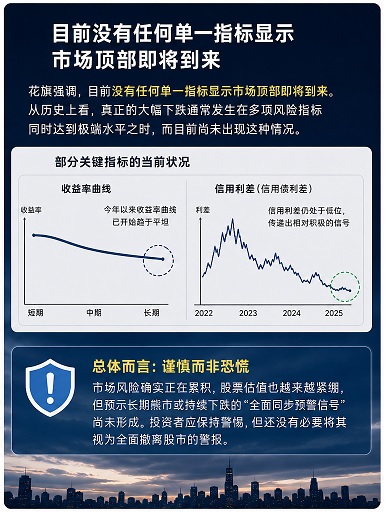
Citi emphasized that currently, no single indicator suggests the market top is imminent. Historically, significant downturns tend to occur when multiple risk indicators reach extreme levels simultaneously—a scenario not present at this time.
The Citi report stated: “Although the yield curve has started to flatten since the start of this year, some more responsive indicators, such as credit spreads, remain at low levels, sending relatively positive signals.”
Overall, Citi’s message leans more toward caution than panic.
In other words, market risks are indeed accumulating and stock valuations are becoming increasingly stretched, but the “broadly synchronized warning signal” that would foreshadow a prolonged bear market or sustained downturn has yet to materialize. At this stage, investors should remain vigilant but do not yet need to view this as a call for a full-scale exit from the stock market.
Disclaimer: The content of this article solely reflects the author's opinion and does not represent the platform in any capacity. This article is not intended to serve as a reference for making investment decisions.
You may also like
Global Forex and Fixed Income Roundup: Market Talk
From the Token Frenzy to the $1.3 Trillion AI Server Blue Ocean: AI Inference Computing Power Fully Explodes, Industry Leaders like Dell Usher in the Golden Era of "Volume, Price, and Market Share"
Leading global AI server cluster manufacturers such as Dell are simultaneously benefiting from two major growth dividends: the accelerated expansion of the AI server market and a significant increase in the order shares from core AI cloud computing customers, including large enterprises and new cloud providers. They are not merely passively profiting from hardware price increases.

GPU Cloud Services Surge in Price: Nebius Raises Prices Again by 20%, Computing Power Supply Side Gains Bargaining Power
From October 1st, Nebius will raise prices for its entire GPU cloud service line by approximately 20%, with multiple chips from H100 to B300 seeing increases. This marks the second round of price hikes in recent months, and the cumulative increase for B300 has reached 56%. Demand visibility extends beyond 24 months, with customers eager to purchase Blackwell computing power, even willing to pay a premium in auctions. The supply-demand imbalance for AI computing power is reshaping the entire industry’s negotiation landscape, as bargaining power is quietly shifting to the supply side.
Crypto prices
More


