
Bitcoin’s Rise May Have Little To Do With The Latest Purchase News

By:Newsbtc
Bitget offers one-stop trading for cryptocurrencies, stocks, and gold. Trade now!
A welcome pack worth 6200 USDT for new users! Sign up now!
Bitcoin’s latest upward move has sparked debate among market participants, and some believe the rally may have little to do with the purchase announcement that received the most attention. While the acquisition is generally viewed as constructive for the broader market, it is not necessarily the type of development that would justify a significant upward move in Bitcoin price.
Why The Latest Purchase May Not Be Driving Bitcoin Rally
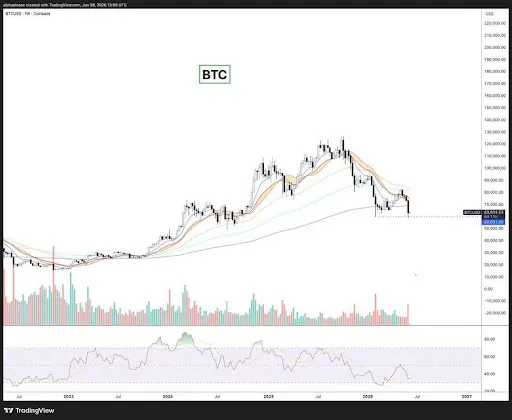
The Bitcoin’s recent move higher is being misinterpreted as a direct reaction to purchase news, when in reality the drivers appear to be more technical in nature. Crypto analyst Aylo has explained on X that the BTC bounce is likely the result of an oversold market finding relief after sweeping key February lows.

Another factor supporting the move higher is the easing of concerns surrounding Strategy and its Bitcoin holdings. The company’s recent sale of a relatively small 32 BTC sparked fears that it could become a larger seller in the future.
var rnd = window.rnd || Math.floor(Math.random()*10e6); var pid607465 = window.pid607465 || rnd; var plc607465 = window.plc607465 || 0; var abkw = window.abkw || ''; var absrc = 'https://servedbyadbutler.com/adserve/;ID=172179;size=0x0;setID=607465;type=js;sw='+screen.width+';sh='+screen.height+';spr='+window.devicePixelRatio+';kw='+abkw+';pid='+pid607465+';place='+(plc607465++)+';rnd='+rnd+';click=CLICK_MACRO_PLACEHOLDER'; document.write('
');
if (!window.AdButler){(function(){var s = document.createElement("script"); s.async = true; s.type = "text/javascript";s.src = "https://servedbyadbutler.com/app.js";var n = document.getElementsByTagName("script")[0]; n.parentNode.insertBefore(s, n);}());}
var AdButler = AdButler || {}; AdButler.ads = AdButler.ads || []; var abkw = window.abkw || ""; var plc366606 = window.plc366606 || 0; (function(){ var divs = document.querySelectorAll(".plc366606:not([id])"); var div = divs[divs.length-1]; div.id = "placement_366606_"+plc366606; AdButler.ads.push({handler: function(opt){ AdButler.register(172179, 366606, [728,90], "placement_366606_"+opt.place, opt); }, opt: { place: plc366606++, keywords: abkw, domain: "servedbyadbutler.com", click:"CLICK_MACRO_PLACEHOLDER" }}); })();
 Source:
Chart from Aylo on X
Source:
Chart from Aylo on X
Aylo suggests that while the current low may hold in the near term, it remains plausible that BTC could form a slightly lower low in June before a rally, particularly if the broader equity markets experience further weakness. Any deeper stock market shakeout could temporarily drag the price lower before a more sustained recovery begins. This level will be temporary before Bitcoin sees a low later in the year.
Furthermore, the fear that Michael Saylor and Strategy may be forced to liquidate a significant portion of their BTC holdings is likely overstated. The company may need to sell limited amounts to meet specific obligations, but the narrative that a major liquidation event from their supply will be driven more by bearish sentiment.
What The Recent Breakdown Could Mean For The Market
Bitcoin’s recent price action appears to be following a market structure that has played out before during previous corrective phases. A crypto trader known as Max Trades pointed out that roughly a month ago, BTC was entering a distribution phase of this pattern, and the outlook has since played out with notable accuracy.
var rnd = window.rnd || Math.floor(Math.random()*10e6); var pid607472 = window.pid607472 || rnd; var plc607472 = window.plc607472 || 0; var abkw = window.abkw || ''; var absrc = 'https://servedbyadbutler.com/adserve/;ID=172179;size=0x0;setID=607472;type=js;sw='+screen.width+';sh='+screen.height+';spr='+window.devicePixelRatio+';kw='+abkw+';pid='+pid607472+';place='+(plc607472++)+';rnd='+rnd+';click=CLICK_MACRO_PLACEHOLDER'; document.write('
');
if (!window.AdButler){(function(){var s = document.createElement("script"); s.async = true; s.type = "text/javascript";s.src = "https://servedbyadbutler.com/app.js";var n = document.getElementsByTagName("script")[0]; n.parentNode.insertBefore(s, n);}());}
var AdButler = AdButler || {}; AdButler.ads = AdButler.ads || []; var abkw = window.abkw || ""; var plc452518 = window.plc452518 || 0; (function(){ var divs = document.querySelectorAll(".plc452518:not([id])"); var div = divs[divs.length-1]; div.id = "placement_452518_"+plc452518; AdButler.ads.push({handler: function(opt){ AdButler.register(172179, 452518, [728,90], "placement_452518_"+opt.place, opt); }, opt: { place: plc452518++, keywords: abkw, domain: "servedbyadbutler.com", click:"CLICK_MACRO_PLACEHOLDER" }}); })();

Bitcoin’s Market Structure Reflects The Influence Of Major Investors
In this bear market, BTC first formed an accumulation range, where price consolidated before breaking higher and sweeping out the liquidity above the previous highs. However, instead of continuing its upward trajectory, the asset price has transitioned into distribution. Since then, BTC has experienced a significant decline, falling more than 20% from its previous highs.
According to Max Trades, what makes the current setup particularly noteworthy is the comparison to a previous distribution phase that ultimately resulted in substantially deeper downside after the initial breakdown. If the current structure continues to mirror that historical pattern, it could imply that the recent decline is not yet complete.
BTC trading at $62,640 on the 1D chart | Source: BTCUSDT on
Tradingview.com
0
0
Disclaimer: The content of this article solely reflects the author's opinion and does not represent the platform in any capacity. This article is not intended to serve as a reference for making investment decisions.
Understand the market, then trade.
Bitget offers one-stop trading for cryptocurrencies, stocks, and gold.
Trade now!
You may also like
UK weighs tokenized gold reforms – Here’s why the timing matters for crypto
AMBCrypto•2026/09/15 01:03
As Anthropic proposes the "AI slowdown theory," AI commercialization is accelerating! From model development to financial advisory, the benefits of AI agents are being realized at a faster pace.
Anthropic is simultaneously advancing frontier AI risk governance and the commercialization of enterprise AI applications, competing with leading AI application rivals such as OpenAI for AI monetization.
智通财经•2026/09/15 01:01

BTC, ETH, XRP, ZEC consolidate near highs as breakout levels approach
Cointurk•2026/09/15 00:39
As chip stocks plummet, "cybersecurity software" surges across the board, CrowdStrike and Palo Alto Networks hit new highs
CrowdStrike surged 13.8% in a single day to a record high, while Palo Alto Networks soared 13%. The software ETF outperformed the semiconductor ETF by more than 10 percentage points in a single day, marking the largest gap in history. Analysts believe that regardless of the pace of AI development, security demand will only continue to rise. Capital is accelerating its rotation from computing hardware to security software, with segments such as identity management and data governance expected to benefit first.
华尔街见闻•2026/09/15 00:16
Crypto prices
More
Bitcoin
BTC
$77,837.94
+1.45%

Ethereum
ETH
$2,512.59
+1.29%

Tether USDt
USDT
$0.9999
+0.03%

BNB
BNB
$719.07
-0.02%

XRP
XRP
$1.42
+5.28%

USDC
USDC
$0.9999
-0.02%

Solana
SOL
$102.4
+2.83%

TRON
TRX
$0.3378
-0.20%

Hyperliquid
HYPE
$80.24
+3.23%

Zcash
ZEC
$1,161.49
+9.54%
How to buy BTC
Bitget lists BTC – Buy or sell BTC quickly on Bitget!
Trade now
Become a trader now?A welcome pack worth 6200 USDT for new users!
Sign up now