
Yuga Labs Rescues $570,000 in NFTs After Floor Protocol Exploit

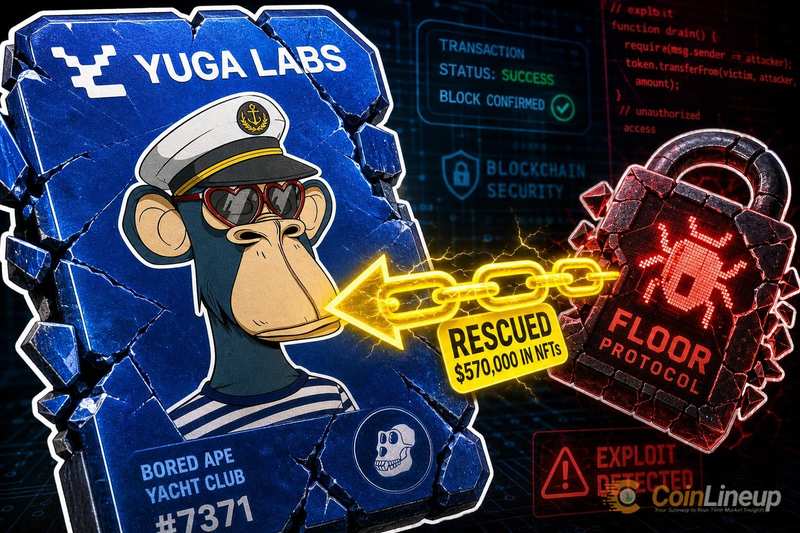
Yuga Labs stepped in to rescue roughly $570,000 worth of NFTs after an exploit hit Floor Protocol, a fractionalization platform that allows users to break high-value NFTs into tradable token units.
What happened with Floor Protocol
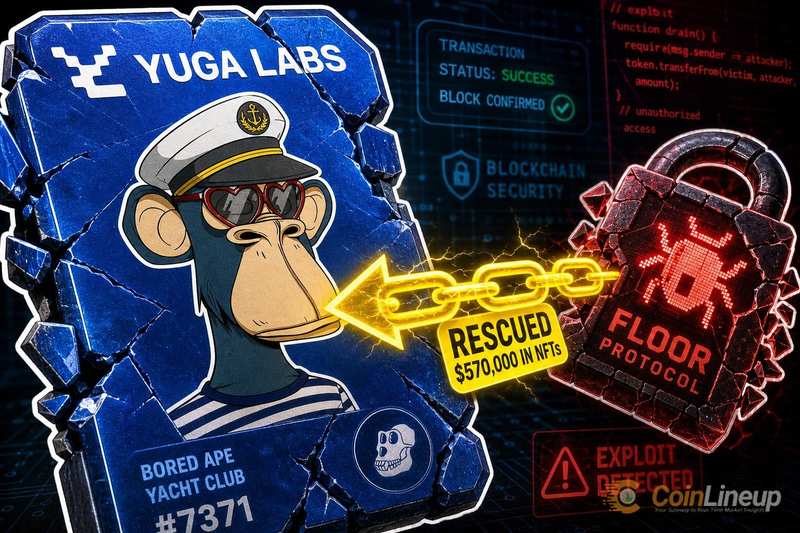
Floor Protocol, which lets holders deposit NFTs in exchange for fractional tokens, suffered an exploit that put user-deposited assets at risk. The vulnerability exposed NFTs held within the protocol’s smart contracts.
The incident drew immediate attention because many of the affected NFTs belonged to prominent Yuga Labs collections, which remain among the most valuable assets in the NFT market.
How Yuga Labs recovered the assets
Yuga Labs, the company behind Bored Ape Yacht Club and other blue-chip NFT collections, moved quickly to extract its ecosystem’s NFTs from the compromised protocol. The rescue effort recovered approximately $570,000 in NFTs before attackers could drain them.
The intervention required Yuga Labs to act on behalf of affected holders, distinguishing the post-exploit recovery from the exploit itself. For NFT owners whose assets were locked in Floor Protocol, the rescue changed the outcome from total loss to recovery. This type of coordinated response is uncommon in the NFT space, where exploits more often result in permanent losses, as seen in incidents that have shaped broader conversations around how regulators approach digital asset protections.
Why it matters for NFT security
The speed of the response proved critical. In NFT exploits, assets can be moved or sold within minutes, leaving little time for recovery. Yuga Labs’ ability to act before the attacker fully drained the protocol limited the damage considerably.
Protocol-level vulnerabilities like this one highlight the risks users face when depositing NFTs into third-party smart contracts. Even well-known fractionalization platforms carry smart contract risk that individual holders may underestimate. The incident comes as the crypto industry continues debating security standards, with firms like Coinbase and Ripple pushing for clearer regulatory frameworks that could eventually address platform security requirements.
For Yuga Labs, the rescue reinforced its role as an active steward of its NFT ecosystem rather than a passive creator. Whether other NFT projects would or could mount similar recovery efforts remains an open question, particularly for smaller teams without the resources to respond to exploits in real time. The broader industry trend toward institutional involvement in crypto, including moves like Strategy’s continued Bitcoin accumulation, suggests that well-capitalized entities may increasingly be expected to backstop their ecosystems when vulnerabilities emerge.
Disclaimer: The content of this article solely reflects the author's opinion and does not represent the platform in any capacity. This article is not intended to serve as a reference for making investment decisions.
You may also like
As Anthropic proposes the "AI slowdown theory," AI commercialization is accelerating! From model development to financial advisory, the benefits of AI agents are being realized at a faster pace.
Anthropic is simultaneously advancing frontier AI risk governance and the commercialization of enterprise AI applications, competing with leading AI application rivals such as OpenAI for AI monetization.

BTC, ETH, XRP, ZEC consolidate near highs as breakout levels approach
As chip stocks plummet, "cybersecurity software" surges across the board, CrowdStrike and Palo Alto Networks hit new highs
CrowdStrike surged 13.8% in a single day to a record high, while Palo Alto Networks soared 13%. The software ETF outperformed the semiconductor ETF by more than 10 percentage points in a single day, marking the largest gap in history. Analysts believe that regardless of the pace of AI development, security demand will only continue to rise. Capital is accelerating its rotation from computing hardware to security software, with segments such as identity management and data governance expected to benefit first.
Altman can afford to wait, but Masayoshi Son can't: OpenAI will not go public this year, exposing a $20 billion gap and a credit weakness for SoftBank.
OpenAI has postponed its public listing, putting its largest external shareholder, SoftBank, in a liquidity crisis. This week, SoftBank is conducting a roadshow in New York, seeking to issue $10-20 billion in bonds to repay the $40 billion bridge loan previously borrowed to increase its investment in OpenAI. According to Bloomberg estimates, SoftBank faces a funding gap of at least $20 billion, and the yield on its existing U.S. dollar bonds has already exceeded 8.5%, with pricing approaching junk status.
Crypto prices
More


