
Brera Holdings Rejects Forward Industries Takeover Bid With 30.7% Premium

Brera Holdings has rejected a takeover bid from Forward Industries that carried a 30.7% premium over its market price, signaling that the company’s board views the offer as insufficient despite the substantial markup.
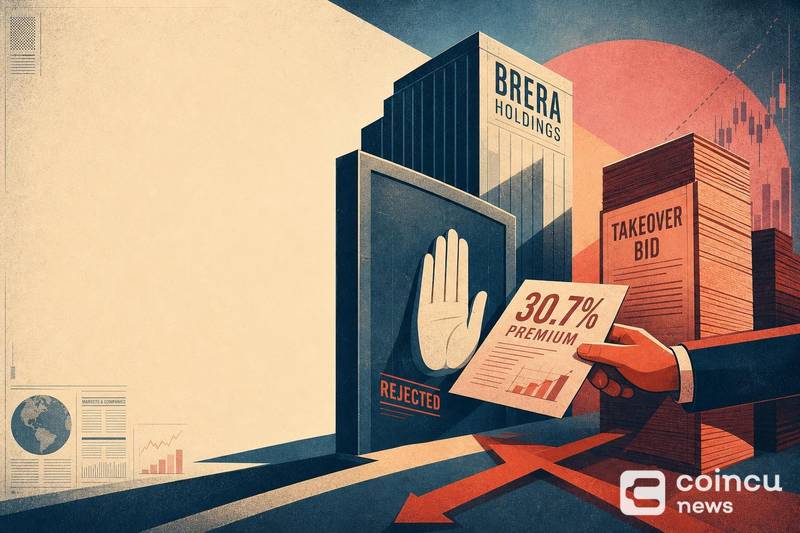
Brera Holdings Rejects Forward Industries’ Offer
Forward Industries submitted a letter of intent to acquire Brera Holdings PLC (Nasdaq: BRER), proposing a deal at a 30.7% premium to Brera’s prevailing share price. Brera’s board declined the proposal.
The bid details were disclosed in a filing with the U.S. Securities and Exchange Commission, which confirmed the structure of the unsolicited approach and Brera’s formal response.
Why Brera Turned Down the Proposal
A 30.7% premium represents a meaningful markup, yet Brera’s decision to reject it indicates the board concluded the offer did not reflect the company’s full value or strategic direction. Companies routinely refuse premium bids when management believes standalone execution will deliver greater long-term shareholder returns.
No public statement from Brera’s board has detailed specific objections beyond the rejection itself. The refusal, however, suggests either a valuation gap between the two sides or concerns about strategic fit with Forward Industries’ business.
What the 30.7% Premium Signals About Valuation
A takeover premium is the percentage above a target company’s current trading price that an acquirer offers to persuade shareholders to sell. Premiums compensate shareholders for giving up future upside and typically need to be large enough to overcome board resistance.
At 30.7%, Forward Industries’ offer sat within the range that markets generally consider a serious bid. Yet a premium alone does not guarantee acceptance. Boards are obligated to evaluate whether the total consideration reflects intrinsic value, not just whether it exceeds the current stock price.
The rejection implies Brera’s leadership sees a wider gap between the offered price and what they believe the company is worth, particularly as companies across the digital asset space explore new valuation frameworks through mechanisms like prediction markets and tokenized instruments.
Potential Market and Strategic Implications
Rejected bids frequently mark the beginning of a negotiation rather than the end. Forward Industries could return with a higher offer, seek to engage Brera’s shareholders directly, or walk away entirely. Each path carries different implications for both companies’ stock prices.
For Brera shareholders, the rejection preserves optionality. The company retains the ability to pursue strategic alternatives, including partnerships, organic growth, or entertaining future offers at a higher valuation. In an environment where firms are increasingly exploring AI infrastructure and Web3 integration, strategic flexibility can carry significant value.
For Forward Industries, the refusal raises the cost of any future attempt. A revised bid would likely need to exceed the initial premium meaningfully to shift Brera’s position, and any hostile approach would face additional regulatory and shareholder approval hurdles.
The broader trend of traditional financial products converging with digital asset infrastructure, as seen in developments like yield-bearing stablecoin collateral offerings, adds context to how companies weigh standalone strategy against acquisition offers. No timeline for further negotiations has been disclosed.
FAQ
What was Forward Industries’ offer to Brera Holdings?
Forward Industries submitted a letter of intent proposing to acquire Brera Holdings at a price representing a 30.7% premium over the company’s market price at the time of the offer.
Why did Brera Holdings reject a bid with a 30.7% premium?
While Brera has not publicly detailed its full reasoning, the rejection indicates the board determined the offer undervalued the company or did not align with its strategic plans. A premium over market price does not necessarily reflect a company’s intrinsic or long-term value.
What happens after a takeover bid is rejected?
After a rejection, the bidder may increase its offer, attempt a direct appeal to shareholders, pursue a proxy fight, or abandon the effort. The target company may also use the bid as a catalyst to explore other strategic alternatives, including seeking competing offers from third parties.
Disclaimer: The content of this article solely reflects the author's opinion and does not represent the platform in any capacity. This article is not intended to serve as a reference for making investment decisions.
You may also like
As Anthropic proposes the "AI slowdown theory," AI commercialization is accelerating! From model development to financial advisory, the benefits of AI agents are being realized at a faster pace.
Anthropic is simultaneously advancing frontier AI risk governance and the commercialization of enterprise AI applications, competing with leading AI application rivals such as OpenAI for AI monetization.

BTC, ETH, XRP, ZEC consolidate near highs as breakout levels approach
As chip stocks plummet, "cybersecurity software" surges across the board, CrowdStrike and Palo Alto Networks hit new highs
CrowdStrike surged 13.8% in a single day to a record high, while Palo Alto Networks soared 13%. The software ETF outperformed the semiconductor ETF by more than 10 percentage points in a single day, marking the largest gap in history. Analysts believe that regardless of the pace of AI development, security demand will only continue to rise. Capital is accelerating its rotation from computing hardware to security software, with segments such as identity management and data governance expected to benefit first.
Altman can afford to wait, but Masayoshi Son can't: OpenAI will not go public this year, exposing a $20 billion gap and a credit weakness for SoftBank.
OpenAI has postponed its public listing, putting its largest external shareholder, SoftBank, in a liquidity crisis. This week, SoftBank is conducting a roadshow in New York, seeking to issue $10-20 billion in bonds to repay the $40 billion bridge loan previously borrowed to increase its investment in OpenAI. According to Bloomberg estimates, SoftBank faces a funding gap of at least $20 billion, and the yield on its existing U.S. dollar bonds has already exceeded 8.5%, with pricing approaching junk status.
Crypto prices
More


