
S&P 500 futures fell today after US attacks on Iran, putting pressure on markets.

- US-Iran conflict sends global stock futures tumbling.
- Bitcoin retreats amid increased risk aversion.
- The market is awaiting the consumer price index (CPI).
Financial markets opened Wednesday under pressure following the announcement of a new US military action against Iran. The escalating tensions in the Middle East increased caution among investors, leading to a drop in futures contracts for major US stock indices and also affecting the cryptocurrency market.
Before the markets opened, S&P 500 futures were trading at 7.372 points, down 0,28%. Dow Jones futures were down 0,14%, at 50.840 points. Nasdaq futures were down 0,47%, trading at 28.981 points. The Russell 2000 index, which tracks smaller-cap companies, was also down 0,31%, at 2.859 points.
The move came after the U.S. Central Command reported that it had carried out attacks classified as "self-defense" operations against Iranian targets. At the same time, Iranian media reported explosions on Qeshm Island, located in the strategic Strait of Hormuz, one of the most important routes for global oil transport.
The escalation of hostilities comes just days after the downing of an American Apache helicopter near the strait. On Tuesday, the current US president, Donald Trump, stated that the aircraft had been shot down by Iranian forces and promised a military response.
The search for protection was also evident in other markets. The VIX index, known as Wall Street's "fear gauge," rose 5,02%, reaching 19,87 points. The indicator usually rises during periods of greater uncertainty and volatility in global markets.
In the cryptocurrency market, Bitcoin followed the risk aversion trend. BTC, the world's largest cryptocurrency, was trading at US$61.400, registering a 2,95% drop in the last few hours. The pullback occurred as investors reduced exposure to assets considered more sensitive to rising geopolitical tensions.
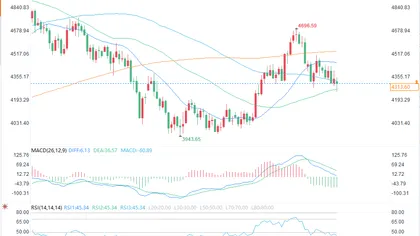
Among commodities, gold was trading down 1,94%, at US$4.203 per ounce. Despite traditionally being seen as a safe-haven asset, the metal was experiencing profit-taking after strong recent gains.
Attention now turns to the release of the Consumer Price Index (CPI) for May. The report is considered one of the main indicators for measuring the trajectory of inflation in the United States and can directly influence expectations for monetary policy in the coming months.
In addition to economic data, investors are watching the corporate earnings season. Oracle will release its financial results after the market closes, with a special focus on the performance of its cloud computing division and demand related to artificial intelligence.
This week also holds one of the most anticipated events of 2026: the initial public offering of SpaceX. The debut of Elon Musk's company on the stock market has attracted strong attention from investors and could become one of the largest IPOs ever recorded.
Disclaimer: The content of this article solely reflects the author's opinion and does not represent the platform in any capacity. This article is not intended to serve as a reference for making investment decisions.
You may also like
BTC, ETH, XRP, ZEC consolidate near highs as breakout levels approach
As chip stocks plummet, "cybersecurity software" surges across the board, CrowdStrike and Palo Alto Networks hit new highs
CrowdStrike surged 13.8% in a single day to a record high, while Palo Alto Networks soared 13%. The software ETF outperformed the semiconductor ETF by more than 10 percentage points in a single day, marking the largest gap in history. Analysts believe that regardless of the pace of AI development, security demand will only continue to rise. Capital is accelerating its rotation from computing hardware to security software, with segments such as identity management and data governance expected to benefit first.
Altman can afford to wait, but Masayoshi Son can't: OpenAI will not go public this year, exposing a $20 billion gap and a credit weakness for SoftBank.
OpenAI has postponed its public listing, putting its largest external shareholder, SoftBank, in a liquidity crisis. This week, SoftBank is conducting a roadshow in New York, seeking to issue $10-20 billion in bonds to repay the $40 billion bridge loan previously borrowed to increase its investment in OpenAI. According to Bloomberg estimates, SoftBank faces a funding gap of at least $20 billion, and the yield on its existing U.S. dollar bonds has already exceeded 8.5%, with pricing approaching junk status.
Meeting postponed, gold price drops rapidly
Crypto prices
More


