
Bitget App
Trade smarter
Buy cryptoMarketsTradeFuturesStocksEarnInstitutionAI & More
Non-USD stablecoins hit $2B ATH – Why altcoins still look weak

Non-USD stablecoins hit $2B ATH – Why altcoins still look weak

CryptoNewsNetCryptoNewsNet2026/06/10 14:33
By:CryptoNewsNet
Back to the list

Non-USD stablecoins hit $2B ATH – Why altcoins still look weak

Non-USD stablecoins hit $2B ATH – Why altcoins still look weak image 0  ambcrypto.com 14 m
Non-USD stablecoins hit $2B ATH – Why altcoins still look weak image 1

Any asset crash tends to ripple through the broader market quickly.

The recent Humanity Protocol [H] drawdown of over 85% on the 8th of June appears to have hit at an especially fragile point in the cycle.

On the macro side, large-cap assets are already hovering near multi-month lows, repeatedly testing key support levels and putting overall market conviction under significant stress.

Against this backdrop, the move in the H crypto token has only added pressure. Ethereum [$ETH], for example, has been down more than 40% this cycle, roughly 2x weaker relative to Bitcoin [$BTC].

That divergence is increasingly notable, especially as it suggests that no strong, fundamentals-driven rally has yet materialized this quarter, despite earlier expectations of DeFi-led momentum following the 2025 bearish phase.
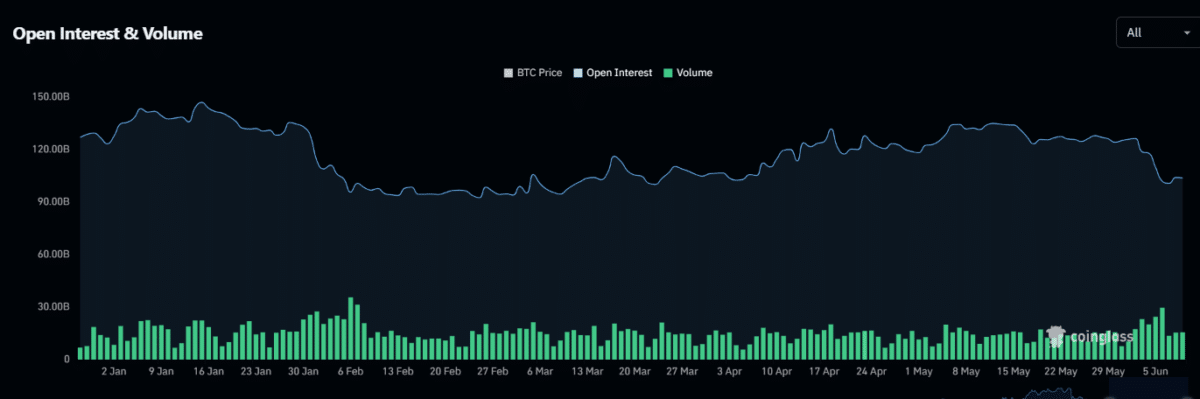
Non-USD stablecoins hit $2B ATH – Why altcoins still look weak image 2 Source: CoinGlass

This breakdown is clearly visible in the chart above.

According to CoinGlass data, overall altcoin Open Interest (OI) has dropped back to mid-March levels, sitting around $115 billion. That’s a decline of over 25% from the early January peak near $150 billion.

In simple terms, speculative activity has cooled significantly across altcoins, a setup that doesn’t look particularly supportive in the current macro environment.

Historically, during risk-off phases, speculation in altcoins tends to pick up as Bitcoin [$BTC] runs into resistance and capital rotates into higher-beta assets.

However, this cycle, that playbook hasn’t really played out. Instead, H’s crash has added further pressure to an already fragile setup. Looking at liquidity flows, this could still be just the early stage of a deeper corrective or bearish phase.

Liquidity flows suggest caution, not confidence in altcoins

Normally, liquidity flowing back into the market is often seen as a bullish signal.

However, in the current macro FUD environment, with Bitcoin’s recent 25%+ correction, stronger liquidity inflows could actually lean bearish in the short term. Spot demand for $BTC hasn’t fully recovered yet, and instead, risk-off sentiment appears to be driving investors toward hedging rather than deploying capital into risk assets, increasing the chance of a deeper correction in altcoins.

According to Arkham Intelligence, the circulating supply of non-USD stablecoins has reached an all-time high of $2 billion, up 43% in 2026 alone. EURC, BRZ, and A7A5 now account for the majority of the market.

Meanwhile, the total market cap of these stablecoins has also moved back up to around $316 billion after two weeks of steady outflows.
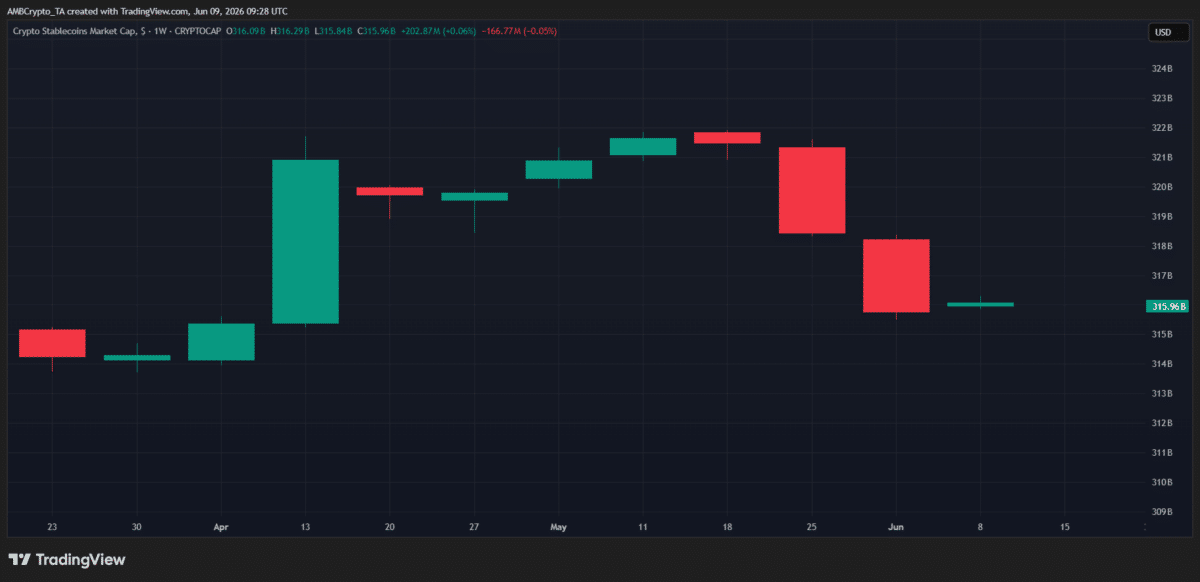
Non-USD stablecoins hit $2B ATH – Why altcoins still look weak image 3 Source: TradingView (STABLE.C)

In essence, liquidity (both USD and non-USD) is gradually flowing back into the market.

However, following the recent Humanity Protocol crash, the altcoin market looks increasingly exposed to potential capital outflows. H’s 150%+ rally in late May had driven strong inflows into the ecosystem, but that momentum has now reversed.

In this context, the pullback has clearly weakened sentiment and raised downside risk for altcoins.

Final Summary

  • Altcoin markets are under pressure as falling open interest, $ETH underperformance, and the Humanity Protocol crash point to weakening speculative momentum.
  • Even as liquidity rises across USD and non-USD stablecoins, it appears to be sitting in a defensive posture rather than flowing into risk assets, keeping downside risk elevated for altcoins.

0
0

Disclaimer: The content of this article solely reflects the author's opinion and does not represent the platform in any capacity. This article is not intended to serve as a reference for making investment decisions.

Understand the market, then trade.
Bitget offers one-stop trading for cryptocurrencies, stocks, and gold.
Trade now!

You may also like

While Meta and Alphabet raise concerns in the market over AI cash burn, Microsoft (MSFT.US) counters with over $10 billion in cash flow and leads AI commercialization from story to profit.

Microsoft released its financial results for the first quarter of fiscal year 2027 (ending September 30, 2026) after the U.S. stock market closed on Wednesday Eastern Time. Revenue, earnings per share, and Azure growth all exceeded market expectations.

智通财经•2026/10/29 00:27

Wall Street "ponders" Walsh's speech: suggests further rate hikes, but not by much

At a press conference, Walsh, backed by strong economic data (GDP over 3%, double-digit investment growth), refused to characterize current financial conditions as "tight," which the market interpreted as an indication that further rate hikes are still needed, although likely to a limited extent. Despite two internal dissenting votes, a hawkish committee member voted in favor, suggesting that most expect a catch-up hike in December. The futures market has already priced in one rate increase each in December and next March.

华尔街见闻•2026/10/29 00:26

Six years of inflation pressure and two dissenting votes: Is the Federal Reserve poised for a December rate hike, with another possible in March next year?

The Federal Reserve holds rates steady; Waller hints at another possible rate hike in December, with additional hikes possible in early 2027. Inflation has failed to meet the target for six years, and futures have already priced in rate hikes for December and March.

智通财经•2026/10/29 00:22

Oracle Commits to AI Bet Yielding Returns Earlier Than Expected, Predicts Positive Free Cash Flow in Second Half of Fiscal 2028 and Reduced Capital Expenditures in Fiscal 2029

Hilary Maxson, Chief Financial Officer of Oracle, stated at Investor Day that Oracle expects its free cash flow to turn positive in the second half of fiscal year 2028, and to exceed $30 billion in fiscal year 2029—whereas the market previously expected this indicator to become positive only in fiscal year 2030. She also predicted that capital expenditures will decrease in fiscal year 2029, and set a cap of $20 billion for additional financing before fiscal year 2030. Following the news, Oracle’s stock price surged over 13%.

华尔街见闻•2026/10/29 00:18
Oracle Commits to AI Bet Yielding Returns Earlier Than Expected, Predicts Positive Free Cash Flow in Second Half of Fiscal 2028 and Reduced Capital Expenditures in Fiscal 2029