ambcrypto.com
On the 9th of June, the Hyperliquid Policy Center (HPC) and the venture capital firm Paradigm jointly sent a comment letter to the US Treasury.
In the letter, they asked the Office of Foreign Assets Control (OFAC) and the Financial Crimes Enforcement Network (FinCEN) to improve certain aspects of their proposed stablecoin compliance rule linked to the $GENIUS Act.
They said,
We broadly support the proposed rule, and in particular FinCEN’s decision to tailor most issuer obligations to the primary market, but write to recommend that certain secondary market obligations be clarified or narrowed to avoid unintended consequences for permissionless blockchain infrastructure and the DeFi ecosystem.
Key six pointers listed by Paradigm and the HPC
Having said that, Paradigm and the HPC listed six crucial areas in which they think regulators ought to improve the proposed stablecoin regulations. They demanded more precise rules about the obligations of stablecoin developers and issuers regarding secondary-market trading.
The group further urged for clarification on when issuers must block, freeze, or reject transactions. They also proposed enhancements to safe harbor protections for Suspicious Activity Report (SAR) filings. Additionally, the groups urged regulators to clarify the extent of adherence to legitimate government directives.
They also called for the improvement of Customer Due Diligence (CDD) regulations. Moreover, they are eyeing further clarification on secondary market obligations pertaining to sanctions, including the definition of an effective sanctions compliance program.
Simply put, the goal of the recommendations is to guarantee that the requirements for compliance are realistic, well-defined, and compatible with the way decentralized blockchain networks function.
Community reaction and more
Although the $GENIUS Act specifically forbids stablecoin issuers from paying out yields to holders, third-party cryptocurrency companies are exempt from this rule.
To solve this problem, the CLARITY Act will maintain activity-based stablecoin rewards. The passage of the latter will allow exchanges and other third-party businesses to allocate yield according to this standard.
This move was also praised by the crypto community, as noted by Jacob Robinson, host of Law of Code, who said,
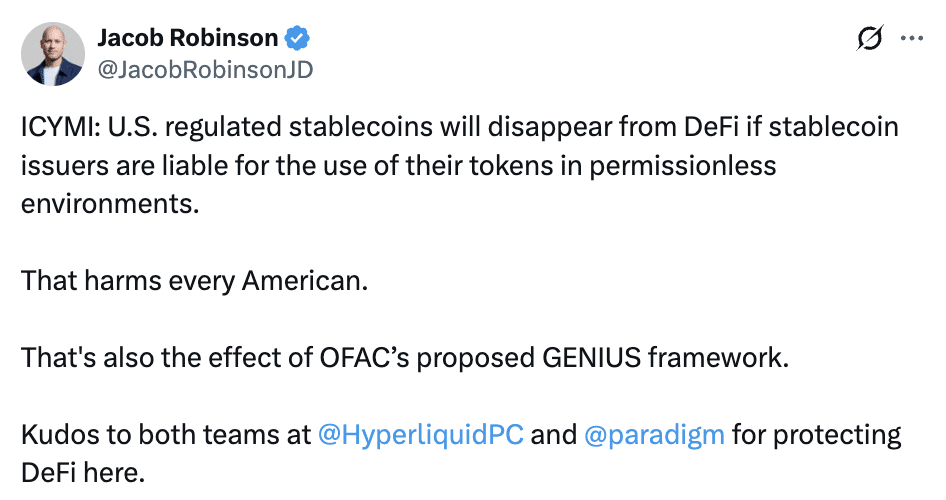 Source: Jacob Robinson/X
Echoing similar sentiments, Brad Bourque, Policy Counsel at HPC, added,
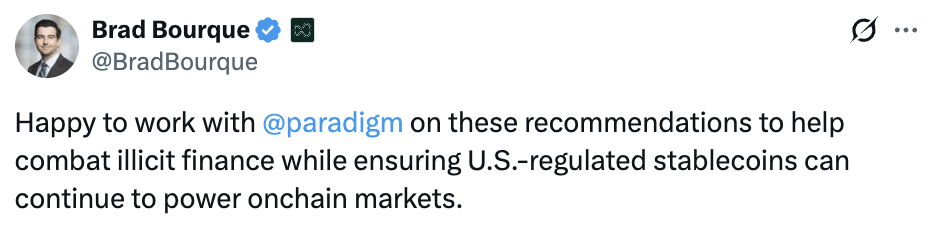 Source: Brad Bourque/X
Main concerns
Here, the primary worry expressed is that the proposed rules of the $GENIUS Act may inadvertently extend them to decentralized blockchain infrastructure and secondary-market activity.
They contend that excessively stringent KYC, sanctions, and monitoring regulations may deter issuers from using permissionless blockchains, impede DeFi innovation, and drive operations offshore.
This comes as a comprehensive new stablecoin regulation framework has been proposed by the New York State Department of Financial Services [NYDFS].
Its purpose is to bring the state’s oversight system into compliance with federal requirements under the $GENIUS Act.
Final Summary
- Their primary concern is that broad compliance regulations may impose regulatory duties on DeFi infrastructure and secondary market participants in addition to stablecoin issuers.
- They urged regulators to keep a clear separation between secondary-market transactions and primary-market activities.