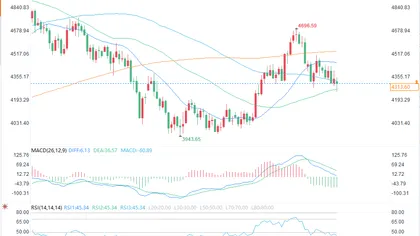
(Kitco News) – Gold is trading firmly below its 200-day moving average as labor market strength and rising inflation reinforce the higher-for-longer rate narrative, which are supporting bond yields and the dollar, with $4,075/oz gold now in play, but long-term fundamentals remain supportive, according to Ole Hansen, head of commodity strategy at Saxo Bank.
In a new update published Tuesday, Hansen noted that gold’s slide below the 200 DMA constitutes an important setback that goes beyond technical damage.
“While the long-term bullish case remains intact, the market is currently being driven by a very different set of forces,” he said. “Since mid-April, gold has increasingly traded as a victim of an energy-driven inflation scare, with investors focusing on rising oil prices, higher inflation expectations, stronger bond yields and a firmer dollar rather than the longer-term themes that helped drive prices to record highs earlier this year.”
Hansen said the latest setback in U.S.-Iran negotiations has only reinforced this dynamic. “As long as the conflict continues to threaten energy supplies and keep inflation risks elevated, investors are likely to remain focused on the prospect of higher-for-longer interest rates rather than gold’s traditional role as a portfolio diversifier,” he wrote, adding that the current supply-driven energy shock does the opposite by lifts inflation expectations, supports the dollar and reduces the scope for monetary easing.
“The break below the 200-day moving average carries significance beyond its technical appearance on a chart,” Hansen said. “For many medium- and long-term investors, the 200-day average serves as an important trend filter. While the level itself has no magical forecasting ability, it is widely used by systematic funds, momentum traders and risk-managed investment strategies when assessing trend direction and exposure. As a result, a sustained break below can trigger position reductions, while also discouraging fresh buying from investors who prefer confirmation that the broader trend remains intact.”
Hansen said traders are now looking for the next level of significant support. “Following the break below the 200-day average, attention turns towards the USD 4,100 to USD 4,075 area, which marks both the March correction low and the 38.2% retracement of the powerful rally that began in 2022 and carried gold close to USD 5,600 earlier this year,” he wrote. “While a decline of this magnitude feels uncomfortable for investors caught on the wrong side of the move, it is worth remembering that in technical terms it still represents a relatively modest correction within a much larger secular uptrend.”
Following this morning’s U.S. CPI report, Hansen said markets will be looking ahead at new Fed chair Kevin Warsh’s first FOMC meeting, which “may provide fresh clues regarding how concerned policymakers are becoming about the inflation outlook.”
Turning to speculative positioning, he said “there are signs that much of the excess optimism has already been removed from the market.”
“Bloomberg-tracked gold ETF holdings have declined by 88 tonnes this year to 3,048 tonnes, although holdings remain 282 tonnes higher than a year ago,” Hansen noted. “Meanwhile, speculative positioning in COMEX gold futures has stabilised after recently falling to a two-year low. Managed money and other reportable traders currently hold a net long position of around 171,000 contracts, up from a recent low near 149,000 contracts, but below the one-year average of 194,000 contracts.”
“With volatility easing and margin requirements falling from recent peaks, the key missing ingredient for renewed demand is momentum,” he added. “At present, momentum remains negative due to the downtrend that has been in place since March.”
For this momentum to return, Hansen said gold prices will need to reclaim $4,500 per ounce before challenging the 50-day moving average near $4,600. “Until then, traders are likely to remain focused on downside risks while longer-term investors wait for a catalyst capable of shifting attention away from inflation fears and back towards the structural drivers that underpin the broader bull market,” he said.
“Ultimately, a durable peace agreement and a normalisation of energy markets remain the most likely catalysts for such a shift,” Hansen concluded. “Only when inflation concerns begin to fade can investors once again refocus on the longer-term themes that have supported gold throughout this cycle: central bank reserve diversification, growing fiscal debt burdens, currency debasement concerns and an increasingly fragmented geopolitical landscape.”