
Bitcoin Now Testing Key Demand Area Following A Triangle Breakdown

By:Newsbtc
Bitget offers one-stop trading for cryptocurrencies, stocks, and gold. Trade now!
A welcome pack worth 6200 USDT for new users! Sign up now!
Bitcoin is testing a key demand zone after breaking down from a symmetrical triangle, putting the market at a critical turning point. While buyers may attempt to defend this support and trigger a rebound, a failure to hold could open the door to further downside in the near term.
Bearish Triangle Breakdown Sends Bitcoin Toward Key Liquidity Zone
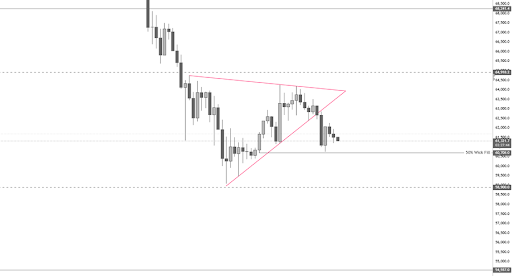
Minga highlighted that the market has experienced a bearish breakout from a symmetrical triangle pattern, and the price is trending toward the 50% wick fill region of the previous weekly candle, an area containing significant untested liquidity and a long limit order that was previously front-ran. While he expects this long position to be filled, the risk on this trade is minimal at 0.25%, effectively serving as a risk-free hedge against his existing short position.

Minga maintains a bullish bias for the remainder of the month, but he emphasizes that this outlook requires technical confirmation, specifically a bounce from the $60,700 level. Losing this key support likely invites further downside, bringing the $58,900 level into focus. Given that the daily trend is showing clear signs of exhaustion, Minga views the $60,700–$58,900 range as a high-probability zone for a potential recovery.
var rnd = window.rnd || Math.floor(Math.random()*10e6); var pid607465 = window.pid607465 || rnd; var plc607465 = window.plc607465 || 0; var abkw = window.abkw || ''; var absrc = 'https://servedbyadbutler.com/adserve/;ID=172179;size=0x0;setID=607465;type=js;sw='+screen.width+';sh='+screen.height+';spr='+window.devicePixelRatio+';kw='+abkw+';pid='+pid607465+';place='+(plc607465++)+';rnd='+rnd+';click=CLICK_MACRO_PLACEHOLDER'; document.write('
');
if (!window.AdButler){(function(){var s = document.createElement("script"); s.async = true; s.type = "text/javascript";s.src = "https://servedbyadbutler.com/app.js";var n = document.getElementsByTagName("script")[0]; n.parentNode.insertBefore(s, n);}());}
var AdButler = AdButler || {}; AdButler.ads = AdButler.ads || []; var abkw = window.abkw || ""; var plc366606 = window.plc366606 || 0; (function(){ var divs = document.querySelectorAll(".plc366606:not([id])"); var div = divs[divs.length-1]; div.id = "placement_366606_"+plc366606; AdButler.ads.push({handler: function(opt){ AdButler.register(172179, 366606, [728,90], "placement_366606_"+opt.place, opt); }, opt: { place: plc366606++, keywords: abkw, domain: "servedbyadbutler.com", click:"CLICK_MACRO_PLACEHOLDER" }}); })();
 Source:
However, the analyst cautions that exhaustion does not inherently guarantee a reversal. Market conditions can often result in a slow, grinding decline as the asset hunts for liquidity on both sides, leading to highly choppy price action. This behavior is historically common near major market turning points.
Given that the market is potentially nearing a macro bottom, the possibility of a prolonged, choppy descent cannot be ignored. Should this scenario materialize and the current support zones fail to hold, Minga identifies the $54,500–$49,000 region as the next critical downside target.
$60,800 Remains BTC’s Most Important Battleground
According to analyst @wangtuai888, whose track record includes eight consecutive accurate trend predictions, the market is currently hovering at a decisive juncture. As long as the $60,800 support holds, the asset remains within an uptrend. However, should the price break and close a 1-hour solid candle below $60,800, which marks a critical Point of Control (POC) and a vacuum zone, the analyst anticipates a sharp, immediate decline.
var rnd = window.rnd || Math.floor(Math.random()*10e6); var pid607472 = window.pid607472 || rnd; var plc607472 = window.plc607472 || 0; var abkw = window.abkw || ''; var absrc = 'https://servedbyadbutler.com/adserve/;ID=172179;size=0x0;setID=607472;type=js;sw='+screen.width+';sh='+screen.height+';spr='+window.devicePixelRatio+';kw='+abkw+';pid='+pid607472+';place='+(plc607472++)+';rnd='+rnd+';click=CLICK_MACRO_PLACEHOLDER'; document.write('
');
if (!window.AdButler){(function(){var s = document.createElement("script"); s.async = true; s.type = "text/javascript";s.src = "https://servedbyadbutler.com/app.js";var n = document.getElementsByTagName("script")[0]; n.parentNode.insertBefore(s, n);}());}
var AdButler = AdButler || {}; AdButler.ads = AdButler.ads || []; var abkw = window.abkw || ""; var plc452518 = window.plc452518 || 0; (function(){ var divs = document.querySelectorAll(".plc452518:not([id])"); var div = divs[divs.length-1]; div.id = "placement_452518_"+plc452518; AdButler.ads.push({handler: function(opt){ AdButler.register(172179, 452518, [728,90], "placement_452518_"+opt.place, opt); }, opt: { place: plc452518++, keywords: abkw, domain: "servedbyadbutler.com", click:"CLICK_MACRO_PLACEHOLDER" }}); })();

Bitcoin Testing A Critical Support After Sharp Market-Wide Selloff
If the $60,800 support holds, @wangtuai888 expects an initial rebound toward $62,400 to break the previous minor high and shift the local market structure. This would be followed by a pullback to the $61,800 POC, which the analyst identifies as a favorable entry point for long positions.
The strategy then pivots toward a tactical shorting opportunity. The analyst intends to initiate a short position near the 63,000 level, noting that even if a stop-loss is triggered, the high reward-to-risk ratio makes this a worthwhile trade.
Ultimately, the analyst emphasizes that this expected rebound should not be mistaken for a full market reversal. The broader direction remains firmly in a downtrend, and the ultimate price target for this bearish cycle is $55,500.
var rnd = window.rnd || Math.floor(Math.random()*10e6); var pid607473 = window.pid607473 || rnd; var plc607473 = window.plc607473 || 0; var abkw = window.abkw || ''; var absrc = 'https://servedbyadbutler.com/adserve/;ID=172179;size=0x0;setID=607473;type=js;sw='+screen.width+';sh='+screen.height+';spr='+window.devicePixelRatio+';kw='+abkw+';pid='+pid607473+';place='+(plc607473++)+';rnd='+rnd+';click=CLICK_MACRO_PLACEHOLDER'; document.write('
');
if (!window.AdButler){(function(){var s = document.createElement("script"); s.async = true; s.type = "text/javascript";s.src = 'https://servedbyadbutler.com/app.js';var n = document.getElementsByTagName("script")[0]; n.parentNode.insertBefore(s, n);}());}
var AdButler = AdButler || {}; AdButler.ads = AdButler.ads || []; var abkw = window.abkw || ''; var plc452519 = window.plc452519 || 0; (function(){ var divs = document.querySelectorAll(".plc452519:not([id])"); var div = divs[divs.length-1]; div.id = "placement_452519_"+plc452519; AdButler.ads.push({handler: function(opt){ AdButler.register(172179, 452519, [728,90], 'placement_452519_'+opt.place, opt); }, opt: { place: plc452519++, keywords: abkw, domain: 'servedbyadbutler.com', click:'CLICK_MACRO_PLACEHOLDER' }}); })();
BTC trading at $61,370 on the 1D chart | Source: BTCUSDT on
0
0
Disclaimer: The content of this article solely reflects the author's opinion and does not represent the platform in any capacity. This article is not intended to serve as a reference for making investment decisions.
Understand the market, then trade.
Bitget offers one-stop trading for cryptocurrencies, stocks, and gold.
Trade now!
You may also like
As chip stocks plummet, "cybersecurity software" surges across the board, CrowdStrike and Palo Alto Networks hit new highs
CrowdStrike surged 13.8% in a single day to a record high, while Palo Alto Networks soared 13%. The software ETF outperformed the semiconductor ETF by more than 10 percentage points in a single day, marking the largest gap in history. Analysts believe that regardless of the pace of AI development, security demand will only continue to rise. Capital is accelerating its rotation from computing hardware to security software, with segments such as identity management and data governance expected to benefit first.
华尔街见闻•2026/09/15 00:16
Altman can afford to wait, but Masayoshi Son can't: OpenAI will not go public this year, exposing a $20 billion gap and a credit weakness for SoftBank.
OpenAI has postponed its public listing, putting its largest external shareholder, SoftBank, in a liquidity crisis. This week, SoftBank is conducting a roadshow in New York, seeking to issue $10-20 billion in bonds to repay the $40 billion bridge loan previously borrowed to increase its investment in OpenAI. According to Bloomberg estimates, SoftBank faces a funding gap of at least $20 billion, and the yield on its existing U.S. dollar bonds has already exceeded 8.5%, with pricing approaching junk status.
华尔街见闻•2026/09/15 00:16
Meeting postponed, gold price drops rapidly
汇通财经•2026/09/14 23:36
The "first metaverse stock" bets on "AI-powered game creation"! Roblox (RBLX.US) competes for creator economy dividends, shares surge nearly 13%
On September 11, after Roblox announced new tools for game developers and features for players at its developer conference, the company's stock price rose by more than 12% on Monday.
智通财经•2026/09/14 23:31

Crypto prices
More
Bitcoin
BTC
$78,119.75
+1.58%

Ethereum
ETH
$2,512.22
+1.11%

Tether USDt
USDT
$0.9998
+0.03%

BNB
BNB
$719.93
+0.45%

XRP
XRP
$1.42
+5.73%

USDC
USDC
$0.9999
+0.00%

Solana
SOL
$102.53
+2.96%

TRON
TRX
$0.3376
-0.10%

Hyperliquid
HYPE
$80.3
+3.65%

Zcash
ZEC
$1,163.54
+9.51%
How to buy BTC
Bitget lists BTC – Buy or sell BTC quickly on Bitget!
Trade now
Become a trader now?A welcome pack worth 6200 USDT for new users!
Sign up now