
Oracle (ORCL) FY2026 Q4 Earnings Beat Expectations: Cloud Infrastructure Soars 93% to $5.8 Billion, Record RPO Hits $63.8 Billion, Raises 2027 EPS Guidance, But $20B Refinancing Sparks Stock Plunge
 Bitget2026/06/11 03:43
Core Highlights:
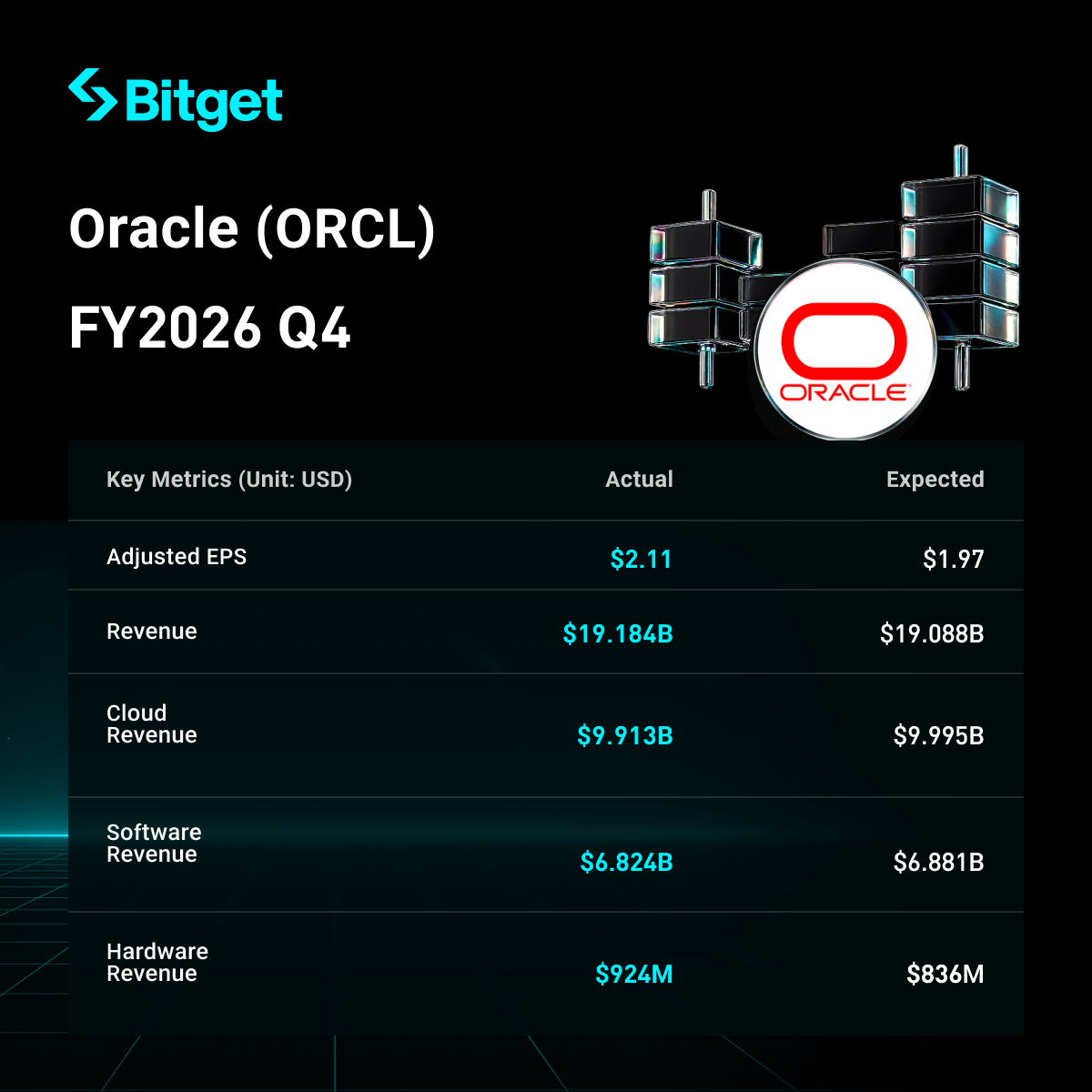
Oracle delivered strong FY2026 Q4 results, with total revenue and cloud infrastructure revenue beating expectations. Remaining performance obligation (RPO) hit a record high and surged significantly, reflecting robust AI cloud demand. The company raised its FY2027 full-year non-GAAP EPS guidance, but plans to raise approximately $40 billion through debt and equity refinancing (including a $20 billion equity offering), triggering market concerns. Shares plunged over 10% in after-hours trading (currently down about 7-10%). Overall, it shows accelerated cloud transformation but notable capital expansion pressure.
Detailed Breakdown:
- Overall Revenue and Profit Performance:
- Q4 total revenue grew 21% year-over-year to $19.2 billion, exceeding expectations of $19.09 billion.
- Non-GAAP operating profit rose 22% year-over-year to a record $8.6 billion.
- Non-GAAP EPS increased 24% year-over-year to $2.11; GAAP EPS rose 21% to $1.45.
- Full-year FY2026 total revenue grew 17% year-over-year to a record $67.4 billion; operating cash flow surged 54% to a record $32 billion; free cash flow was negative $23.7 billion (due to massive cloud infrastructure investments).
- Cloud Infrastructure (IaaS) and Cloud Business Performance:
- Cloud infrastructure (IaaS) revenue skyrocketed 93% year-over-year to $5.8 billion, the primary driver of overall results.
- Combined cloud revenue (IaaS + SaaS) grew 47% year-over-year to $9.9 billion, first time breaking $10 billion.
- Oracle Multicloud AI Database business grew 404% in Q4, the fastest-growing segment in company history.
- Remaining performance obligation (RPO) reached a record $63.8 billion at quarter-end, up $8.5 billion sequentially and 363% year-over-year; largely driven by large-scale AI contracts (including $75 billion in prepayments and customer-supplied hardware).
- Other Business Segment Performance:
- Cloud applications (SaaS) revenue grew 10% year-over-year to $4.1 billion.
- Legacy software revenue declined 2% year-over-year to $6.8 billion (reflecting customer migration to the cloud).
- Services revenue was $1.3 billion, up 13% year-over-year.
- Hardware revenue was $0.9 billion, up 9% year-over-year.
- Capital Expenditure and Financing Plans:
- In FY2026, the company raised $43 billion in debt and $5 billion in equity, totaling $48 billion for AI cloud infrastructure expansion.
- For FY2027, plans to raise approximately $40 billion through a combination of debt and equity, including a $20 billion at-the-market (ATM) equity offering; no additional debt financing planned for the remainder of 2026.
- Adopting clean energy solutions such as natural gas fuel cells, while emphasizing high-performance networking, advanced security architecture, and autonomous software as key differentiators.
- Free cash flow remains negative, reflecting the current high-intensity capex phase.
- Next Quarter and Full-Year Guidance:
- Q1 FY2027 total revenue expected to grow 27%-29% year-over-year; cloud revenue expected to grow 57%-64%.
- Q1 FY2027 non-GAAP EPS expected at $1.72-$1.76, up 17%-20% year-over-year.
- Full-year FY2027 total revenue target maintained at $90 billion; non-GAAP EPS guidance raised to $8.05 (approximately 18% growth, or ~18% excluding one-time gains).
- Board declared a quarterly cash dividend of $0.50 per share, payable on July 24, 2026.
- Market Context and Investor Concerns:
- Positive factors: Surge in large AI deals driving explosive RPO growth, accelerating cloud business, and healthcare AI initiatives (such as AI-powered Cerner system, AI molecular design, and clinical trial systems) expected to drive double-digit growth for Oracle Health in FY2027.
- Core tension: The refinancing plan (especially equity issuance) raised dilution concerns, causing a sharp after-hours stock drop. Despite cloud revenue beating expectations and strong guidance, the market focused more on the pressure from capital expansion on cash flow and equity.
🎉 Limited-Time Promotion: From now until June 30, 18:59, join the “Buy US Stocks, Get NVIDIA for Free” event. Share a $200,000 NVIDIA prize pool. Invite friends for doubled rewards!
Activity details: [Buy US Stocks, Get NVIDIA Free]
Disclaimer: This content is for reference only and does not constitute any investment advice.
Disclaimer: The content of this article solely reflects the author's opinion and does not represent the platform in any capacity. This article is not intended to serve as a reference for making investment decisions.
You may also like
As chip stocks plummet, "cybersecurity software" surges across the board, CrowdStrike and Palo Alto Networks hit new highs
CrowdStrike surged 13.8% in a single day to a record high, while Palo Alto Networks soared 13%. The software ETF outperformed the semiconductor ETF by more than 10 percentage points in a single day, marking the largest gap in history. Analysts believe that regardless of the pace of AI development, security demand will only continue to rise. Capital is accelerating its rotation from computing hardware to security software, with segments such as identity management and data governance expected to benefit first.
Altman can afford to wait, but Masayoshi Son can't: OpenAI will not go public this year, exposing a $20 billion gap and a credit weakness for SoftBank.
OpenAI has postponed its public listing, putting its largest external shareholder, SoftBank, in a liquidity crisis. This week, SoftBank is conducting a roadshow in New York, seeking to issue $10-20 billion in bonds to repay the $40 billion bridge loan previously borrowed to increase its investment in OpenAI. According to Bloomberg estimates, SoftBank faces a funding gap of at least $20 billion, and the yield on its existing U.S. dollar bonds has already exceeded 8.5%, with pricing approaching junk status.
Meeting postponed, gold price drops rapidly
The "first metaverse stock" bets on "AI-powered game creation"! Roblox (RBLX.US) competes for creator economy dividends, shares surge nearly 13%
On September 11, after Roblox announced new tools for game developers and features for players at its developer conference, the company's stock price rose by more than 12% on Monday.

Crypto prices
More


