
Australian Dollar: Limited upside and bearish crosses – TD Securities

TD Securities’ Prashant Newnaha and Howard Du note the Australian Dollar (AUD) has delivered its strongest year-to-date performance in 15 years but now sees constrained upside. They prefer expressing a bearish AUD stance via lower AUD/CAD, citing stronger Canadian data, and maintains a short-dated AUD/NZD fly as weak Australian data and hawkish Reserve Bank of New Zealand (RBNZ) guidance cap AUD/NZD gains.
Bearish AUD views via CAD and NZD
"The AUD has had its best year-to-date performance in 15 years, but we see more limited AUD upside for rest of the year."
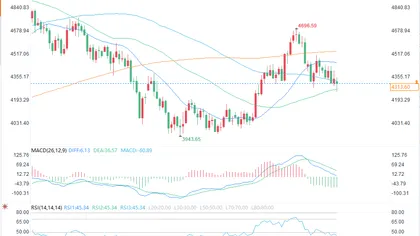
"Slew of weak AU data releases in May has already pushed AUD/USD down from 0.72 to 0.70."
"We see limited AUD upside for rest of the year and prefer to express bearish AUD views via lower AUD/CAD on diverging data."
"In the near-term, we like to express bearish AUD view via lower AUD/CAD."
"Elsewhere on AUD-crosses, we continue to hold short-dated 1.18/1.2050/1.23 AUD/NZD fly as weak AU data and hawkish RBNZ guidance has likely buckled the year-to-date AUD/NZD uptrend."
(This article was created with the help of an Artificial Intelligence tool and reviewed by an editor.)
Disclaimer: The content of this article solely reflects the author's opinion and does not represent the platform in any capacity. This article is not intended to serve as a reference for making investment decisions.
You may also like
BTC, ETH, XRP, ZEC consolidate near highs as breakout levels approach
As chip stocks plummet, "cybersecurity software" surges across the board, CrowdStrike and Palo Alto Networks hit new highs
CrowdStrike surged 13.8% in a single day to a record high, while Palo Alto Networks soared 13%. The software ETF outperformed the semiconductor ETF by more than 10 percentage points in a single day, marking the largest gap in history. Analysts believe that regardless of the pace of AI development, security demand will only continue to rise. Capital is accelerating its rotation from computing hardware to security software, with segments such as identity management and data governance expected to benefit first.
Altman can afford to wait, but Masayoshi Son can't: OpenAI will not go public this year, exposing a $20 billion gap and a credit weakness for SoftBank.
OpenAI has postponed its public listing, putting its largest external shareholder, SoftBank, in a liquidity crisis. This week, SoftBank is conducting a roadshow in New York, seeking to issue $10-20 billion in bonds to repay the $40 billion bridge loan previously borrowed to increase its investment in OpenAI. According to Bloomberg estimates, SoftBank faces a funding gap of at least $20 billion, and the yield on its existing U.S. dollar bonds has already exceeded 8.5%, with pricing approaching junk status.
Meeting postponed, gold price drops rapidly
Crypto prices
More


