
Ethereum Nears 200 Million Non-Empty Wallets Despite Market Uncertainty

Despite persistent market uncertainty and bearish sentiment across parts of the cryptocurrency sector, Ethereum is approaching a significant adoption milestone, with the number of non-empty wallets nearing 200 million. While price fluctuations often dominate investor attention, the steady growth in wallet activity suggests that participation in the ETH ecosystem continues to expand.
How Ethereum’s Expanding User Network Signals Resilience
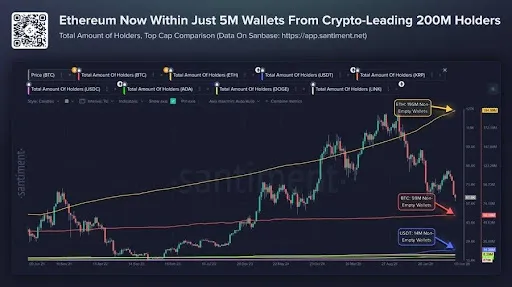
Ethereum is rapidly approaching a major adoption milestone, with the network now approaching 200 million non-empty wallets despite high Fear, Uncertainty, and Doubt (FUD). Santiment Intelligence on X pointed out that the ETH network continues to grow exponentially compared to other top market capitalizations, while facing some of the most negative sentiment in crypto.

The network now boasts approximately 195 million non-empty wallets, significantly outpacing Bitcoin’s roughly 59 million. This represents a lead of more than 230%, a gap that has continued to grow across multiple market cycles. While social media narratives focus on ETH’s recent price underperformance, user adoption continues to move in the opposite direction.
 Source:
ETH now sits just 5 million wallets away from the 200 million milestone. Much of the growth is driven by ETH dominance in Decentralized Finance (DeFi), staking, and broader on-chain activity, where users are not just holding assets but actively participating in the network. Despite the recent crowd sentiment indicators falling into extreme fear territory, ETH’s rising wallet growth suggests that long-term adoption continues to accelerate beneath the surface.
Why Ethereum’s Consolidation May Be A Sign Of Market Maturity
Ethereum’s current market structure may be less a sign of weakness and more a reflection of a natural consolidation process. According to Materkel, ETH remains one of the fastest assets in history to reach a $500 million valuation, even if Anthropic might overtake it depending on when it goes public.

Rather than signalling weakness, this appears to be an extremely healthy consolidation that happens after an asset has experienced a meteoric rise. Materkel argues that a large portion of BitMine’s ETH is most likely coming from long-term holders who invested at sub-$100 levels. Over the past five years, with ETH trading between $1,000 and $5,000, many of these investors have had ample opportunity to realize substantial gains.
Though some of these investors may have lost conviction, they are also sitting on outsized profits for more than 5 years. It’s only natural that they would sell a bit at some point. Historically, many of the world’s most successful assets have experienced lengthy consolidation phases after periods of explosive growth in the stock market. These consolidation periods often lasted 5, 10, or even 20 years, and are frequently accompanied by widespread skepticism before eventually giving way to powerful new expansion phases.
Disclaimer: The content of this article solely reflects the author's opinion and does not represent the platform in any capacity. This article is not intended to serve as a reference for making investment decisions.
You may also like
As chip stocks plummet, "cybersecurity software" surges across the board, CrowdStrike and Palo Alto Networks hit new highs
CrowdStrike surged 13.8% in a single day to a record high, while Palo Alto Networks soared 13%. The software ETF outperformed the semiconductor ETF by more than 10 percentage points in a single day, marking the largest gap in history. Analysts believe that regardless of the pace of AI development, security demand will only continue to rise. Capital is accelerating its rotation from computing hardware to security software, with segments such as identity management and data governance expected to benefit first.
Altman can afford to wait, but Masayoshi Son can't: OpenAI will not go public this year, exposing a $20 billion gap and a credit weakness for SoftBank.
OpenAI has postponed its public listing, putting its largest external shareholder, SoftBank, in a liquidity crisis. This week, SoftBank is conducting a roadshow in New York, seeking to issue $10-20 billion in bonds to repay the $40 billion bridge loan previously borrowed to increase its investment in OpenAI. According to Bloomberg estimates, SoftBank faces a funding gap of at least $20 billion, and the yield on its existing U.S. dollar bonds has already exceeded 8.5%, with pricing approaching junk status.
Meeting postponed, gold price drops rapidly
The "first metaverse stock" bets on "AI-powered game creation"! Roblox (RBLX.US) competes for creator economy dividends, shares surge nearly 13%
On September 11, after Roblox announced new tools for game developers and features for players at its developer conference, the company's stock price rose by more than 12% on Monday.

Crypto prices
More


