
StanChart looks for 3 signs of BTC bottom, including Strategy’s Monday news

Standard Chartered analyst Geoff Kendrick on Friday told clients that he believes crypto asset prices have seen the low in the current cycle and he is looking for confirmation in three indicators: Strategy’s reporting that it bought more Bitcoin last week; crypto exchange-traded funds (ETF) saw positive inflows on Friday; and, oil prices continue to break lower.
“We have now seen the low in crypto asset prices for the cycle. That would be USD59k for BTC (53% down from USD126k high),” Kendrick said in a brief note to clients on Friday. The biggest crypto was last trading on Sunday at about $63,704, according to CoinMarketCap data.
Depending on how investors read Strategy chief Michael Saylor’s near-weekly tweet issued earlier on Sunday, The first sign that Kendrick is watching for may have come.
“Still adding dots,” was Saylor’s message that accompanied the now-familiar dot, or bubble, chart that the Strategy executive frequently includes in his social media posts teasing forthcoming BTC purchases.
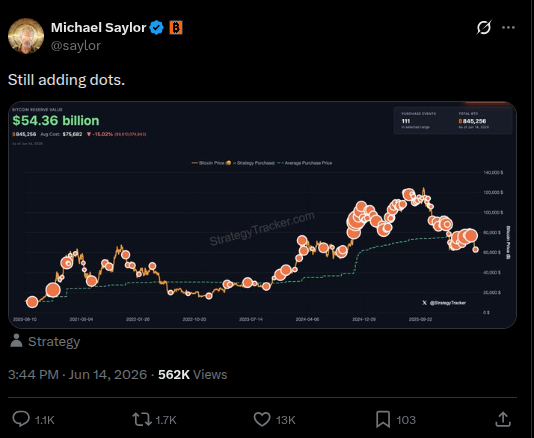
Michael Saylor's tweet on Sunday had more than a half a million views by mid-afternoon, ET. Source: Michael Saylor on X.com
As for the other indicators of a BTC bottom that StanChart’s global head of digital assets research cited, Bitcoin ETFs on Friday posted one-day net inflow of $85.84 million, with investors moving money into five of the funds while eight of the US-traded BTC ETFs had no net change, according to data tracked by SoSoValue.com. Crude oil futures fell on Friday for the second straight day, according to Yahoo Finance data.
Kendrick closed his note with: “Winter is over. Welcome back to crypto Spring.“
Related: Bitcoin sales are necessary for Strategy's digital credit business, Saylor says
Surprise Bitcoin sale defended as “necessary“ defense of digital credit
Strategy disclosed its first reported Bitcoin sale since 2022 in a June 1 filing with the US Securities and Exchange Commission, offloading 32 BTC in a move that appeared at odds with Saylor's long-running “never sell your Bitcoin“ mantra. He defended that sale, saying the ability to sell the asset is necessary to continue issuing “digital credit.“
“If the company's policy is that we won't sell the Bitcoin, then the credit won't have value and the equity won't have value,” he told Cointelegraph at the BTC Prague conference.

Cointelegraph’s Ciaran Lyons (left) and Strategy founder Michael Saylor (right) at BTC Prague. Source: Cointelegraph
Saylor said that Bitcoin treasury companies must retain the ability to sell holdings when necessary to support dividend-paying securities and other BTC-backed credit products.
Magazine: Bitcoin, the ‘canary in the coal mine,’ XRP transaction demand falls 91.5%: Market Moves
Disclaimer: The content of this article solely reflects the author's opinion and does not represent the platform in any capacity. This article is not intended to serve as a reference for making investment decisions.
You may also like
UK weighs tokenized gold reforms – Here’s why the timing matters for crypto
As Anthropic proposes the "AI slowdown theory," AI commercialization is accelerating! From model development to financial advisory, the benefits of AI agents are being realized at a faster pace.
Anthropic is simultaneously advancing frontier AI risk governance and the commercialization of enterprise AI applications, competing with leading AI application rivals such as OpenAI for AI monetization.

BTC, ETH, XRP, ZEC consolidate near highs as breakout levels approach
As chip stocks plummet, "cybersecurity software" surges across the board, CrowdStrike and Palo Alto Networks hit new highs
CrowdStrike surged 13.8% in a single day to a record high, while Palo Alto Networks soared 13%. The software ETF outperformed the semiconductor ETF by more than 10 percentage points in a single day, marking the largest gap in history. Analysts believe that regardless of the pace of AI development, security demand will only continue to rise. Capital is accelerating its rotation from computing hardware to security software, with segments such as identity management and data governance expected to benefit first.
Crypto prices
More


