
Bitget Wallet Research Institute: A Review of the First Lesson in On-chain IPO Launches

The global distribution capability of blockchain is faced with a set of game rules that do not belong to it at the most crucial stage.
Written by: Lacie Zhang, Bitget Wallet Researcher
In November 2021, a group of strangers pooled over $40 million in just a few days in order to buy the first edition of the US Constitution, printed in 1787. This organization, called ConstitutionDAO, eventually lost at Sotheby’s auction to a billionaire hedge fund manager. They brought the money but left empty-handed. For many, that was the first time they witnessed blockchain’s ability to swiftly aggregate retail funds scattered around the globe and direct them towards a unique scarce asset.
Four and a half years later, a similar scene played out again, but the narrative was different.
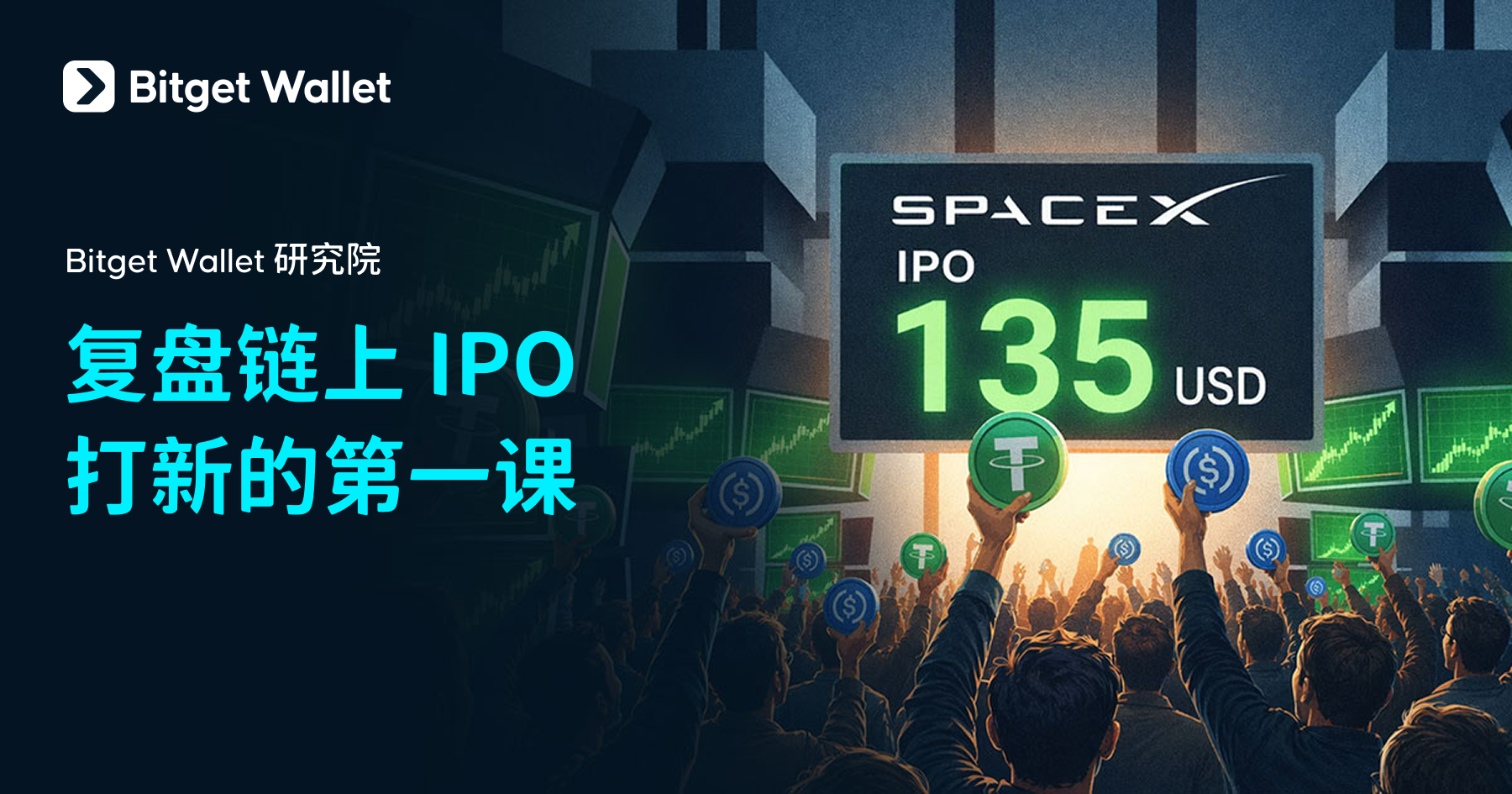
On June 12, 2026, SpaceX (stock code: SPCX) landed on NASDAQ, opening at $150 per share — about 11% higher than the IPO indication price of $135 — marking the strongest IPO in history.
For the vast majority of users, a US stock IPO is almost an invisible barrier. They lack the status of qualified investor, have no traditional brokerage account, and no long-term relationship with underwriters. Blockchain eliminates this barrier: several crypto platforms attempted to bring this highly exclusive scarce asset onchain via tokenization. Bitget Wallet also briefly collaborated with tokenized stock platform xStocks, opening the tokenized subscription for SPCX’s IPO, setting individual investment limits between $10 to $5,000, thus dropping participation thresholds close to zero.
The result was less than ideal. Due to xStocks' upstream underwriting channels failing to secure allocations, the underlying shares for tokenized subscriptions could not be delivered as scheduled, and the attempt ended with a refund.
However, this outcome is actually the best entry point for understanding the reality of onchain Pre-IPOs.
1. The Ultimate Challenge for Tokenized IPOs: Centralized Allocation of Off-Chain Assets
Tokenized IPOs, at their core, tokenize the allocation of traditional brokerage IPO quotas. The core obstacle preventing the industry’s breakthrough lies in the structural mismatch between the traditional IPO allocation system and the distribution capabilities of blockchain.
What tokenized channels achieve is placing the subscription portal onchain: anyone, anywhere, without account opening, can participate using stablecoins. But what cannot be changed is that the allocation decision still lies in the hands of the traditional finance syndicate.
Take SpaceX for example: the joint bookrunners include top investment banks like Goldman Sachs, Morgan Stanley, BofA Securities, Citi, and J.P. Morgan, who are responsible for organizing the order book, aggregating demand, and ultimately allocating quotas.
This allocation logic favors institutions, relationships, and long-term clients. Underwriters prefer large-scale orders and clients who can hold positions steadily. The more scarce and popular an IPO, the stronger this bias. For SpaceX, the IPO was approximately 4x oversubscribed, and BlackRock alone placed $5 billion worth of orders, leaving extremely limited allocations for crypto-native channels.
The outcome: Blockchain has powerful global distribution, but faces a set of game rules that do not belong to it at the most critical stage.
The solution paths are not complicated — but all require time: One is for crypto-friendly institutions to gradually enter the traditional underwriting network, attaining institutional positions in the primary market through proper licensing, capital strength, and long-term track records; the other is to promote onchain-native issuance of assets at source, fundamentally bypassing the existing IPO quota system. Until either path is fully realized, tokenized IPOs will always face a supply-side ceiling.
2. An Imperfect but Meaningful Onchain Stress Test
Despite the unsatisfactory delivery, this industry-wide experiment wasn’t fruitless. It sent real signals on two dimensions: First, that permissionless onchain distribution fully meets the real retail demand for scarce assets; second, the basic infrastructure for onchain distribution is relatively mature and beginning to reveal its potential to reshape traditional IPO participation.
On the demand side. Over $800 million in subscription funds were aggregated in a short period from retail users worldwide, targeting an offering essentially closed off by traditional channels. For assets like SpaceX, geographic restrictions, qualified investor criteria, and brokerage account requirements exclude most people. Blockchain offers a new portal: users don’t need a traditional brokerage account or complicated onboarding — just a wallet and stablecoins. This demand itself won’t vanish because of one failed delivery.
It’s also worth noting that onchain participation allows greater flexibility after allocation. In traditional IPOs, “anti-flipping” constraints are common; new shares allocated and quickly sold may face commission recapture penalties or blacklisting. Tokenized assets typically lack enforced lockups and can be traded freely upon receipt. For retail who have long been troubled by “whether they can get access,” simply “being able to enter and exit freely after participation” represents scarce, real value.
On the execution side. This event served as a real-world stress test for onchain infrastructure. Bitget Wallet, for instance, leveraged its self-developed DEX aggregator and multichain gas sponsor system to expand subscription access to USDC/USDT on 5 different chains — users could participate with stablecoins on any major chain, without cross-chain swaps or concern over native gas tokens, providing robust technical support for totaling over $13 million in onchain subscriptions in less than half an hour.
After delivery failure was confirmed, full refunds (including principal, fees, and FX spreads) were completed within around 4 hours, requiring no user intervention. More importantly, every refund, reconciliation, and status change was recorded as a real onchain, publicly verifiable transaction. Compared to the internal ledgers and manual coordination traditional brokers rely on, the transparency and efficiency advantages of onchain infrastructure were clearly demonstrated in this stress test.
3. Two Ways to Participate in Pre-IPO: Tokenized IPO or Perp?
Since tokenized IPOs cannot yet change the primary market supply, expectations may need to be toned down in the foreseeable future. Permissionless and unlimited supply are hard to achieve; more realistically, the process might offer a “stablecoin-ified” version of the traditional IPO process. When subscriptions exceed quotas, oversubscription, lotteries, proportional allocation, or even full refunds will become normal.
By contrast, another participation mechanism deserves more attention: Pre-IPO perpetual contracts (“Perps”).
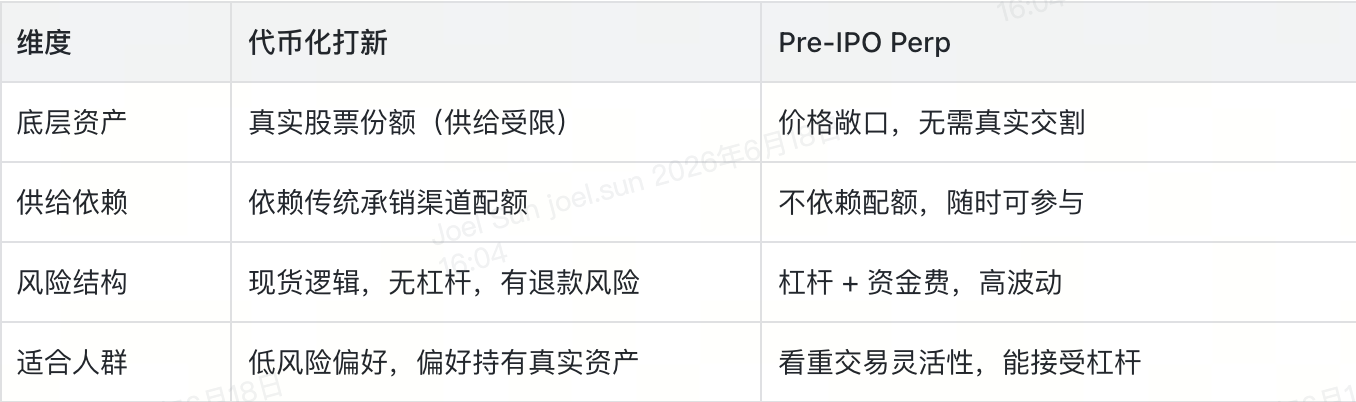
The two tools serve different user profiles. Tokenized IPOs follow a spot logic: they are backed by real underlying assets, suit low-risk users unwilling to endure leverage or funding fee costs, but face supply constraints and may result in allocation lotteries or full refunds. Pre-IPO Perps do not require allocation, do not depend on underwriter distribution, and do not require real share settlement; instead, they allow direct speculation on the expected price of unlisted assets, bringing higher flexibility but also exposure to leverage and high volatility risk.
More notably, Pre-IPO Perps are already showing some price discovery capability. The SPCX Perp has been traded on venues like Hyperliquid 24/7 (UTC+8) since May 18, several weeks before the official June 12 listing. As the official listing approached, its cross-venue volume-weighted average price was about $155, about 15% above the $135 IPO price; the first official trade on listing was $150, demonstrating that the onchain market already converged close to the real price by open. For reference, with Cerebras, Hyperliquid’s Pre-IPO Perp price at listing was just about 1.3% from the official $350 open price.
Evidently, not only can onchain venues achieve price consensus for unlisted assets, but they can also reflect the market’s expectation of the launch price in advance. This ability has already gone beyond mere “IPO participation.”
4. Conclusion
Returning to the auction floor of 2021: ConstitutionDAO lost to higher bids, while SpaceX’s tokenized IPO lost to issues of trust and qualification, with the onchain channel never even having access to the room where allocations were decided.
The reason for failure has shifted from “not bidding high enough” to “not qualified to participate,” moving the problem from execution to structural level. Maturity of onchain infrastructure does not automatically open up the off-chain supply side. These are two different matters progressing on different timelines.
That said, over a longer perspective, such unsynchronized development is far from rare. Every financial infrastructure upgrade — from clearinghouses to electronic trading replacing open outcry — has gone through lengthy periods of coexistence and friction between old and new systems. The traditional financial system will not open IPO allocations just because of one failed tokenized IPO, just as Sotheby’s did not change its auction rules for ConstitutionDAO. Yet friction leaves marks: it changes user cognition, platform capability, and gradually shifts institutional perception of crypto channels.
Perhaps the most significant aspect of this event is not the outcome, but the fact that, inadvertently, every user who participated has now become accustomed to using stablecoins in their wallet to interact with assets that once belonged only to institutions. Once this awareness forms, it’s hard to reverse. By the time the supply-side access structure changes, the demand side — and the infrastructure — will already be prepared.
This post-mortem’s value may lie precisely here: a vague failure has been clarified into a concrete problem, and only concrete problems can be solved.
Disclaimer: The content of this article solely reflects the author's opinion and does not represent the platform in any capacity. This article is not intended to serve as a reference for making investment decisions.
You may also like
AUD/JPY Price Forecast: Holds gains above 110.50, but maintains bearish bias below 100-day SMA
Hollywood Plans "Film Production Reshoring"! US Economic "Soft Landing" Welcomes a $249.1 Billion Film Incentive Blueprint
A study shows that federal incentives for film and television production will bring $249.1 billion in revenue to the U.S. economy by 2035 and add 143,500 full-time jobs. The Motion Picture Association has been working with Hollywood unions to launch a campaign for national incentives to better compete with markets such as the United Kingdom and Australia.

Tonight, a "dovish rate hike"?
The Federal Reserve is almost certain to raise interest rates tonight, but the key issue is "what will be said after the hike." Citi characterizes this move as a "fine-tuning" adjustment, suggesting there is no inevitable future rate hike, yet warns that if Chairman Powell does not provide clear forward guidance, it will trigger significant market volatility. Goldman Sachs bluntly stated that there is insufficient economic foundation for this rate hike, with inflation being merely a one-off factor, and expects this to be a "signal-less rate hike."
JPMorgan: "Open source disruption" and "AI safety" are not issues, there is still room for capital expenditure in the next two years, semiconductor equipment will become the "new bottleneck"
JPMorgan believes that open-source models are not a threat, regulatory disruptions are only short-term, and cloud vendors’ leverage remains low—the fundamentals of computing power investment have not changed. It forecasts that the capital expenditure of the seven major tech giants will soar from $443 billion in 2025 to $1.577 trillion in 2027, with semiconductor equipment becoming the core bottleneck of the supply chain and a new round of price increases expected in wafer foundry and advanced packaging.
Crypto prices
More


