
As the West Hesitates, Asian Investors are Quietly Accumulating Gold

An intriguing rift is emerging in the gold market: while Western investors continue to exit, Asian buyers are rushing in against the trend.
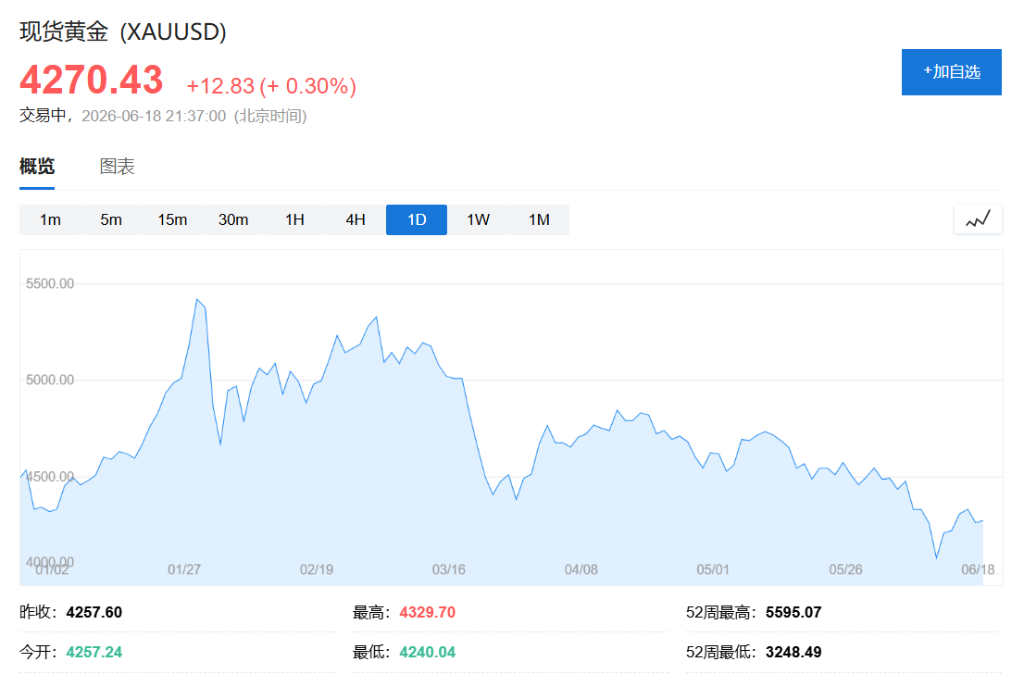
According to an article by Bloomberg macro strategist Simon White, despite a growing sense of caution among US and European investors toward gold, demand in the Asian market remains strong. Gold prices saw a strong rebound near the $4,000 mark last week—although news of an Iran peace agreement had temporarily suppressed prices, Asian buyers did not retreat. This divergence is becoming an important signal for observing the direction of the gold market.
For the market, this divergence in demand between East and West indicates that the structural support for gold is shifting. While funds continue to exit Western ETFs, Asian ETF sizes are expanding rapidly. The sustained divergence in these trends could have profound implications for the medium-term outlook of gold prices.
Continued Outflows from Western ETFs, Temporary Resurgence in Bitcoin's Appeal
Gold is currently trying to find support above the $4,000 level.
Last week, after news of the Iran peace agreement broke, gold prices rebounded strongly from that level, but the pace of Western investor withdrawals did not slow down as a result.
According to Bloomberg, large gold ETFs primarily registered in the US have seen sustained and expanding outflows. Meanwhile, outflows from bitcoin ETFs have begun to stabilize, a comparison that may suggest some investors are redirecting preferences back to cryptocurrencies rather than physical gold.
However, Simon White believes that drawing the conclusion that gold is losing ground based solely on this signal may be too hasty.
Hong Kong and India Lead, Asia Heavily Importing Gold from Switzerland
Asian market demand for gold is being clearly validated through trade data. As the world's largest gold exporter, Switzerland's export flows show that Hong Kong and India are currently the two largest economies importing gold from Switzerland, surpassing all other countries.
This trade data closely matches global ETF position changes. Holdings in US gold ETFs continue to decline, European ETFs remain relatively stable, while Asian gold ETFs are rapidly climbing—with almost no signs of pullback.
Simon White points out that Asian gold ETFs are still smaller than their Western counterparts, but this is likely just the tip of the iceberg of real gold demand in Asia—as evidenced by Swiss export data.
Recent Weakness in Gold Prices Has Not Shaken Asian Buying; The Signal is Significant
In Simon White’s view, Asian investors’ enthusiasm for gold has not waned despite the recent price corrections—this phenomenon itself is a market signal that should not be easily ignored.
While Western investors are hesitating between gold and bitcoin, Asian funds continue to accumulate gold positions in a steady and persistent manner. This resilience of demand shows that Asian buyers’ allocation logic for gold is not reliant on short-term price momentum, but is more likely rooted in deeper asset allocation needs.
For investors focusing on the trajectory of gold, instead of fixating on fund flows in Western ETFs, it may be more valuable to look to Asia—which could be the real driving force behind the next wave of gold prices.
Disclaimer: The content of this article solely reflects the author's opinion and does not represent the platform in any capacity. This article is not intended to serve as a reference for making investment decisions.
You may also like
After the closure of the key bypass pipeline, Saudi Arabia is reportedly seeking to increase crude oil exports via the Strait of Hormuz
After last week's attack in Saudi Arabia, the east-west oil pipeline—with a previous maximum daily crude oil transport capacity of 5 million barrels—was shut down. The U.S. Energy Secretary stated he expects the pipeline to resume operations soon, but regional officials said recovery may take several weeks. Saudi Arabia’s crude oil exports dropped to 3 million barrels per day in August, the lowest in at least nine years, but increased in September. Iran claimed it postponed a meeting regarding Hormuz shipping, originally scheduled for this Monday, at Saudi Arabia’s request. Trump stated that Iran is eager and urgently needs to reach a deal; he will decide if the U.S. will participate, and that the U.S. remains open to the discussion.
Sidney Brewer urges XRP holders to leverage tokens, avoid large sales
The S&P 500 at 7400 or 8000? Why the Future of Stocks Is So Murky. -- Barrons.com
MemeToro Price Prediction: Can $MT Crypto Hit $1 After CEX Listings? 1,373 Code Lines Added to Fair-Launch Development
Crypto prices
More


