
Peace Talks Bring Stability but Fail to Rescue Gold! Geopolitical Concerns and Equity Volatility Deliver Double Blow to Gold Prices

Huitong News, June 19—— US-Iran talks remain stable, but the Swiss agenda has been postponed; geopolitical concerns and ongoing sharp volatility in equity markets continue to penalize gold prices.
During the Asian and European sessions on Friday (June 19), spot gold continued its recent pattern of declining before recovering slightly. Previous articles have pointed out the phenomenon of frequent bullish news but stagnant gold prices and discussed the reasons—readers can refer back to those for details.
At local time June 18 (early morning June 19, GMT+8), US Vice President JD Vance made it clear at a White House press conference that the 60-day negotiation window for the US-Iran memorandum of understanding, signed by President Trump and Iranian President Pezeshkian, has officially opened.
Vance elaborated on the core content of the agreement and the US stance: the blockade of the Strait of Hormuz has now officially been lifted, “last night, 12.5 million barrels of oil passed through the strait,” and Iran has made concrete nuclear commitments, including accepting international oversight, diluting, and destroying its current stockpile of highly enriched uranium, and refraining from developing missiles that pose a broad threat to the world.
He emphasized that, unlike the Obama-era Joint Comprehensive Plan of Action, “this time, the US will not give Iran a penny.” Iran is only allowed to use, in phases, $6 billion in oil revenue stored in Qatar, and solely for purchasing US humanitarian supplies and unsanctioned goods. The release of these funds is directly tied to the progress of strait navigation and negotiation outcomes.
Agreement Implementation and Follow-Up: Blockade Lifted + Long-Term Mechanism, Congressional Notification on the Agenda
Regarding the implementation and subsequent arrangements of the agreement, Vance pointed out that the US has lifted its maritime blockade on Iranian ports,
The agreement plans for Oman, Iran, and the Gulf Cooperation Council to jointly develop a long-term security mechanism for the Strait of Hormuz. “The core is to ensure this international waterway is no longer a global economic chokepoint,” and to oppose any form of transit fee collection.
On the political level, Vance said Congress would be briefed as soon as possible,
He also clarified the US has already destroyed billions of dollars worth of Iranian nuclear infrastructure through military strikes, “firmly holding its economic lifeline,” and will push to establish effective verification and enforcement mechanisms to ensure Iran fundamentally changes its behavior.
Senior US-Iran Statements: Mutual Endorsement, Focus on Cease-Fire and Strait Navigation
Situation Shift: Vance Cancels Swiss Talks, Israeli Military Action Primary Cause
However, as all parties pushed for the deal’s implementation, Vice President Vance’s original plan to visit Switzerland for technical negotiations that night was abruptly cancelled.
Israeli Prime Minister Benjamin Netanyahu made it clear that the Israeli military will “remain stationed in southern Lebanon’s ‘security zone’ as long as security needs dictate,”
Deep Geopolitical Logic: Israel’s Approaching Snap Election and Netanyahu’s Political Calculus
It is reported that Israel’s parliament has decided to hold snap elections, with voting expected between September 8 and October 20, with the exact date to be set by the parliamentary internal committee.
Previous articles have explained that Israel’s core electoral logic is that initiating war produces military achievement—for example, a war can create disputed territory whose temporary occupation provides practical benefits such as water control. Over time, through ongoing conflict, these temporary controls may become long-term occupations.
Looking for Geopolitical Inflection Points—Real Interest Rates Are Fundamental:
Real interest rates are roughly equal to nominal interest rates minus inflation expectations. During the US-Iran event, nominal rates were pushed up by global US Treasury selloffs for dollar exchange and AI-driven expectations for massive capital expenditure—the pressure was structural. War-induced inflation expectations spike at the start but quickly fall back.
This meant that throughout the US-Iran event, the overall real interest rate kept rising, suppressing the holding cost of gold. At the same time, higher returns in US Treasury and US equities led to a diversion of investment funds away from gold, thus shifting gold’s trajectory into a downtrend—characterized by small rises with stocks and sharp falls when equities correct. As for the impact of central banks on gold prices, that is more medium- to long-term; readers can refer to previous articles for an in-depth discussion.
Technically, gold remains in a descending channel, with a typical sell-the-rally pattern characterizing the downtrend.
The 0.618 Fibonacci retracement near 4025 remains a key support; resistance is near the 5-day moving average and the midline of the descending channel.
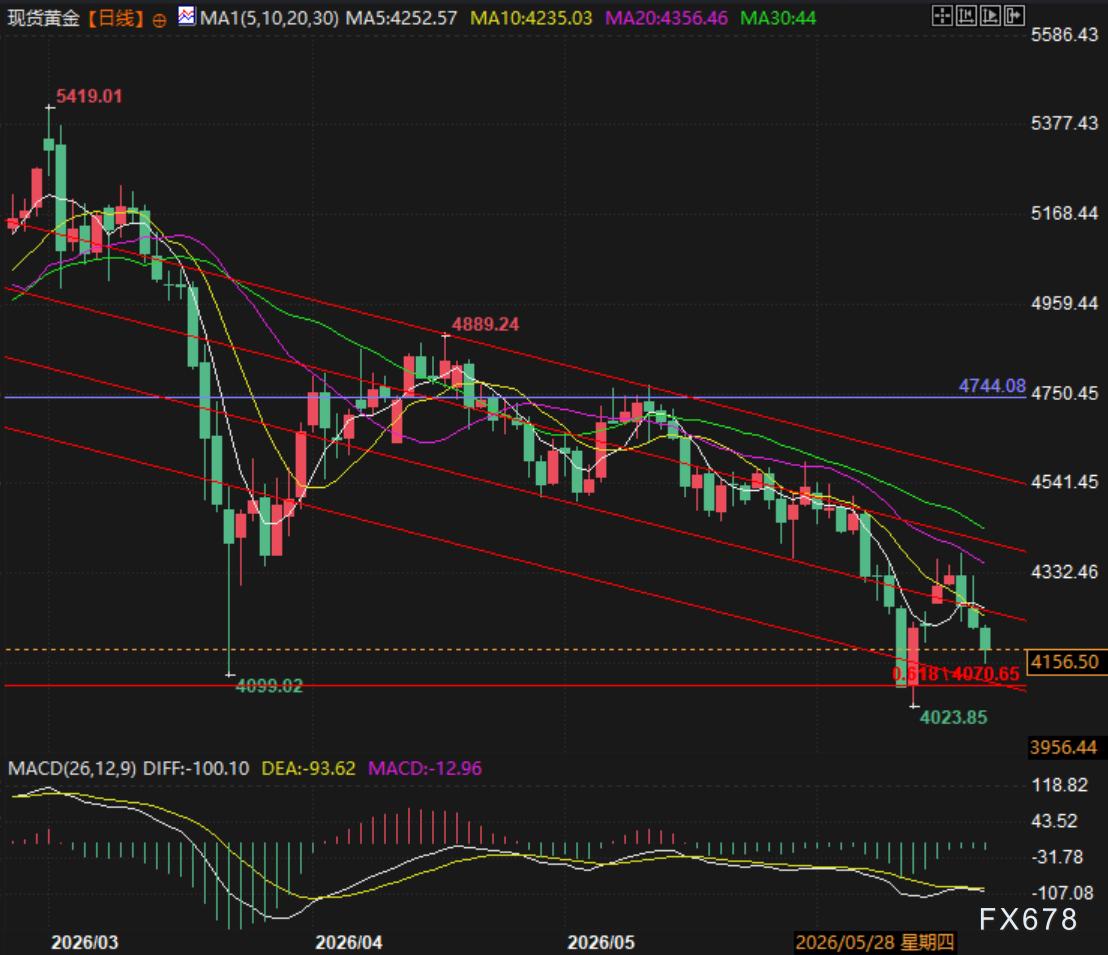
(Spot gold daily chart, source: Yihuitong)
At 15:51 (UTC+8), spot gold was quoted at $4,155/oz.
Disclaimer: The content of this article solely reflects the author's opinion and does not represent the platform in any capacity. This article is not intended to serve as a reference for making investment decisions.
You may also like
MemeToro Price Prediction: Can $MT Crypto Hit $1 After CEX Listings? 1,373 Code Lines Added to Fair-Launch Development
Here is the revised Clarity Act ethics provision Donald Trump has agreed to
HYPE price stays above $80 as ETF inflows and network activity climb
Gold gets squeezed by 5% Treasury yields as FOMC week begins
Crypto prices
More


