
Is the "Waller's debut" a "once-in-a-decade turning point"? Nomura: Beware of "preventive rate hikes" turning into "substantive tightening"

Nomura Securities Chief Macro Strategist Naka Matsuzawa believes that, in hindsight, the Federal Reserve's June FOMC meeting may prove to be a "once-in-a-decade turning point," namely the inflection point of the credit cycle and the beginning of the end of the AI boom.
According to Chase News Desk, in a macro strategy weekly report released on June 19, Naka Matsuzawa, Chief Macro Strategist at Nomura Securities, stated that the market currently overestimates the risk of a Fed rate hike this year, but seriously underestimates the risk of the longer-term path of rate hikes.
He warns that the one or two rate hikes currently labeled as "precautionary" by both the market and the Fed carry a substantial risk of evolving into a systemic tightening cycle. If so, it would have profound impacts on the credit cycle.
The core basis for this assessment is that Matsuzawa expects AI-related investments and AI-driven productivity gains will drive economic growth and inflation beyond the Fed's expectations. Should this scenario materialize, the yield on 10-year U.S. Treasuries could surge well above 5%.
The FOMC's signals have not been fully digested by the market
Matsuzawa points out that the market has not fully absorbed the information delivered at this FOMC meeting, and to some extent, this is not surprising.
This is because the FOMC's most crucial member, the new Chair Walsh, has spoken very little to date and did not include their own rate projections in the dot plot. He is especially focused on two points:
- First, the urgency and triggers for Fed rate hikes;
- Second, the actual possibility of the Fed initiating rate hikes.
He concludes that the market overestimates the former, while the underestimation of the latter is of greater concern.
Matsuzawa expects that in the coming week, speeches from Fed officials with a more neutral or dovish stance, including Christopher Waller and John Williams, will help alleviate market concerns about the urgency of rate hikes within this year.
However, on the more crucial issue of the depth and persistence of the rate hike path, no new substantive information will be forthcoming in the near term. The next significant test point will be the U.S. employment data released on July 2.
Dot plot logic is self-contradictory—can the "insurance rate hike" framework hold?
The median forecast of this FOMC's dot plot indicates one rate hike in 2026, and one rate cut each in 2027 and 2028.
This path raises a direct logical question: If the Fed plans to cut rates in the future, why raise rates now?
Matsuzawa's interpretation is that members advocating for a rate hike this year (mainly likely to be regional Fed presidents) characterize this hike as purely an "insurance operation."
The logic is that a single preemptive rate hike is sufficient to prevent overheating in the economy and inflation, while stabilized oil prices and other factors will eventually open up room for future rate cuts back to the neutral rate of 3.1%.
This moderate framework is supported by the economic forecasts of this meeting:
- Economic growth rates from 2026 to 2028 are projected at 2.2%, 2.3%, and 2.2% respectively, with almost no change;
- Unemployment rate forecasts are 4.3%, 4.3%, and 4.2%, barely touching full employment (4.2%) by 2028.
- The lower bound of the 2028 unemployment rate forecast is 4.0%, implying that almost no member is worried about economic or inflation overheating.
Matsuzawa believes the Fed will hold steady in 2026. He thinks that, once Walsh's policy stance becomes clear or inflation expectations stabilize (e.g., with further declines in oil prices), the market's current pricing of around 1.5 rate hikes this year could be rapidly revised or even erased.
Biggest risk: Preemptive rate hikes slipping into a substantial tightening cycle
However, Matsuzawa holds a completely different view for the longer-term path. He is skeptical of the Fed's consensus assumption that "the economy and inflation will not overheat before 2026."
The research report notes that the continued expansion of AI-related investments and the productivity boost from AI (i.e., increased real incomes) will accelerate economic growth and inflation beyond the Fed’s expectations.
If this happens, the Fed will not stop at one or two insurance rate hikes, but will be forced to enter a conventional tightening cycle to curb economic and inflation overheating, or the market will price in this path in advance.
Historical data provides a reference: During the recent rate hike cycle from 2022 to 2023, the 2-year real yield, which reflects policy rate expectations, once exceeded 3.0%, before falling back after the SVB impact triggered financial turmoil and an economic slowdown.
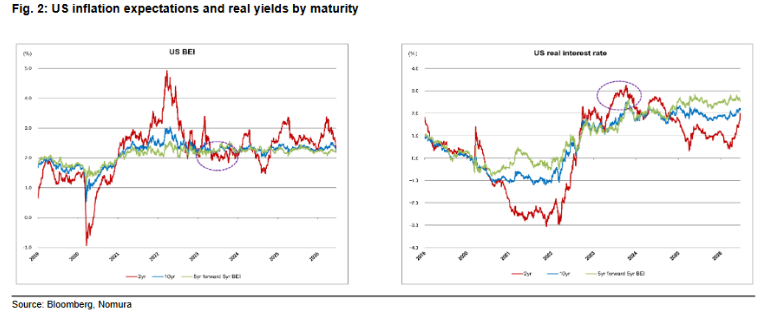 (Inflation expectations and real yields of U.S. Treasuries with different maturities)
Currently, the 2-year real yield is around 2.00%, indicating the Fed has at least 100 basis points of rate hike room left. Matsuzawa warns that if such a scenario truly unfolds, the 10-year U.S. Treasury yield is highly likely to rise well above 5.00%.
The credit cycle implications of a "once-in-a-decade turning point"
In his report, Naka Matsuzawa raises a more macro, structural proposition: Looking back, this FOMC meeting may prove to be a "once-in-a-decade game changer," i.e., the beginning of the end for the AI-driven credit cycle.
His core logic is that the AI boom will not end naturally; only a genuine start to Fed rate hikes can end it.
From another perspective of the credit cycle, the end of the AI boom simultaneously means the bond market will "discover the real neutral rate" and thus break away from its structurally downward trend.
Currently, the market has priced in the timing of rate hikes earlier than Matsuzawa previously expected, but the shape of the hike path (up first then down, ultimately returning to the starting point) shows that the market still regards this round of rate hikes as a one-off preemptive move.
If this assessment proves wrong, the entire evolution logic of the credit cycle will be thoroughly rewritten.
~~~~~~~~~~~~~~~~~~~~~~~~
Disclaimer: The content of this article solely reflects the author's opinion and does not represent the platform in any capacity. This article is not intended to serve as a reference for making investment decisions.
You may also like
XRP ETF Expands Regulated Investor Access

Strive lifts bitcoin holdings to 25,000 BTC after $36 million purchase
Fed Set to Raise Rates This Week, Signal Another Hike Later in 2026, UBS Says
Vitalik Buterin’s AI warning could become crypto’s next bearish catalyst in Q4
Crypto prices
More


