
Euro: Rate Hikes May Not Change the Euro's Weak Trend

I. The Intention to Raise Interest Rates is Very Clear
Since the establishment of the Eurozone, the European Central Bank (ECB) has almost always lagged behind the Federal Reserve in both raising and cutting interest rates. However, after four years, this time the ECB has raised interest rates ahead of the Fed, and gave the market ample time and expectations for pricing in advance. As a result, the post-rate hike EURUSD rebound was less than 100 points. Thanks to the positive news about significant progress in US-Iran negotiations on Monday morning, it barely managed to stay above the 1.16 mark.
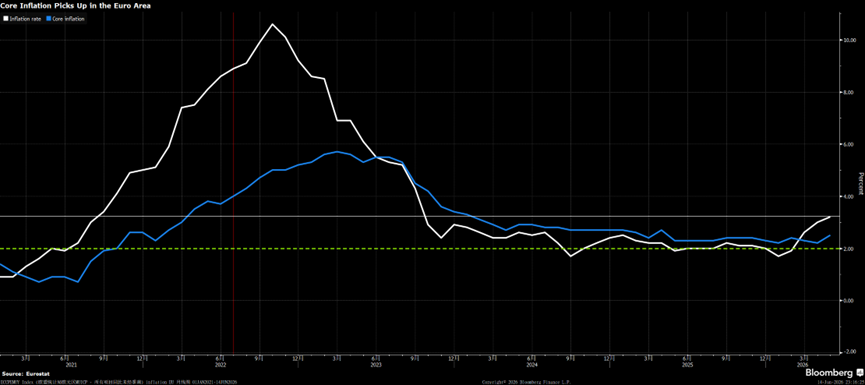
The reasons for the euro rate hike are also very clear. The ECB is afraid that the ongoing US-Iran conflict will lead to a further sustained rise in commodity prices, causing inflation in the Eurozone to spiral out of control again. Even though raising rates may harm the already fragile Eurozone economy, controlling inflation in advance is prioritized. From the current overall inflation and core inflation levels, they are at the levels of August and December 2021, which are far below the levels seen during the 2022 rate hike. However, the continued month-on-month rise has made the ECB very uneasy.
Eurozone Core Inflation Continues to Rise
II. It Cannot Change the Weak Euro Trend
In the future, it will be difficult for the euro to replicate the 2022-2023 market trend, in my opinion.
1. If the US-Iran conflict does not end (currently there is a basis for a short-term agreement), global commodity prices will continue to rise. There is a certain probability that the Fed will also follow up with rate hikes. Since the US economy is more resilient than the Eurozone and better able to withstand shocks, the safe-haven property of the dollar will continue to play a role. Even if the Fed is more cautious with its interest rate policy, it is also uncertain whether the Eurozone can withstand the market's expectation of a 75bp rate hike this year.
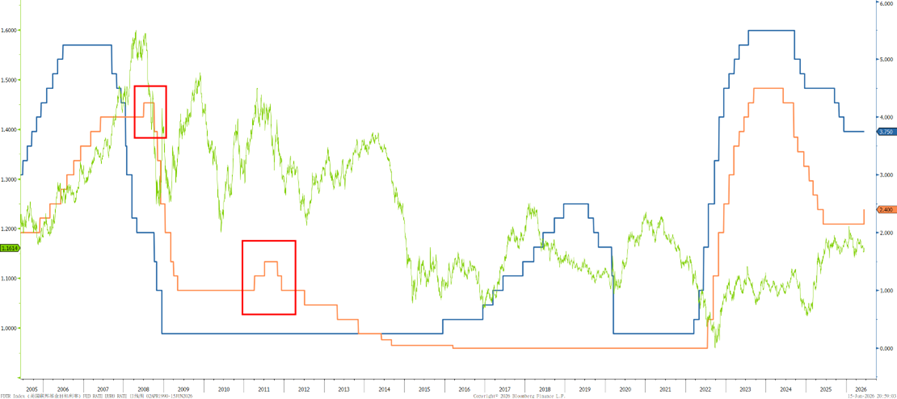
2. Assuming the US-Iran conflict ends quickly or an agreement is reached and both sides abide by it, with Israel not adding trouble, commodity prices will fall (with some delay—generally expected by the market in several months or even quarters). The likelihood of further ECB rate hikes will decrease, which would have limited medium-term support for the euro. In addition, the ECB has twice rapidly cut rates shortly after briefly raising them, in 2008 and 2011. While the probability of a similar economic or financial crisis occurring soon is relatively low, as inflation drops, there is a considerable chance the ECB will pause rate hikes.
In 2008 and 2011, the ECB quickly switched to rate cuts after briefly raising rates
No matter which scenario unfolds, in the medium term, the euro's trend remains weak.
III. At the Trading Level, Does a Bearish Outlook Mean It's Time to Short?
Anyone who has been involved in trading understands that often, being bearish does not automatically mean you go short, because you have to consider the risk-reward of shorting.
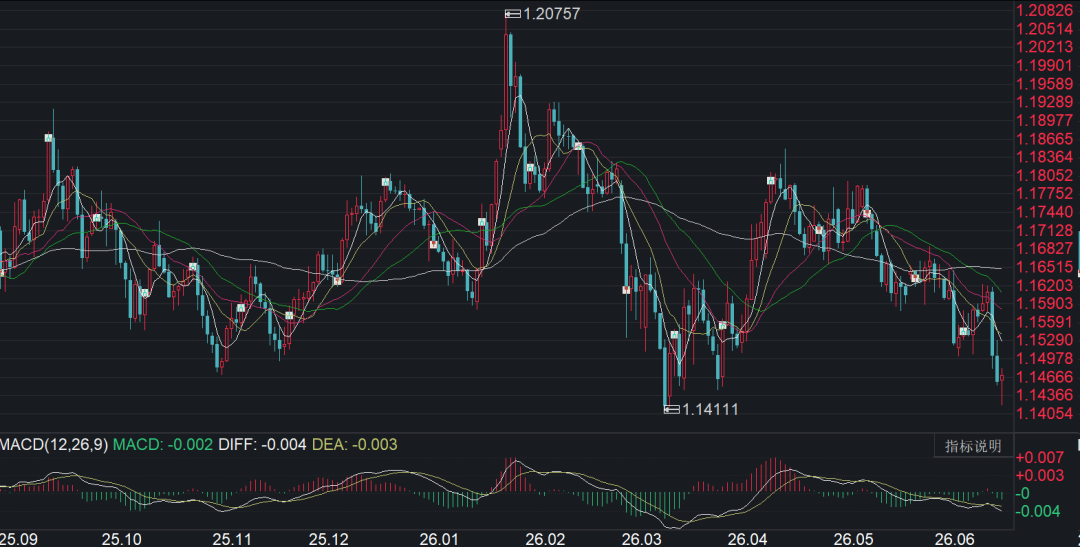
Currently, EURUSD has already dropped below the critical 1.15 level. In my view, the previous year's low of 1.14 will be the next key support. If the pair continuously fails to break 1.14, from a risk-reward perspective, it may be more prudent to wait for a move above 1.17 to initiate euro shorts.
EURUSD has now fallen below 1.15
From a corporate perspective, there is a possibility that both the RMB and USD could remain strong this year, but the realization of RMB appreciation expectations remains uncertain in terms of timing and magnitude. Against this backdrop, euro-receiving enterprises face greater market risk, and it is difficult to time EURCNY trades precisely. A hedging strategy combining EURUSD + USDCNY or using options with forwards/spots/swaps can be considered to mitigate risks.
Disclaimer: The content of this article solely reflects the author's opinion and does not represent the platform in any capacity. This article is not intended to serve as a reference for making investment decisions.
You may also like
Strive lifts bitcoin holdings to 25,000 BTC after $36 million purchase
Fed Set to Raise Rates This Week, Signal Another Hike Later in 2026, UBS Says
Vitalik Buterin’s AI warning could become crypto’s next bearish catalyst in Q4
Bitcoin rebounds above $77,500 as MVRV momentum oscillator signals bullish shift
Crypto prices
More


