u.today
Shiba Inu is getting close to a crucial on-chain milestone that might have a big impact on the token's future price movement.
Recent blockchain data indicates that $SHIB exchange reserves are returning to the 80 trillion token threshold, which traders have historically kept a close eye on because of its connection to market liquidity and possible selling pressure.
Shiba Inu inflows flip
According to the most recent data, exchange reserves have reached one of the highest levels in recent months, at about 80.5 trillion $SHIB. In the most recent reporting period, more than 959 billion $SHIB entered trading platforms, indicating a sharp increase in exchange inflows. Because tokens moved to exchanges are typically thought to be more likely to be sold than assets kept in private wallets, such movements frequently draw attention.
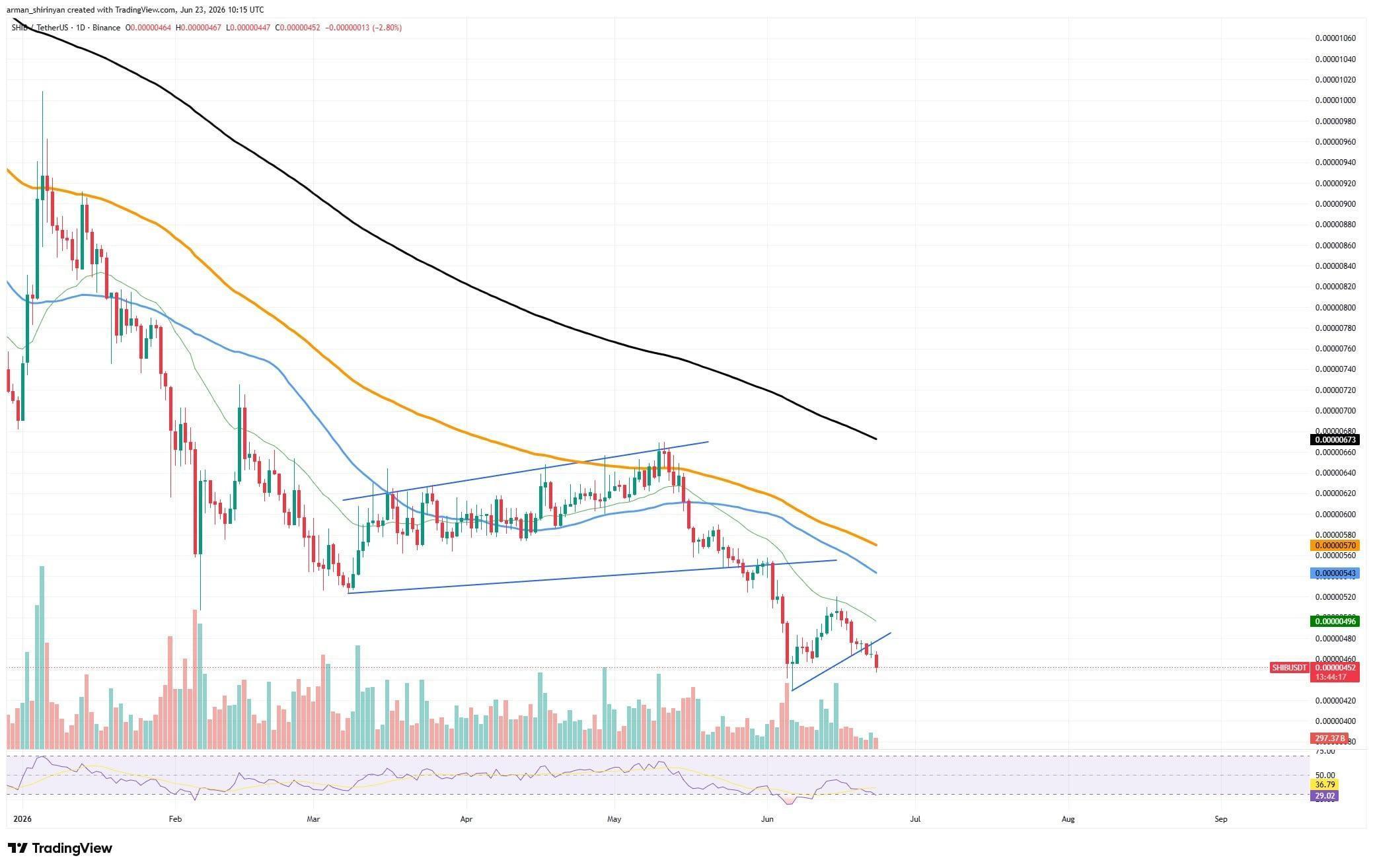 $SHIB/USDT Chart by TradingView
Given $SHIB's current technical state, the timing is especially crucial. The token is still stuck below all significant moving averages after recently breaking below a rising wedge formation. The price is currently trading close to $0.0000045, and the 50-, 100-, and 200-day moving averages are still much higher, supporting the overall downward trend.
Rising exchange reserves have historically had conflicting effects on $SHIB. Large reserve increases have occasionally preceded waves of selling pressure, as investors transferred tokens to exchanges in an effort to increase profits or reduce exposure. In other cases, increased reserves did not cause significant drops; rather, they simply represented increased market participation and better liquidity conditions.
The larger market environment is what distinguishes the current situation. After months of weakness, $SHIB is already trading close to local lows, indicating that many speculative holders have already sold their positions. Therefore, another significant selloff is not necessarily ensured by the return of the 80 trillion reserve threshold.
Exchange activity matters
It does, however, heighten the significance of closely monitoring exchange activity. If reserves keep increasing in tandem with faster inflows, traders might see this as a sign that more supply is getting ready to hit the market. On the other hand, the market may absorb the available liquidity without suffering major negative effects if reserves stabilize while prices start to rise.
Technically and fundamentally, $SHIB is still under pressure as of right now. Although the return of the 80 trillion reserve level is a significant change in on-chain dynamics, it is not necessarily a bearish event on its own. $SHIB's next big move will probably depend on whether it becomes a source of selling pressure or merely a sign of increased market activity.