

Bitwise crypto fund Head of Research André Dragosch has published archival data confirming that Satoshi Nakamoto intentionally protected his multibillion-dollar fortune from future quantum computers. After studying the historical correspondence of Bitcoin's creator, Dragosch supported analyst Marco Battistoni's investigation that the splitting of the capital across 22,000 small wallets was not an accident, but a deliberate defensive strategy.
Marco Battistoni's investigation is based on the famous "Patoshi pattern" — the proven structure of Bitcoin's early mining activity. According to it, the creator's personal fortune of 1.1 million coins was never consolidated and remains distributed across more than 22,000 independent addresses, each holding exactly 50 BTC.
Why quantum attacks on Satoshi's wallets are too expensive
Since in the earliest versions of the network, wallet public keys were visible on the blockchain from day one, a single address with a multibillion-dollar balance would have become an easy and highly attractive jackpot for a powerful quantum computer. Nakamoto anticipated this attack vector and turned the vulnerability into an economic dead end.
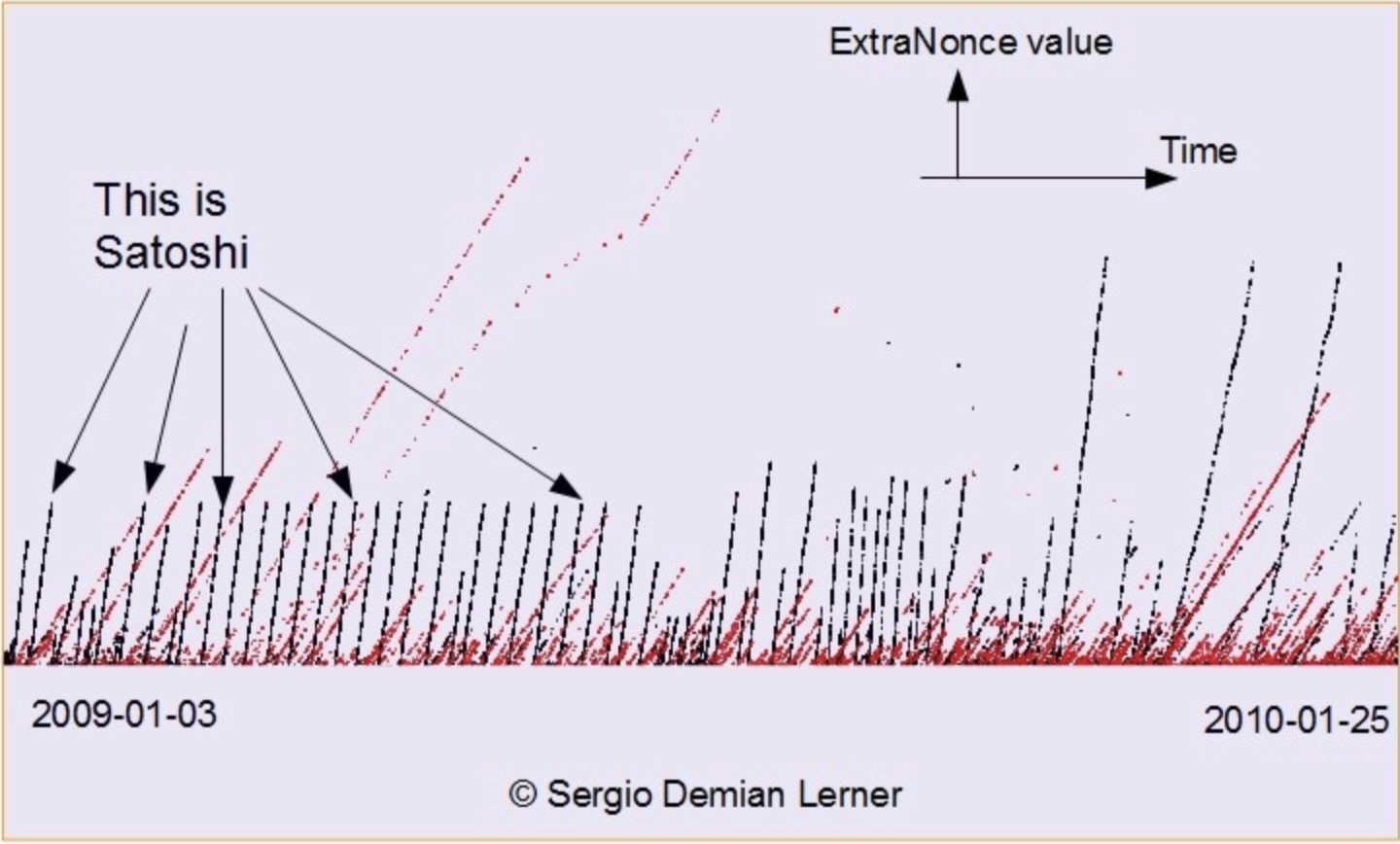 Patoshi pattern addresses, Source:
Sergio Demian Lerner
Patoshi pattern addresses, Source:
Sergio Demian Lerner
To steal all the coins, attackers would have to break into each wallet separately, repeating an extremely complex computational cycle more than 22,000 times. Battistoni emphasizes that the time, energy, and hardware costs of such a marathon would be so enormous that extracting small portions of Bitcoin one step at a time would never justify the attackers' resources.
Satoshi's math vs. BIP-361
The new data appeared amid a sharp split among Bitcoin developers over BIP-361, a proposal regulating the transition to post-quantum signatures. The document sets a deadline after which the network would stop accepting old digital signatures. According to its authors, all inactive BTC from the early era whose owners fail to move them to new wallets in time should be permanently frozen and excluded from circulation for the sake of the broader market's security.
Part of the developer community, including Blockstream CEO Adam Back, has already sharply criticized BIP-361. Opponents of the fork argue that forcibly depriving people of access to their lawful coins would destroy Bitcoin's core law — the absolute inviolability of private funds and independence from decisions imposed by others.
As the main argument against forced freezing, André Dragosch published a screenshot of a forum post by Satoshi Nakamoto from July 2010, in which, responding to users' panic over the threat of cryptographic attacks, he calmly stated: "If it happens gradually, we'll have time to transition to something stronger."
 Satoshi replying to user concern about signatures compromise back in 2010, Source:
Bitcointalk
Satoshi replying to user concern about signatures compromise back in 2010, Source:
Bitcointalk
If users eventually simply move their coins to new protected addresses, Satoshi's own distributed network of wallets will remain in the blockchain as a passive global security sensor — a "canary in the coal mine." The first attempt to break even one of these ancient addresses would become an instant signal that a working quantum weapon has been created.
For now, however, the investigation confirms that an artificial freeze through BIP-361 is not required, because Satoshi's trap protects the network by itself.


