
BIS warns stablecoins risk fragmenting global financial system

The Bank for International Settlements (BIS) warned that the rapid expansion of stablecoins risks fragmenting the global monetary system and weakening sovereign monetary control, urging central banks and the financial industry to accelerate the development of tokenized forms of central bank and commercial bank money as a safer alternative.
In its Annual Economic Report published Sunday, the Basel-based institution delivered a sharp assessment of the approximately $316 billion stablecoin market, arguing that tokens pegged to fiat currencies lack the institutional features required to serve as safe, reliable money at scale.
BIS pointed to structural vulnerabilities in reserve asset management and warned that a significant migration from commercial bank deposits into private digital tokens could reduce bank funding and constrain credit to the real economy.
The report also provides a signal to policymakers that the current regulatory approach to stablecoins may prove insufficient if private digital currencies continue expanding. Rather than positioning stablecoins as a durable foundation for the future monetary system, BIS said that tokenized commercial bank deposits, combined with tokenized central bank money operating on regulated infrastructures, offer a more robust path toward modernizing payments while preserving monetary stability.
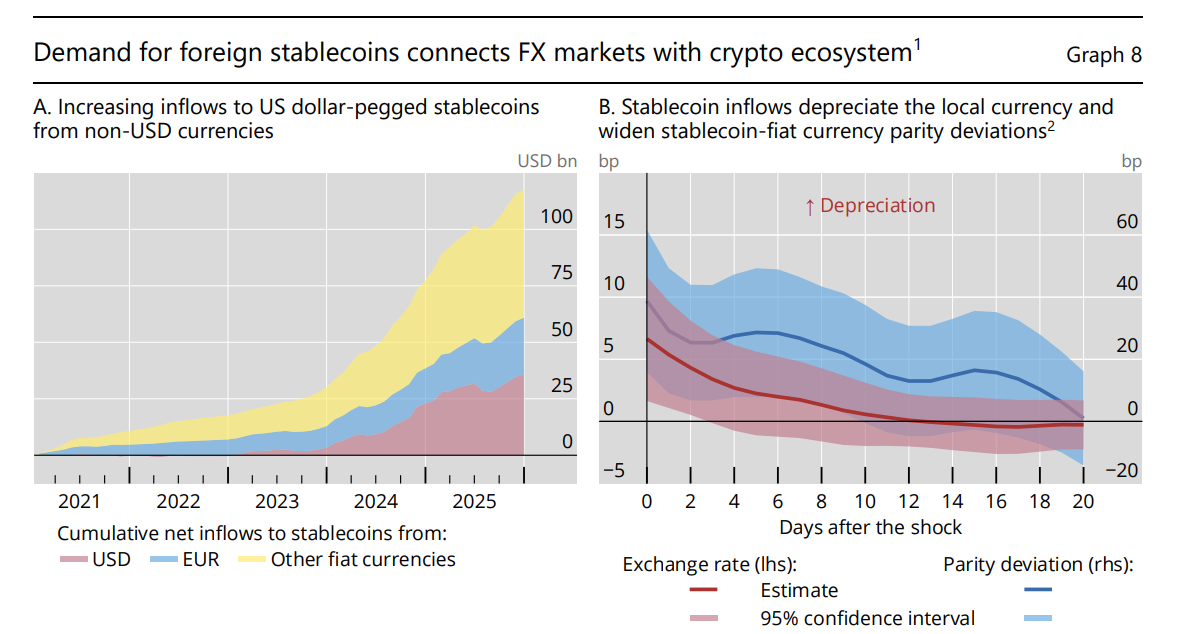
Demand for foreign stablecoins connects FX markets with crypto ecosystem. Source: BIS Annual Economic Report 2026.
The report focuses particular attention on "stablecoin dollarization," that is, the growing use of dollar-denominated stablecoins in economies with weaker domestic currencies. According to BIS, this trend could weaken monetary sovereignty, erode the effectiveness of domestic monetary policy, reduce bank intermediation and increase exposure to volatile cross-border capital flows, particularly in emerging market economies.
Related:
BIS raises fresh concerns about public blockchains' limits
The report also delivers one of BIS's strongest critiques yet of public permissionless blockchains such as Bitcoin and Ethereum as a foundation for the monetary system. It argues that decentralized networks relying on distributed validation and lacking a central governance structure struggle to meet the requirements for scalability, legal accountability and settlement finality expected of systemically important financial infrastructure.
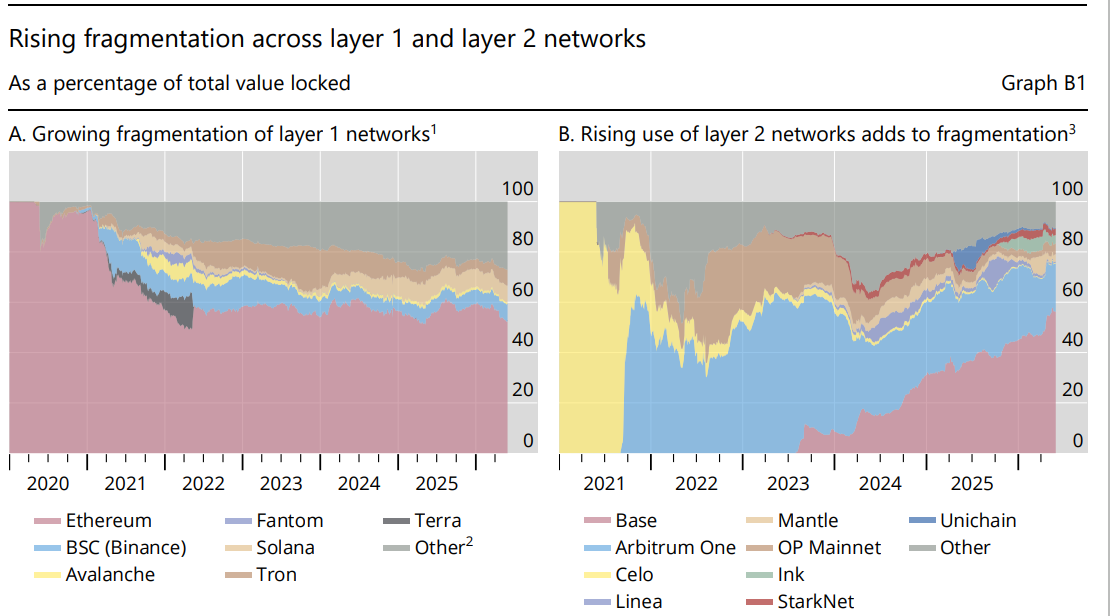
BIS raises concerns on rising fragmentation across layer 1 and layer 2 networks.
Source: BIS Annual Economic Report 2026.
At the center of BIS's critique is the economics of decentralized consensus. The report argues that public permissionless blockchains compensate validators through transaction fees that rise as network activity increases, making congestion, longer confirmation times and higher costs structural features of the system rather than temporary technical shortcomings. According to BIS, these characteristics undermine the efficiency and network effects that are essential for a unified monetary system.
The Basel-based institution further argues that permissionless blockchains lack the clear governance and accountability frameworks required for institutional finance. Without an identifiable entity responsible for maintaining the integrity of the system, resolving disputes or ensuring compliance with financial integrity standards, BIS contends that such networks face significant obstacles to supporting large-scale regulated financial activity.
Rather than rejecting tokenization itself, BIS advocates a "unified ledger" architecture that combines tokenized central bank money, tokenized commercial bank deposits and tokenized financial assets on programmable platforms operating within regulated legal and institutional frameworks.
By preserving the benefits of tokenization, including programmable transactions and faster settlement, while maintaining the institutional foundations of the existing monetary system, BIS said that financial markets can improve efficiency without sacrificing monetary stability, financial integrity or public trust.
Related:
Disclaimer: The content of this article solely reflects the author's opinion and does not represent the platform in any capacity. This article is not intended to serve as a reference for making investment decisions.
You may also like
As global tungsten prices surge, U.S. mining company Almonty Industries (ALM.US) quickly acquires a tungsten mine in Rwanda to ease supply shortages.
U.S. mining company Almonty Industries has signed a tungsten mining agreement in Rwanda, expanding Western supply.


Novo Nordisk (NVO.US) renamed to "Novo" for a fresh start—Can multi-line breakthroughs dispel the shadow over its stock price?
Danish pharmaceutical company Novo Nordisk (NVO.US) has launched a comprehensive rebranding centered around the shorter name "Novo." The company will use "Novo" in daily brand promotion, but its legal name will remain Novo Nordisk A/S.

High interest rates are not the "end" of US stocks? Is profitability the real key?
JPMorgan believes that profit growth is the key factor determining the resilience of U.S. stock valuations. Data since 1950 shows an "inverted U-shaped" relationship between the 10-year U.S. Treasury yield and S&P 500 valuations. Based on current profit levels, yields would need to reach about 5%-6% to significantly compress valuations. As long as profit growth remains above 15%, there is still room for valuations to be re-rated. If the yield curve steepens in a bear market, cyclical sectors such as energy and financials will benefit more; if it flattens, technology stocks will have a relative advantage.
Crypto prices
More


