
Oil prices fall to pre-war levels, why aren't US interest rates following?

Morning FX
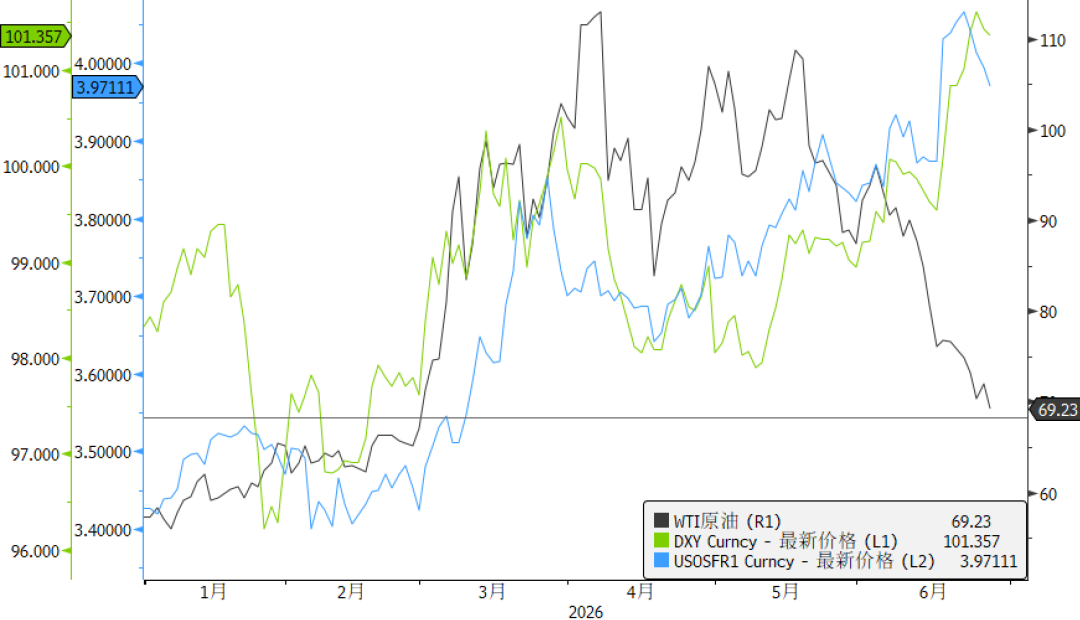
Since the US-Iran agreement, the prices of both international crude oils have unknowingly approached the levels seen at the beginning of March, which has exceeded market expectations. At the same time, 1Y SOFR has risen continuously since May, moving in the opposite direction to oil prices. Why doesSOFRignore the decline in oil prices?
1. Contrary to expectations: Why did oil prices fall so quickly?
When the US-Iran conflict began in March, the whole market was awash with concerns that international oil prices would remain at high levels throughout the year. Many insisted oil would hold a "floor at 100" for the year, and Bank of America pegged the peak at a terrifying 150–200. However, in reality, since May, both major oil benchmarks have been declining, and now have almost reached pre-war levels.
Why did oil prices move completely contrary to market expectations? In my opinion, JP's recent oil market review provided a clear explanation:
Under the supply shocks caused by the war, the market has two ways to rebalance,
"First, if overall demand remains unchanged and supply is insufficient, prices will soar. In the short term, the market can make up for the shortfall by depleting inventories. However, the continuous accumulation of consumption and replenishment demand in the medium and long term will make it harder for oil prices to fall back over a longer period."
This was the expectation of most market participants at the start of the war, but the truth is that commercial inventories did not fall as much as expected, while demand loss has far exceeded expectations. This leads to another rebalancing path:
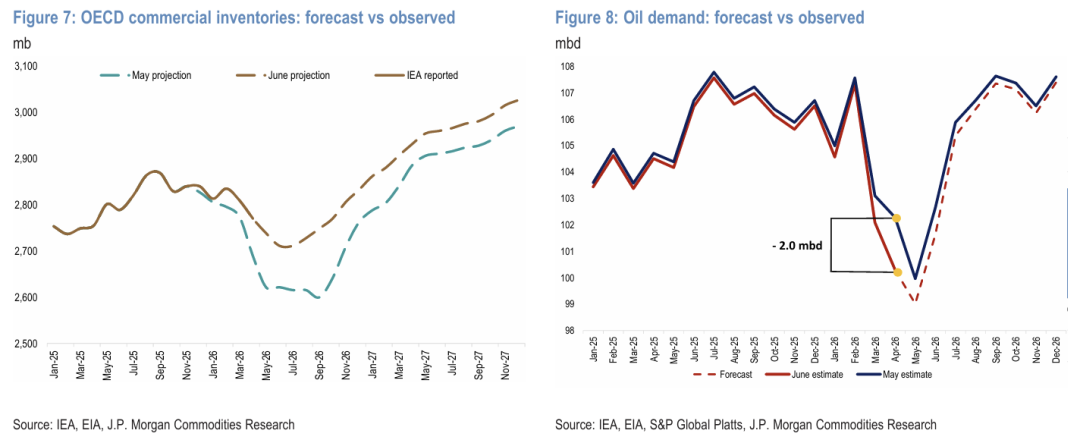
"Secondly, when supply is lacking, demand also shrinks rapidly, which puts downward pressure on oil prices." JP especially highlighted how quickly Asia (particularly China) adjusted its oil demand after the conflict began. Of course, the rapid development in the new energy sector has contributed greatly as well.
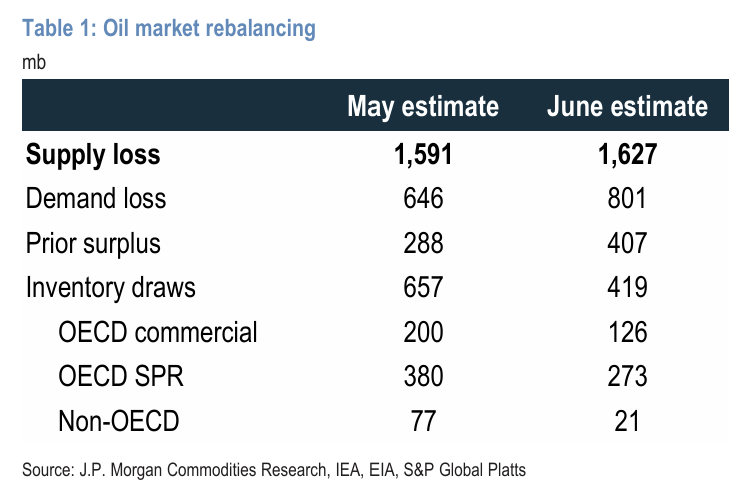
Here is JP’s conclusion to share with everyone: “The market always clears, but the path the market takes to clear is the key to determining the final price outcome.”.
2. Counterintuitive: Why are US interest rates ignoring falling oil prices?
Before May, oil prices and 1Y SOFR showed a strong correlation in their trends, but after mid-May the correlation dropped significantly. This is actually quite counterintuitive, since the main driver for this wave ofSOFRincreases was the logic of “rising oil prices → higher inflation → policy path expectations raised.” So why do interest rates rise with oil but not fall when oil drops?
In my view, the current divergence between oil prices and US interest rates stems from two reasons: First, the US fundamentals are indeed strong — two consecutive months of nonfarm payrolls that exceeded expectations, and PMI is ranked at the top among G10 countries. Second, the new Fed Chair Walsh, in his debut, already laid an uncertain foundation for tightening, vowing to achieve the 2% inflation target that has been elusive for more than five years. Combined with his refusal to communicate policy, the market can only price in a higher degree of uncertainty with the hawkish guidance he provided.
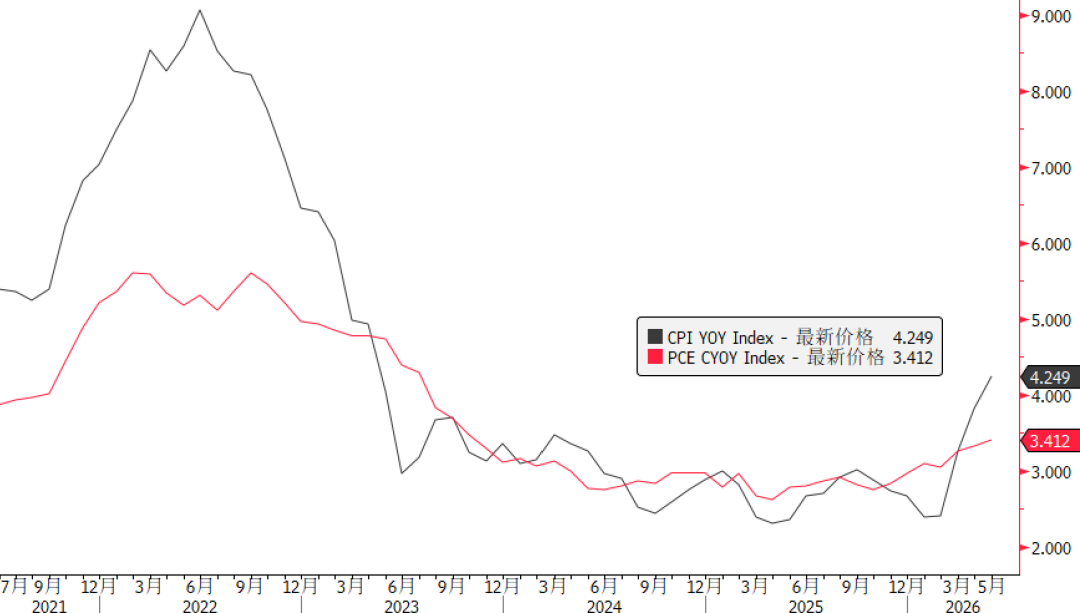
So in the current environment, the tendency for US rates to “rise with oil but not fall with oil” is likely to persist. Unless (1) oil stabilizes below 80, US CPI falls below 3% after a few months of digestion, or (2) US stocks crash, forcing the fed put into play, otherwise, short-term US rates are unlikely to fall significantly.
3. Summary
International oil prices dropping to pre-war levels might be because demand shrank faster than supply, and the market took a clearing path completely different from initial expectations.
SOFR “rises with oil but not with oil’s fall”; strong US fundamentals and Walsh’s hawkish stance are key reasons. For SOFR to drop sharply, it would require a significant decline in US CPI or a US stock market crash.
Disclaimer: The content of this article solely reflects the author's opinion and does not represent the platform in any capacity. This article is not intended to serve as a reference for making investment decisions.
You may also like
As global tungsten prices surge, U.S. mining company Almonty Industries (ALM.US) quickly acquires a tungsten mine in Rwanda to ease supply shortages.
U.S. mining company Almonty Industries has signed a tungsten mining agreement in Rwanda, expanding Western supply.

Novo Nordisk (NVO.US) renamed to "Novo" for a fresh start—Can multi-line breakthroughs dispel the shadow over its stock price?
Danish pharmaceutical company Novo Nordisk (NVO.US) has launched a comprehensive rebranding centered around the shorter name "Novo." The company will use "Novo" in daily brand promotion, but its legal name will remain Novo Nordisk A/S.

High interest rates are not the "end" of US stocks? Is profitability the real key?
JPMorgan believes that profit growth is the key factor determining the resilience of U.S. stock valuations. Data since 1950 shows an "inverted U-shaped" relationship between the 10-year U.S. Treasury yield and S&P 500 valuations. Based on current profit levels, yields would need to reach about 5%-6% to significantly compress valuations. As long as profit growth remains above 15%, there is still room for valuations to be re-rated. If the yield curve steepens in a bear market, cyclical sectors such as energy and financials will benefit more; if it flattens, technology stocks will have a relative advantage.
Crypto prices
More


