
Bond giants flock to the "belly of the curve": Betting on 5-year U.S. Treasuries becomes the "sweetest deal" of the Walsh era

According to Zhitong Finance, against the backdrop of Federal Reserve Chairman Kevin Warsh ushering in a new era of hawkishness, some of the world's largest bond management firms are focusing on the "belly" of the US Treasury yield curve—the five-year note, viewed as the optimal position to navigate the current policy uncertainty.
From Capital Group to Insight Investment, from Natixis to PIMCO, the message is highly consistent: the "belly" of the yield curve—the five-year note—is considered the best position for traversing the early phase of the Warsh era. With US Treasury yields stabilizing after Warsh's hawkish remarks at the June FOMC meeting, combined with easing oil prices and traders paring back aggressive rate hike bets, these giants are accelerating their focus on medium-term Treasuries.
As of last Friday (June 26), the five-year US Treasury yield stood at 4.13%. This is a figure that balances yield and defense—high enough to provide an attractive coupon yet "intermediate" enough to avoid the extreme risks at either end.
Why Has the "Belly" Strategy Become a Consensus? The Triple Logic of the "Sweet Spot"
Across Cycles: Can Accommodate Both Rate Hikes and Cuts
The five-year US Treasury is highly favored in the current environment due to its unique risk-reward profile—it sits at the intersection of Fed policy rate expectations and long-term inflation expectations. It is not as overly sensitive to short-term rate changes as the two-year note, nor does it bear the massive inflation and term premium risks of the thirty-year bond.
Brendan Murphy, Head of North American Fixed Income at Insight Investment, said bluntly: "The five-year is a great balance point" and "a great inflection point." This global asset manager, with approximately $836 billion in assets under management, believes medium-term Treasuries can lock in attractive yields while avoiding excessive interest rate volatility risk.
Chitrang Purani, portfolio manager at Capital Group, offered a more detailed explanation: "Volatility is higher on the front end of the yield curve, so I prefer intermediate rates." He added, "So far this year, the inflation path and the resilience of economic growth do support hikes, but looking ahead, the drivers of economic growth remain uneven and inflation has not yet been demand-driven." Capital Group manages over $3 trillion in assets.
Risk-Return Ratio: Avoiding Both Ends' Traps
Short End (2-year): Highly dependent on the Fed’s policy trajectory, extremely sensitive to every official’s statement and economic data. After Warsh eliminated forward guidance, volatility here has soared.
Long End (10-year, 30-year): Highly sensitive to inflation expectations and term premiums. Warsh’s plan to restructure the Fed’s balance sheet and gradually reduce holdings of mortgage-backed securities (MBS) is changing the supply-demand structure of the long end.
Medium Term (5-year): Neither overly exposed to policy noise nor inflation risk, making it the "safest" duration exposure.
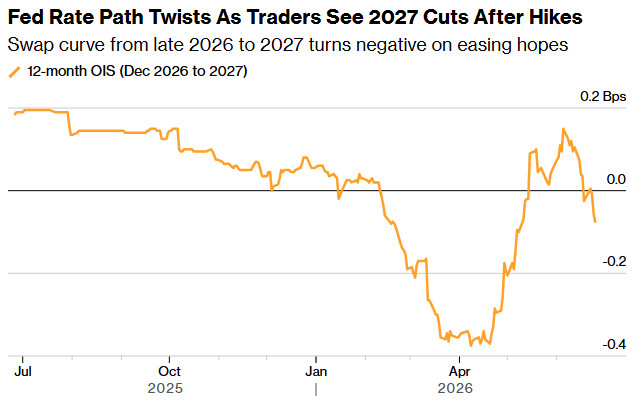
John Briggs, Head of US Rates Strategy, North America at Natixis, explained the belly’s advantage from a policy cycle perspective: "If the Fed hikes in 2026, they will exit rate hikes later, in 2027." Thus, he prefers the market to be "somewhat looser, enabling more time to digest potential rate cut expectations".
Dan Ivascyn, Chief Investment Officer at PIMCO, sent an even clearer signal at a mid-June media roundtable. He pointed out that the most attractive opportunity in the bond market currently is the five-year US Treasury. "The risk for cash investors is that economic growth could suffer some sort of unpredictable shock," Ivascyn warned. "You might have expected about a 4% cash return over the next five years, but suddenly the yield drops to 2%, and you can only earn 2% for the remainder." Extending the investment horizon to five years lets investors lock in higher yields for longer—the five-year Treasury yield is now about 4.2%. PIMCO manages around $2.3 trillion, overweighting rate exposure and holding rate bonds at the front end and in the belly (i.e., 2- to 5-year maturities).
Relative Value: Butterfly Spread Near the Highest in Over a Year
Another attraction of five-year Treasuries is their relative cheapness. The so-called "butterfly yield"—a measure comparing the five-year Treasury yield to two-year and 30-year yields—is near its highest level in more than a year.
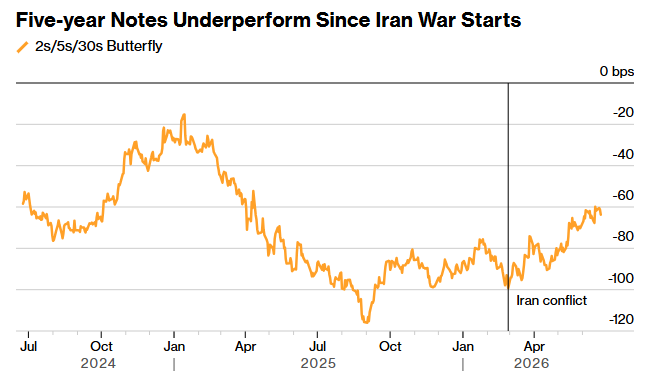
This means, from a relative value perspective, the five-year Treasury is undervalued. As of end-May 2026, the five-30 year yield spread narrowed to about 81–82 basis points, indicating a reduced term premium required by investors for the belly. Goldman Sachs analysis previously noted that, based on butterfly spread models, yields for the five-year are historically high.
Policy Background: Hawkish Fog of the Warsh Era
This wave of "belly" positioning is closely linked to the policy framework shift since Warsh took over as Fed Chair.
On June 18, the Fed maintained the federal funds rate target range at 3.50%–3.75%, but policy signals were clearly hawkish. The dot plot showed nearly half of FOMC members projecting at least one hike in 2026. Warsh did not submit a dot plot and canceled forward guidance, emphasizing the 2% inflation target and a data-dependent stance. The decision statement removed the “easing bias,” which hinted at future rate cuts, and the text was significantly streamlined.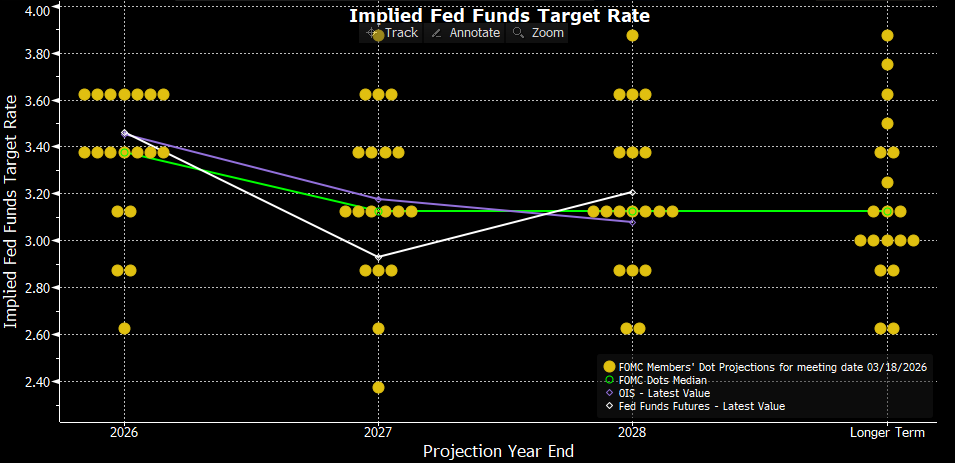
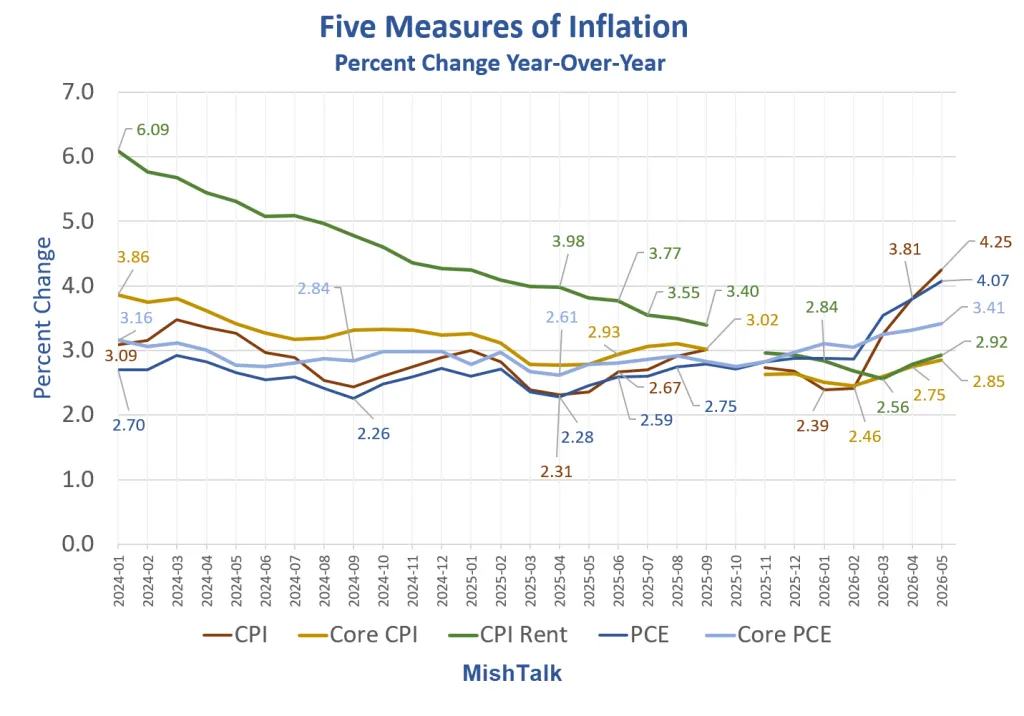
Simultaneously, the Fed sharply raised its inflation forecast—the Q4 2026 PCE year-on-year forecast was upped by 0.9 percentage points to 3.6%, and core PCE by 0.6 percentage points to 3.3%. For economic forecasts, Q4 2026 real GDP year-on-year growth was trimmed by 0.2 percentage points to 2.2%.
Under this policy framework, expectations for the Fed’s path have fluctuated dramatically. After the June FOMC meeting, expectations for a 2026 hike rose 17 basis points to 39, with the two-year yield rising 12 basis points to 4.19%. However, subsequent economic data and market recalibration moderated hike expectations.
Huatai Securities analysis noted Warsh is committed to Fed reform, but the hawkish signal from the dot plot may be overinterpreted by the market. Dongwu Securities believes that by August-September, short-term factors supporting the economy will gradually weaken, and the market's excessive pricing of rate hikes could be corrected.
Market Data: Economic Resilience and Inflation Pressures Coexist
Recent economic data offers a complex backdrop for the strategy. For inflation, the core PCE price index in May rose 3.4% year-on-year, the highest since October 2023; overall PCE rose 4.1% year-on-year, the highest since April 2023. Inflation pressure mainly stemmed from energy prices—energy-related goods and services rose 4% month-on-month. However, May’s core CPI was up just 0.2% month-on-month, below the expected 0.3%, giving the market some respite.
As for growth, US Q1 real GDP final annualized growth was 2.1%, above the previously reported 1.6%. May personal consumption expenditures rose 0.7% month-on-month, surpassing the expected 0.6%, showing consumers remain robust.
On the labor market, May nonfarm payrolls added 172,000 jobs—beating expectations for a third straight month. The June employment report is due this Thursday, and the market expects around 150,000–200,000 new jobs. Sarah Chen, senior US economist at Oxford Economics, said: "The labor market is clearly gaining momentum, but this is exactly what the Fed is currently most worried about."
Notably, the attack on oil tankers off Oman reignited market concerns over Middle East tensions. This geopolitical risk is a reminder that the sustainability of a US-Iran ceasefire remains a key variable.
"Belly" Allocations of Major Institutions
Market activity over the past week has already shown traders softening their hawkish stance. They now expect the Fed to hike once or twice by mid-next year, foreseeing this as the peak of tightening—whereas previously, they expected the first hike as soon as next month.
The appeal of the five-year note has been further validated by recent data. As of June 26, the two-year US Treasury yield retreated to 4.13%, the five-year fell to 4.167%, and the 10-year dropped to 4.39%. Compared to two weeks prior, the two-year yield rose by 14 basis points while the 30-year declined by 7 basis points, continuing to alleviate yield curve steepness.
PIMCO: Overweight 2- to 5-Year, Contrarian to the Market
With $2.3 trillion in assets, PIMCO is the most steadfast executor of this strategy. Senior Portfolio Manager Michael Cudzil says PIMCO is overweight rate exposure, holding rate bonds in the 2- to 5-year maturities.
Cudzil’s base case contrasts with market pricing: "We don’t think the Fed hikes, because economic growth should slow in the second half of the year, buying the Fed time to hold rates steady." After the recent selloff, this segment has become more attractive. He adds: "If markets digest rate hike expectations and begin discussing possible easing, short and long yields could easily fall below 4% in the second half. Market sentiment turns on a dime—it only takes a couple of data points to cause volatility."
PIMCO’s holdings reflect this strategy—among several of its fund products, futures on 2- and 5-year Treasuries are core portfolio positions.
Insight Investment: $836 Billion "Balance Point"
Brendan Murphy, Head of North American Fixed Income at Insight Investment, calls the five-year "a great balance point" and "a great inflection point." Given $836 billion in assets under management, this view carries significant weight.
Capital Group: Intermediate Rates Preferable to Front End
Chitrang Purani, portfolio manager at Capital Group, which manages over $3 trillion, clearly stated: "Volatility is higher on the front end of the yield curve, so I prefer intermediate rates." He notes that, while this year’s inflation path and economic resilience do support hikes, "looking ahead, the drivers of economic growth remain uneven, and inflation has not yet been driven by the demand side."
Natixis: "Room for Cuts" in 2027
John Briggs, Head of US Rates Strategy at Natixis North America, takes a more forward-looking approach. He thinks that if the Fed hikes in 2026, it will unwind them in 2027. Therefore, he prefers the market to be "somewhat looser, leaving more room to digest potential rate cut expectations".
Outlook: Seeking Balance Between Hawks and Doves
In summary, the five-year US Treasury sits at the confluence of Fed policy and inflation expectations. Recent price trends reflect growing confidence that energy shocks are fading, while also suggesting that the notion of inflation moderating without seriously damaging growth is gaining acceptance.
Standard Chartered Bank expects the Fed to hold rates steady through year-end and is optimistic about US dollar bond durations shortening to 3–5 years. DBS Bank also believes that, after the inflation data release, market doubts about further rate hikes have subsided.
PIMCO’s Ivascyn predicts that, given the gradual easing of Iranian tensions and the disinflationary pressure brought by AI, inflation will remain controlled over the next five years overall. PIMCO overweights 2- to 5-year rate exposure; Cudzil says: "If markets digest rate hike expectations and begin discussing the potential for easing, both short and long yields could fall below 4% in the second half. Market sentiment can change rapidly—just a couple of data points can spark volatility."
In this period full of uncertainty, the "belly" strategy may be the steady choice for navigating the fog.
Risk Warning: Not Without Headwinds
Despite broad consensus on the "belly" strategy, risk factors must not be overlooked.
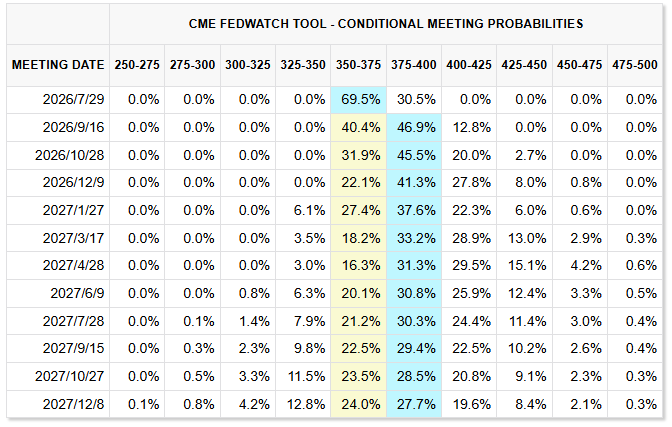
Rate Hike Risk: If upcoming employment and inflation data show no price moderation, the Fed could hike as soon as September. Policy-sensitive two-year Treasuries would take the brunt, but while the five-year is more insulated, it is not immune. CME data indicates a 45% probability of a 25bp hike in September priced in by overnight index swaps.
Geopolitical Risk: The attack on a vessel in the Gulf of Oman reminds the market that Middle East volatility could at any time impact energy prices and inflation expectations.
Downside Economic Risk: If hike expectations keep rising, it may tighten financial conditions and suppress economic growth. PIMCO’s Ivascyn notes that if growth takes a hit and rates fall, five-year Treasury investors would benefit from price gains—but this means the "belly" strategy also carries value as a hedge against downside risks.
Disclaimer: The content of this article solely reflects the author's opinion and does not represent the platform in any capacity. This article is not intended to serve as a reference for making investment decisions.
You may also like
Pushing Forward Against the "AI Slowdown" Trend? Reports Suggest Kioxia Plans U.S. IPO to Raise at Least $10 Billion
Kioxia is reportedly considering raising $10 billion through a listing in the United States.

3 Altcoins Poised to Pump Soon: LTC, TRX, ADA

AI Computing Power Construction Shifts from "Lack of Electricity" to "Lack of Talent": Modularization Rises, Schneider, Vertiv, Eaton Embrace New Opportunities
Bernstein recently released a research report stating that, amid the rapid expansion of AI computing power, the main constraint affecting the development of data centers is undergoing a shift.

Zcash slides from $1,300, risk of $850 pullback before new rally
Crypto prices
More


