
Openly rebuilding the plank road while secretly crossing the warehouse! Is Walsh paving the way for a "rate cut" in September?

The hawkish stance of Federal Reserve Chairman Kevin Walsh may just be a carefully orchestrated smokescreen.
Academy Securities analyst Peter Tchir suggested in his latest report that, although the market has now priced in a 75% probability of a rate hike in September and expected a total of 1.25 hikes by year-end, he believes the market is missing a real path toward a rate cut in September — a path that may be quietly paved by Walsh himself.
Tchir points out that the signals released by Walsh have been clear enough: using hawkish rhetoric to suppress tail risks on the long end of rates (10-year U.S. Treasury yields already fell from 4.46% to 4.37% this week), while leaving room for a shift in narrative prompted by future data. In his view, the culmination of these strategies may very well be a rate cut in September, followed by another in October — just in time for the midterm elections.
This judgment remains a personal view for now, and Tchir himself admits there is uncertainty. But his argument is tightly knit, covering the redefinition of inflation data, the contest for control over the definition of the neutral rate, and the core premise that the White House's policy objectives have never changed.
Is the hawkish stance just a performance? Political logic points to rate cuts
The starting point of Tchir's argument is a political economy interpretation of Walsh's motivations.
He believes that the policy objectives of the Trump administration have not fundamentally changed. The president himself has stated numerous times that he is well-versed in real estate, fully aware of the importance of low interest rates to the property market. Against this backdrop, it is hard to imagine Trump being satisfied with continued hawkishness from the Fed Chairman he personally nominated—unless, of course, this is a negotiated strategy.
Tchir paints a hypothetical scenario: Walsh convinces Trump that releasing dovish signals now would be disastrous. By presenting a hawkish stance, he could suppress long-term yields and maintain the illusion of Fed independence, while nudging Wall Street analysts and the media toward expecting rate hikes. Afterwards, as the data slowly “cooperates,” the narrative can shift to rate cuts under the guise of being “data-driven,” conveniently blaming inflation on the previous Fed for “using the wrong data and acting too late.”
He adds that Walsh’s father-in-law is a major donor to Trump, a detail that may not be irrelevant.
Taking aim at inflation data: PCE is not the benchmark for this Fed
The most substantial aspect of Tchir’s argument is his systematic questioning of the current inflation measurement system.
He explicitly states that PCE is not the preferred inflation gauge for Walsh's Fed. In his view, PCE was a favorite during the Bernanke era, but Walsh is unlikely to be losing sleep over late-night PCE data releases.
When it comes to measuring housing inflation, his criticism is particularly sharp. The “Owners’ Equivalent Rent” (OER) in CPI only peaked around mid-2023, at about 8%, while Zillow’s rent data had already hit a high near 16% as early as early 2022. He points out that the Cleveland Fed has developed the “New Tenant Repeat Rent Index” (NTRR), which closely matches Zillow’s data, yet this more realistic metric has received very little attention.
His conclusion is that the Fed could, without introducing external data, pivot to using indicators developed by the Cleveland Fed itself, thereby providing a legitimate data-driven basis for rate cuts.
Truflation and “2-point-something is enough”
Outside of PCE, Tchir also references real-time inflation data from Truflation. According to him, Truflation constructs a daily inflation index based on massive, real-time data sets. Its core inflation rate is currently about 1.45% and has stayed below 1.8% since February this year.
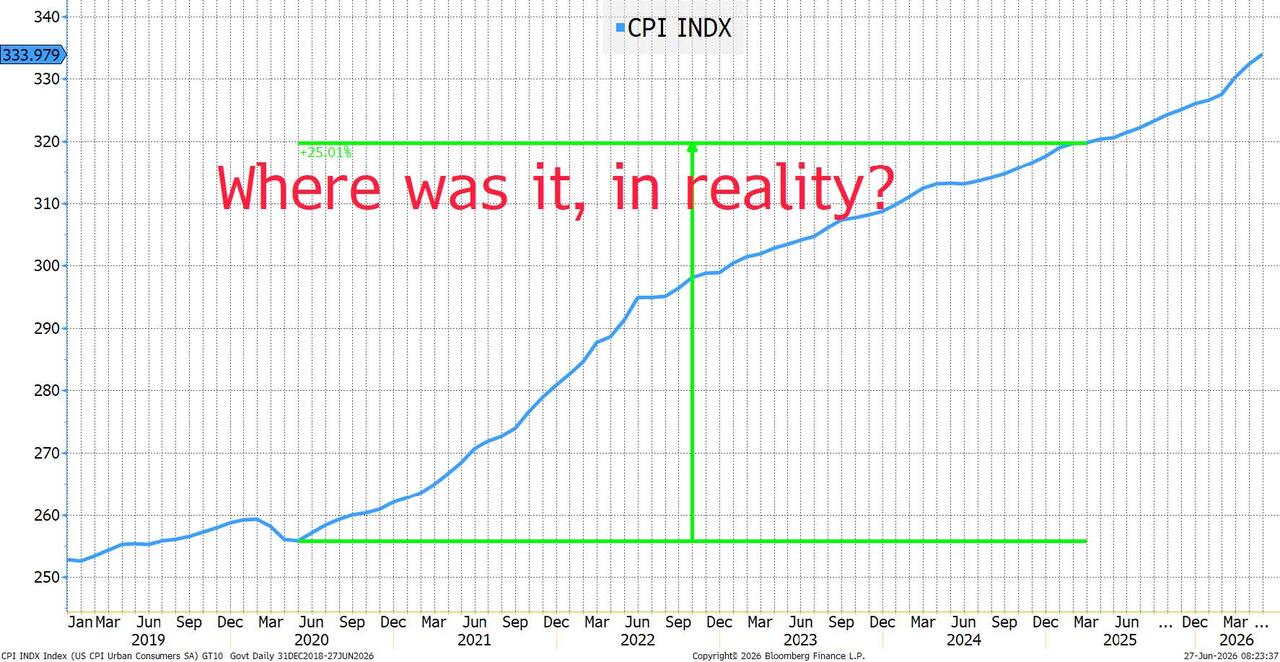
He also notes that Walsh has recently implied in his comments that the “leading digit” of the inflation number (i.e., the integer part) is more important than the precise value. Tchir thus suggests that the market is being gradually “conditioned” to accept the framework in which “2-point-something” is tantamount to hitting the roughly 2% target. In his charts, he marks the inflation target line at 2.9%, instead of the traditional 2%.
He argues that once the data narrative has fully shifted, the technical barriers to rate cuts will be greatly reduced.
Tchir also mentions former Fed insider Miran’s work on the neutral rate. He believes that, while the market is not currently discussing the neutral rate, this topic will resurface at the right time.
His logic runs as follows: The neutral rate is itself hard to measure precisely and has a wide range of estimation. If the new Fed leadership can demonstrate that the previous team judged the neutral rate too high, that alone provides theoretical grounds for 50 to 100 basis points of rate cuts, while blaming “the old Fed’s mistakes.”
Apple price hikes and AI inflation: Rate hikes are missing the target
In response to market concerns about AI-driven inflation, Tchir offers a counter-interpretation.
He notes that after Apple (AAPL) recently announced price hikes, its share price fell. The market’s reaction clearly shows that consumer capacity to absorb price increases is under question. If even Apple, the top consumer goods company, cannot pass higher prices through to the market, ordinary consumer goods firms will have even less pricing power — a narrative that is at odds with persistent inflation.
He also cites feedback from a chipmaker: memory prices have not surged because of AI demand, with some products even cheaper than five years ago. He believes that while spending on AI and data center construction may indeed be inflationary, this is a completely different dimension from the affordability issues facing ordinary consumers.
More crucially, he argues that rate hikes have virtually no suppressive effect on AI/data center spending — technology companies trading at 100x valuations simply aren’t sensitive to a 50 basis point move. The real victims of rate hikes are regular borrowers, who have nothing to do with AI inflation.
Based on these judgments, he believes the market will start to reprice rate cut expectations, and the most certain opportunities lie at the short end of the yield curve — going long short-term Treasuries, betting on front-end rates falling. For the long end, he maintains a neutral to slightly bullish stance and believes Treasury Secretary Bessent wants 10-year yields back in the “3s,” while Walsh’s hawkish statements have already neutralized tail risks on the long end.
At the equity level, he recommends overweighting the energy sector, especially global nuclear power assets; in the ProSec (defense and security) theme, overweight biotechnology/pharmaceuticals, and underweight chips. He remains cautious about AI and data center stock valuations and warns that the potential for large-cap tech companies to issue new shares could weigh on their stock prices.
Disclaimer: The content of this article solely reflects the author's opinion and does not represent the platform in any capacity. This article is not intended to serve as a reference for making investment decisions.
You may also like
Pushing Forward Against the "AI Slowdown" Trend? Reports Suggest Kioxia Plans U.S. IPO to Raise at Least $10 Billion
Kioxia is reportedly considering raising $10 billion through a listing in the United States.

3 Altcoins Poised to Pump Soon: LTC, TRX, ADA

AI Computing Power Construction Shifts from "Lack of Electricity" to "Lack of Talent": Modularization Rises, Schneider, Vertiv, Eaton Embrace New Opportunities
Bernstein recently released a research report stating that, amid the rapid expansion of AI computing power, the main constraint affecting the development of data centers is undergoing a shift.

Zcash slides from $1,300, risk of $850 pullback before new rally
Crypto prices
More


