
The yen breaks through the 40-year bottom line, this year’s trillions of yen intervention efforts fully lost, Tokyo trapped in a policy deadlock

Since the intervention at the end of April, the yen has continued to weaken over the past two months, pushing the Japanese government into a nearly unsolvable policy dilemma.
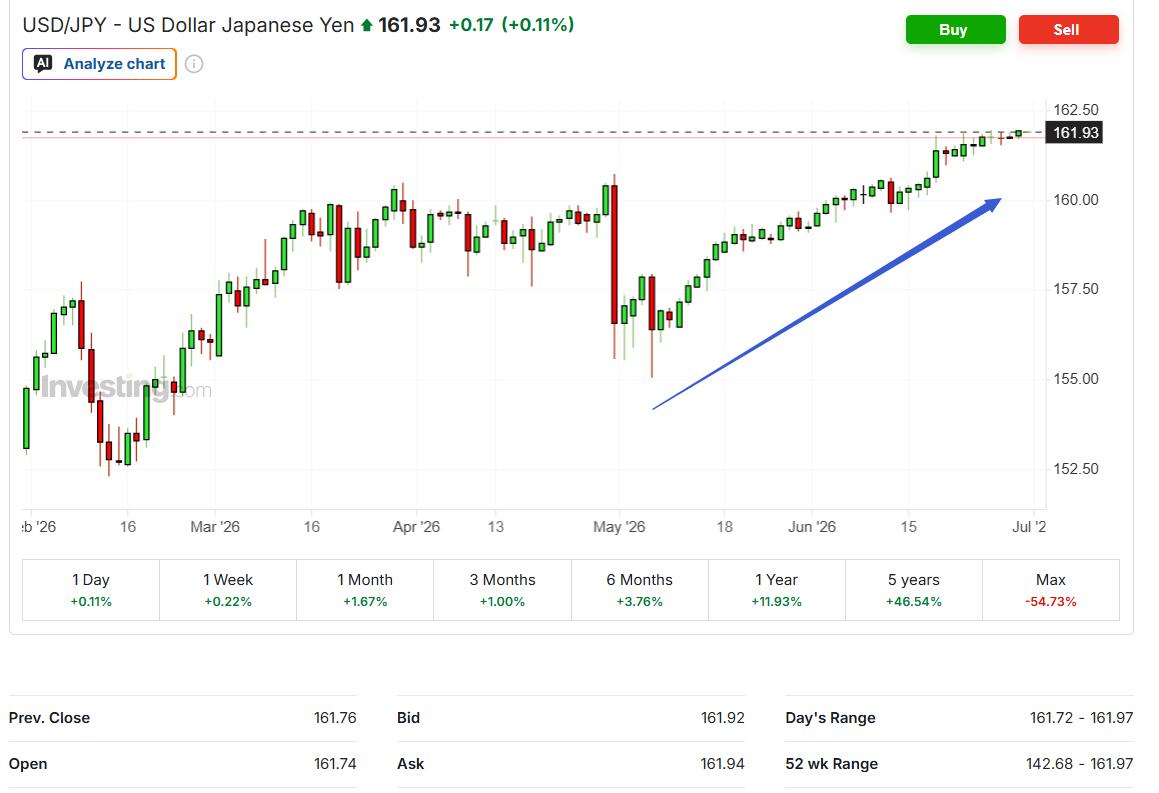
On Monday, the 29th of US Eastern time, during the early trading session of the US stock market, the yen's exchange rate against the US dollar fell to its lowest since 1986, with the USD/JPY rate rising as high as 161.97 (UTC+8), breaking through the key threshold of 161.95. This level of 161.95 was precisely the entry point for the Japanese government's intervention in the forex market in July 2024.
To curb the unilateral depreciation of the yen, the Japanese Ministry of Finance conducted a record-scale forex intervention within about a month at the end of May, investing a total of 11.73 trillion yen. However, by this Monday, the market had entirely erased the support for the yen that the Japanese government bought for approximately $72.5 billion this year.
Just over a week ago, after the USD/JPY surged past 161.00 (UTC+8), Japanese Finance Minister Kaoru Katayama reiterated on June 19 that the Japanese government was ready to take “bold action” at any time to curb excessive speculative volatility, and stated that after an online meeting with US Treasury Secretary Besant, the two countries’ positions on exchange rate policy had become increasingly “aligned,” and if necessary would take “bold measures” together.
However, verbal statements by senior Japanese officials failed to provide effective support for the exchange rate. The market's indifferent response reflects a deeper structural contradiction: on one hand, imported inflation continues to erode consumers' purchasing power, forcing the government to stabilize the exchange rate; on the other hand, the Japanese government is believed to be pressuring the Bank of Japan to refrain from further rate hikes, and it is precisely this gradual and restrained monetary policy that keeps the US-Japan interest rate differential high, fundamentally suppressing the yen. Thus, Tokyo’s policy dilemma is revealed.
The 11.73 Trillion Yen Intervention Result is Wiped Out, Yen Approaches Historic Threshold Again
From April 28 to May 27 this year, after the yen first fell below the 160 mark, the Japanese Ministry of Finance immediately launched an unprecedented scale of forex intervention, cumulatively buying 11.73 trillion yen. The effect was initially dramatic—the yen quickly rebounded to around 155 against the dollar (UTC+8).
However, in about a month, all gains were given back, the yen again fell below the 160 threshold, and on Monday further broke through the 2024 intervention low of 161.95 (UTC+8), setting a new near-40-year low.
Looking back at history, this situation is yet another reflection of the Japanese government’s repeated but unsuccessful forex intervention attempts. Media note that after resuming interventions in 2022 for the first time in over 20 years, and again in 2024, each effort brought only brief relief before the depreciation trend continued on schedule. Behind the massive intervention costs, the Japanese government financed these actions using its holdings of foreign securities—including US Treasuries—which could spark ripple effects in the US and even global bond markets.
Andrew Hazlett, forex trader at Monex Inc., said that if the yen fails to adjust quickly, “intervention is just around the corner.” But he also admitted that intervention “is only a temporary fix, the core problem of the interest rate gap remains unsolved.”
The US-Japan Interest Rate Gap Dominates, Carry Trades Form Persistent Selling Pressure
The core logic suppressing the yen remains the stark interest rate gap between the US and Japan. The US Federal Reserve’s federal funds rate target range is currently maintained at 3.50% to 3.75%, and new Fed Chair Walsh sent even more hawkish policy signals after this month’s meeting, prompting the market to further raise rate hike expectations for this year.
Meanwhile, the Bank of Japan announced a 25 basis point rate hike to 1% (UTC+8) on the 16th of this month, raising rates to the highest level since 1995, but analysts believe this move is not enough to disrupt the interest rate gap between the two countries.
According to reports, analysts from LMAX Group noted that the Bank of Japan’s rate hike “cannot offset the still-hefty US-Japan interest rate differential, especially as the Fed maintains its hawkish stance and signals that rates will remain high for a long time.”
The existence of the interest rate gap provides fertile ground for carry trades: investors borrow low-cost yen, swap for dollars, and invest in high-yielding US dollar assets, thus placing persistent selling pressure on the yen. Under this mechanism, even the Bank of Japan’s rate hikes have almost negligible impact on bolstering the yen.
Bloomberg macro strategist Brendan Fagan said frankly: “Without official action, there’s no reason for the yen’s structural depreciation to stop on its own. Japan must re-enter the market, or the direction of US real interest rates must undergo a substantive change.”
Deep-Seated Contradictions Between Government and Central Bank
The policy dilemma currently facing the Japanese government goes well beyond the exchange rate itself. The continued depreciation of the yen has raised import costs, with energy and food prices surging across the board, eroding consumers’ purchasing power and threatening the public approval of Prime Minister Sanae Takamichi’s cabinet. Such pressure should prompt the government to support the central bank in raising rates to strengthen the yen.
However, it is reported that the Japanese government is expected to call for the central bank to adopt “appropriate” monetary management in its basic policy statement, which is widely interpreted as a signal to dissuade further rate hikes. Behind this stance lies a fiscal reality: Japan's government debt-to-GDP ratio is the highest among developed countries, and a rapid rise in policy rates would significantly increase national financing costs, resulting in considerable fiscal burden.
Hawkish voices within the Bank of Japan have risen recently, with Policy Board member Naoki Tamura recently calling for rate hikes every few months, gradually pushing the policy rate to a neutral 2% level. Despite this, the market generally expects the Bank of Japan to maintain a gradual rate hike path, with the next hike not likely until year-end. Thus, the tension between exchange rate stability and fiscal stability constitutes the deeper root of Tokyo’s policy conundrum.
Intervention Outlook: Limited Window, Dubious Effectiveness
Against this backdrop, the market remains highly vigilant about further intervention by the Japanese government. The online meeting between Kaoru Katayama and Besant this month, as well as their statements about taking "bold measures" if necessary, have been interpreted as providing some political backing. However, analysts are cautious about the actual effectiveness of any intervention.
Shaun Osborne, Head of FX Strategy at Scotiabank, stated that the Bank of Japan is undoubtedly closely monitoring the situation. However, observers generally point out that pure forex intervention can only bring short-term respite and cannot change the structural trend driven by the interest rate gap.
According to Shanghai Securities News, citing analyst Zhang Meng, intervention frequency and scale are constrained by IMF rules on free-floating exchange rates. Also, interventions often require selling US Treasuries in advance, a financing process that itself could trigger global bond market fluctuations, making the authorities very cautious. The assessment is that authorities will first observe whether the 162 level will trigger intervention; if not, the next key level is 165 (UTC+8).
Other analyses suggest that the optimal window for intervention is often when the exchange rate is in a “more undervalued” state—in other words, the deeper the fall, the higher the cost-effectiveness of intervention. Before there is a real loosening of the US-Japan rate gap, even if intervention induces a technical rebound in the yen, it will at most be short-term market repair, and does not guarantee a reversal of the overall trend.
As Andrew Hazlett put it, intervening without solving the interest rate gap is merely buying time, and the next challenge will eventually arrive.
Disclaimer: The content of this article solely reflects the author's opinion and does not represent the platform in any capacity. This article is not intended to serve as a reference for making investment decisions.
You may also like
Pushing Forward Against the "AI Slowdown" Trend? Reports Suggest Kioxia Plans U.S. IPO to Raise at Least $10 Billion
Kioxia is reportedly considering raising $10 billion through a listing in the United States.

3 Altcoins Poised to Pump Soon: LTC, TRX, ADA

AI Computing Power Construction Shifts from "Lack of Electricity" to "Lack of Talent": Modularization Rises, Schneider, Vertiv, Eaton Embrace New Opportunities
Bernstein recently released a research report stating that, amid the rapid expansion of AI computing power, the main constraint affecting the development of data centers is undergoing a shift.

Zcash slides from $1,300, risk of $850 pullback before new rally
Crypto prices
More


