
Bitcoin put-call ratio hits 1-year high: Are bears preparing for drop to $55K?

Key takeaways:
- An extreme Bitcoin put-call options imbalance and a 19% delta skew reveal heavy hedging against downside price swings.
- Strategy’s cash hoard eases short-term debt fears but does not hold back a broader capital rotation into tech stocks.
Bitcoin has failed to reclaim the $61,000 mark since Thursday, despite optimism fueled by lower crude oil prices following the US and Iran's 60-day ceasefire agreement. Demand for downside Bitcoin price protection jumped to unusually high levels, prompting traders to question whether $55,000 is the next target.
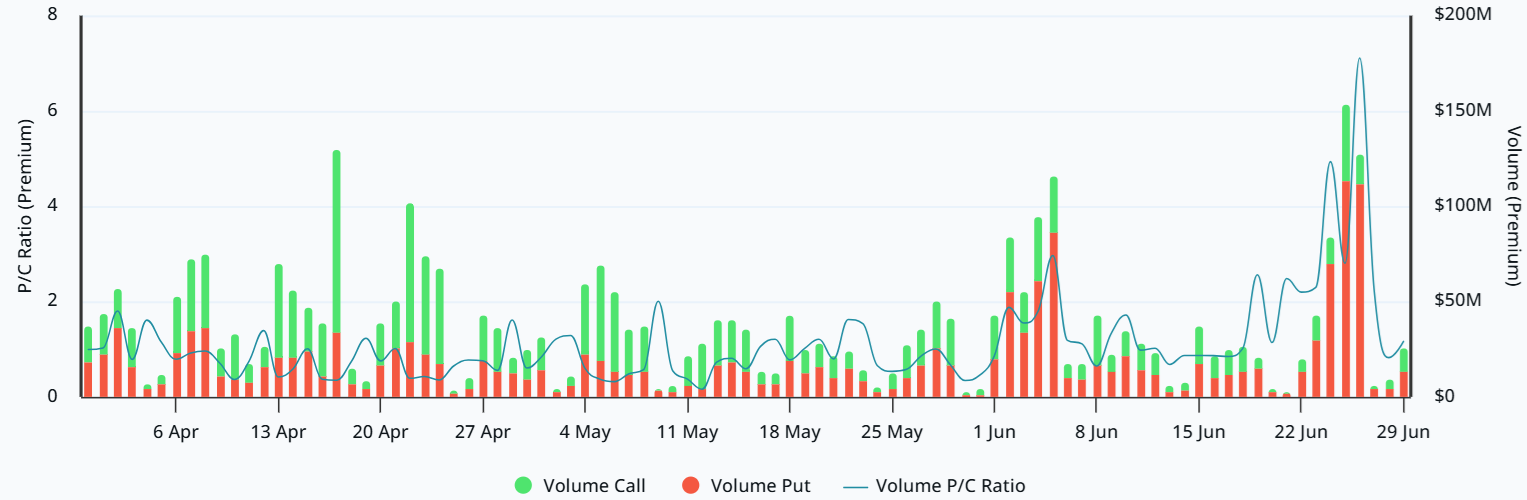
Deribit Bitcoin options premium put-to-call ratio. Source:
The premium paid on Bitcoin put (sell) options on Deribit totaled $115 million on Friday, 7 times the $16 million paid on call (buy) options. The imbalance was the highest in over 12 months, signaling extremely low demand from bulls. However, such data does not necessarily signal conviction from bears.
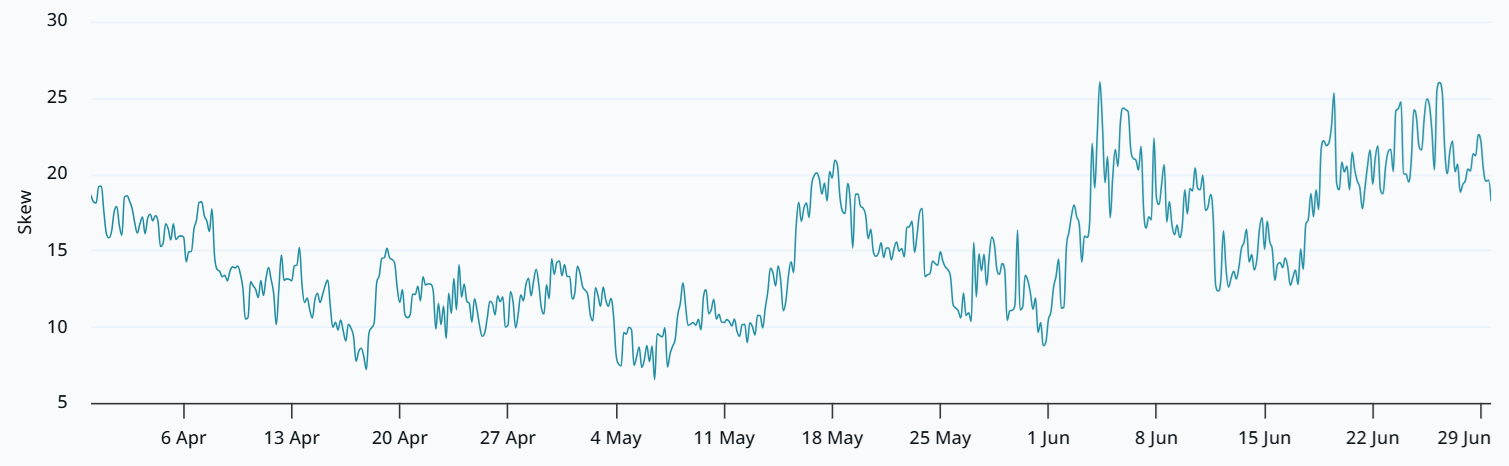
Bitcoin 30-day options delta skew (put-call) at Deribit. Source: Laevitas
The Bitcoin options delta skew stood at 19% on Monday, meaning market makers are unwilling to hold downside price exposure. This setup hints at fear, although that has been the norm for the past 4 weeks. Data aligns with growing demand for bearish hedging as Bitcoin price struggles to sustain levels above $60,000.
Bitcoin’s weakness can be partially pinned to investors’ discomfort with MicroStrategy (MSTR US) ability to pay dividends and debt maturing in 2027. The company reacted on Monday by announcing an additional $1.2 billion in cash from recent share sales and setting aside $1.25 billion in Bitcoin for eventual sale.
The measures taken by Strategy ease some short-term concerns but also create anxiety about Bitcoin’s supply and demand dynamics. Even if no sales occur over the next couple of months, bears are more comfortable knowing that Strategy has no incentives to issue MSTR shares given the current 17 months of dividend coverage.
Related:
Rotation from Bitcoin and gold into semiconductor stocks
In contrast to Bitcoin investors’ pessimism, momentum in the US stock market has shifted favorably after inflationary pressure eased, with crude oil prices dropping to their lowest levels in 4 months. Additionally, a Goldman Sachs report projected 22% annual earnings growth for S&P 500 companies, easing concerns about excessive valuations.
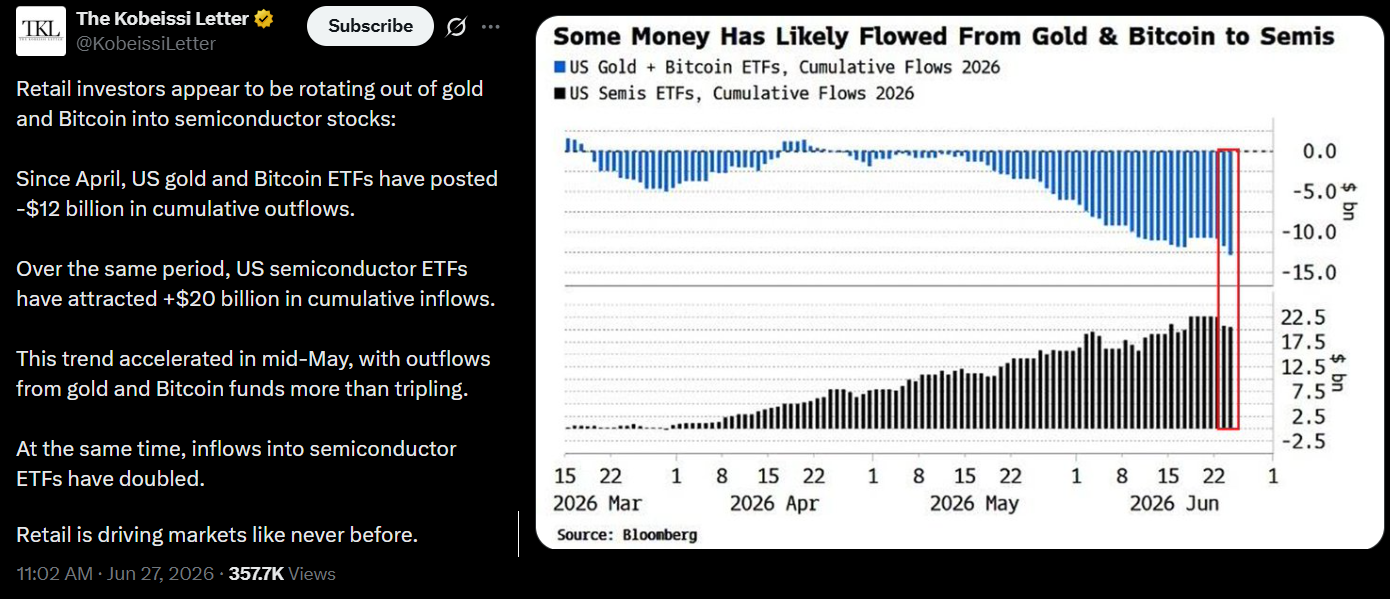
Source: X/
Retail investors appear to be rotating out of gold and Bitcoin into semiconductor stocks, according to ‘The Kobeissi Letter’ analysis. Data collected by Bloomberg has shown over $20 billion in cumulative inflows in semiconductor exchange-traded funds (ETFs), triggering an 81% rally in iShares Semiconductor ETF (SOXX US) and 60% gains in VanEck Semiconductor ETF (SMH).
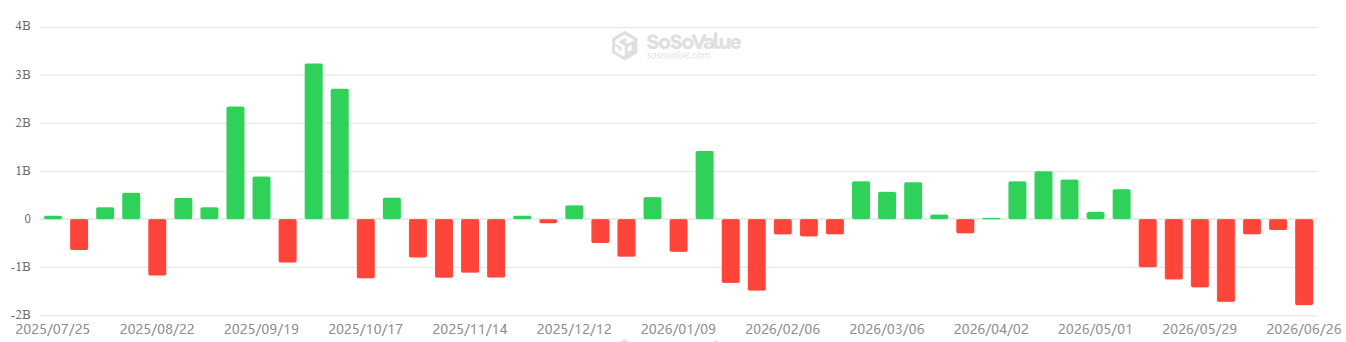
US-listed Bitcoin spot exchange-traded funds weekly net flows, USD. Source: SoSoValue
The 7 consecutive weeks of net outflows from the US-listed Bitcoin spot ETFs have shattered bulls’ hopes of a strong bounce from the $58,050 lows on June 25. Regardless of whether the sell-off can be attributed to the rotation into tech stocks, sentiment is unlikely to improve while Bitcoin spot ETFs continue to see strong net outflows.
A retest of $55,000 should not be dismissed, but the increased demand for downside hedging in Bitcoin options should not be interpreted as growing confidence among bears.
Disclaimer: The content of this article solely reflects the author's opinion and does not represent the platform in any capacity. This article is not intended to serve as a reference for making investment decisions.
You may also like
High interest rates are not the "end" of US stocks? Is profitability the real key?
JPMorgan believes that profit growth is the key factor determining the resilience of U.S. stock valuations. Data since 1950 shows an "inverted U-shaped" relationship between the 10-year U.S. Treasury yield and S&P 500 valuations. Based on current profit levels, yields would need to reach about 5%-6% to significantly compress valuations. As long as profit growth remains above 15%, there is still room for valuations to be re-rated. If the yield curve steepens in a bear market, cyclical sectors such as energy and financials will benefit more; if it flattens, technology stocks will have a relative advantage.
The "Outlier" Investment Art in the New Era of Berky

Chevron (CVX.US) explores alternative hedging for Middle East supply disruptions: targets Argentina and the Mediterranean to drive global LNG growth, seeks deal with India
Chevron is focusing on Argentina and the Mediterranean region, seeking global growth in liquefied natural gas, and plans to reach an agreement with India.

Expert Drops a Bullish Yet Scary Prediction for ETH Price in 2027, $10,000 ATH to $800 Black Swan Event?

Crypto prices
More


