- Ethereum is trading below key Fibonacci levels, but with pressure still headlined into the second half of 2026.
- Persistent negative funding rates indicate bearish positioning remains elevated across Ethereum derivatives markets.
- Historical Ethereum cycle patterns continue suggesting a possible capitulation event before market stabilization.
Ethereum Price remains under pressure as technical and derivatives indicators continue pointing toward the possibility of a final capitulation phase before the broader cryptocurrency market establishes a longer-term bottom.
Ethereum Cycle Structure Continues to Resemble Previous Bear Markets
Recent market analysis has renewed attention on Ethereum’s long-term price structure. Market participants continue comparing the current cycle with the 2021-2022 correction. Similarities between both periods remain notable.
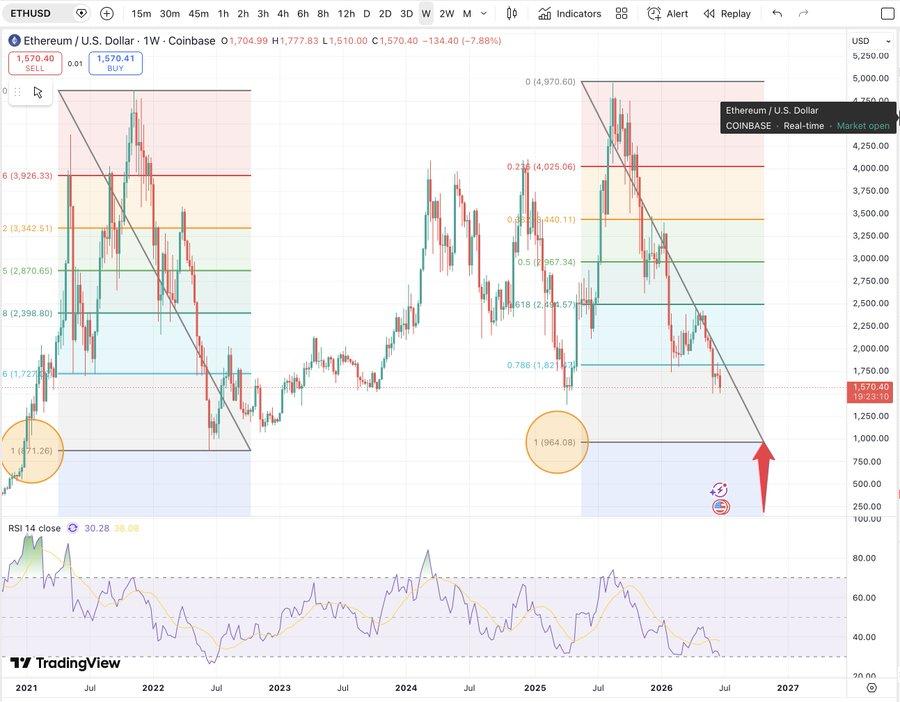
Veteran trader Matthew Dixon recently stated on X that Ethereum may face one final washout. According to his analysis, a move toward the 100% Fibonacci extension remains possible. Such a fall may coincide with a larger market bottom in the fourth quarter,” he said.
 Source: X
Ethereum actually reached a high price of nearly $4,900 before the next big bear market.That cycle eventually ended near the 100% Fibonacci extension zone. The final decline exhausted bullish positioning and established a durable market bottom.
The ongoing cycle seems to be on a similar trajectory. Ethereum reached a height of almost $4,970 and then started a long correction. It has been unable to recover near major retracement levels time and again.
Technical Indicators Continue Supporting a Defensive Outlook
Ethereum at the time of writing, was trading at $1,580 following some volatile price movement. However, buyers pushed temporarily above the $1,600 resistance region.
The rejection near $1,605 reinforced prevailing market weakness. Sellers subsequently regained control and pushed prices lower. Ethereum later stabilized near the $1,565 support zone.
The weekly chart continues displaying a series of lower highs. The descending trendline from the cycle peak remains intact. Until that trendline breaks, the broader trend remains corrective.
Weekly RSI readings have also entered oversold territory again. Similar conditions appeared during previous market bottoms. However, oversold readings alone rarely identify precise reversal points.
Derivatives Positioning Reflects Persistent Market Caution
CoinGlass data continues to reveal substantial bearish positioning within Ethereum derivatives markets. Funding rates remained strongly positive during Ethereum’s previous rally. Traders aggressively accumulated leveraged long positions.
Market conditions changed considerably following Ethereum’s price reversal. Negative funding spikes emerged during periods of accelerated selling. The events were indicative of broad deleveraging activity.
Throughout much of 2025 and 2026, negative funding persisted. Traders continued positioning for additional downside movement. Short-side conviction remained elevated across perpetual futures markets.
Recent funding data has shown modest improvement. Positive funding periods have gradually returned in recent weeks. However, leverage utilization remains substantially below prior cycle highs.
Dixon’s broader thesis suggests that extreme pessimism often precedes major recoveries. Should Ethereum revisit its projected extension zone, market conditions could potentially establish the foundation for a future recovery cycle.