
Circle tumbles as BlackRock backs rival revenue-sharing stablecoin

Circle Internet Group shares have dropped more than 17% after a consortium backed by BlackRock, Google, Visa, Coinbase, and more than 140 other companies unveiled a competing revenue-sharing stablecoin.
- Circle shares fell 17.5% after Open USD launched with backing from BlackRock, Google, Visa, Coinbase, and 140+ partners.
- Open USD introduces a revenue-sharing model that distributes most reserve income to ecosystem participants.
- Circle CEO Jeremy Allaire said USDC will continue expanding despite growing competition in the stablecoin market.
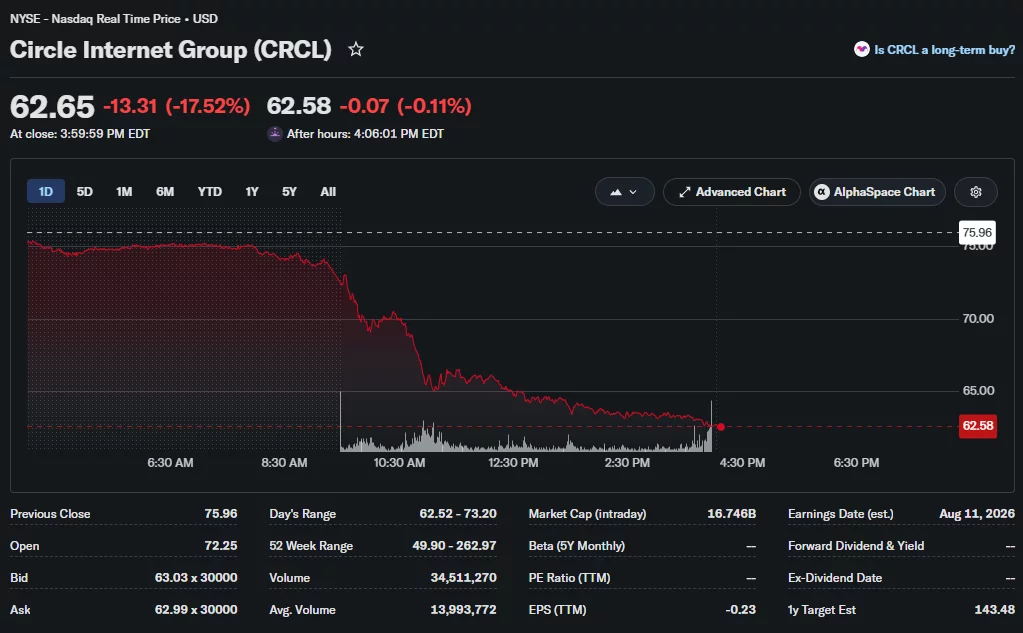
According to Yahoo Finance market data, Circle closed at $62.65 on Tuesday, down 17.52% from the previous session after falling as low as $62.52 during intraday trading. The stock opened at $72.25 and extended losses throughout the day before stabilizing near its session low.
 Source:
Trading volume climbed to more than 34.5 million shares, well above its average daily volume of about 14 million, as investors reacted to the latest development in the stablecoin market.
Open USD introduces a different revenue model
The selloff followed the launch of Open USD (OUSD), a new stablecoin developed by Open Standard, an industry initiative led by Bridge co-founder Zach Abrams. The network is backed by more than 140 companies, including BlackRock, Google, Visa, Coinbase and other financial and technology firms seeking to build shared stablecoin infrastructure.
Unlike traditional issuer-led models, Open USD offers fee-free minting and redemption while distributing most reserve income to participating ecosystem members. Governance will also be handled by an independent partner-led organization instead of a single issuing company.
The structure directly challenges one of Circle’s core business models by allowing ecosystem participants to share reserve income that has traditionally accrued to stablecoin issuers. The design is similar to the incentive framework used by Paxos’ Global Dollar Network, which also shares reserve revenue with partners.
Open USD enters the market as stablecoins continue to expand beyond crypto trading into cross-border payments, merchant settlement and corporate treasury management. Growing institutional interest has encouraged multiple companies to launch new dollar-backed tokens with different economic models to attract banks, payment firms and fintech platforms.
Circle says competition will not slow USDC expansion
Responding to the announcement, Circle Chief Executive Officer Jeremy Allaire dismissed suggestions that the new entrant poses a significant threat to USDC, arguing that the stablecoin sector is large enough to support multiple successful issuers.
According to Allaire, Circle will continue expanding USDC’s institutional network by adding banking, payment, and capital markets partners while investing in infrastructure that improves interoperability across blockchain networks.
“USDC remains the most trusted, widely adopted, institutional-ready stablecoin in the world, and we count thousands of institutions as partners in our ecosystem across nearly every major sector.”
Allaire added that Circle plans to keep building on additional blockchain networks while integrating USDC more deeply with banks, payments companies, capital markets firms and enterprises. He also said the company intends to expand opportunities for partners to participate economically in the continued growth of the USDC ecosystem.
Although Circle maintains that its long-term strategy remains unchanged, Tuesday’s market reaction showed investors closely watching how new revenue-sharing models could influence competition in the fast-growing stablecoin industry.
With Open USD backed by some of the largest names in finance and technology, the launch introduces another well-funded rival as issuers compete for institutional adoption and payment market share.
Disclaimer: The content of this article solely reflects the author's opinion and does not represent the platform in any capacity. This article is not intended to serve as a reference for making investment decisions.
You may also like
High interest rates are not the "end" of US stocks? Is profitability the real key?
JPMorgan believes that profit growth is the key factor determining the resilience of U.S. stock valuations. Data since 1950 shows an "inverted U-shaped" relationship between the 10-year U.S. Treasury yield and S&P 500 valuations. Based on current profit levels, yields would need to reach about 5%-6% to significantly compress valuations. As long as profit growth remains above 15%, there is still room for valuations to be re-rated. If the yield curve steepens in a bear market, cyclical sectors such as energy and financials will benefit more; if it flattens, technology stocks will have a relative advantage.
The "Outlier" Investment Art in the New Era of Berky

Chevron (CVX.US) explores alternative hedging for Middle East supply disruptions: targets Argentina and the Mediterranean to drive global LNG growth, seeks deal with India
Chevron is focusing on Argentina and the Mediterranean region, seeking global growth in liquefied natural gas, and plans to reach an agreement with India.

Expert Drops a Bullish Yet Scary Prediction for ETH Price in 2027, $10,000 ATH to $800 Black Swan Event?

Crypto prices
More


