
The Korean stock market hit hard again by "unverified reports": National Pension Fund reportedly rebalancing, may sell up to 74 trillion KRW of domestic stocks

South Korea’s National Pension Service (NPS) is expected to resume its domestic stock rebalancing operations, sparking a new wave of market concerns over capital flows in the Korean stock market.
According to The Korea Herald on June 30, with the recent sharp rise in KOSPI, the proportion of Korean stocks held by NPS has surpassed the annual allocation target. Several securities firms predict that the fund will gradually reduce its holdings of Korean stocks starting in July, and in the most pessimistic scenario, the selling scale could reach as high as 74.4 trillion won (about $48 billion).
Influenced by this news, KOSPI opened up 1.4% on Wednesday but quickly plunged, dropping as much as 4% intraday and ultimately closing down more than 2%.
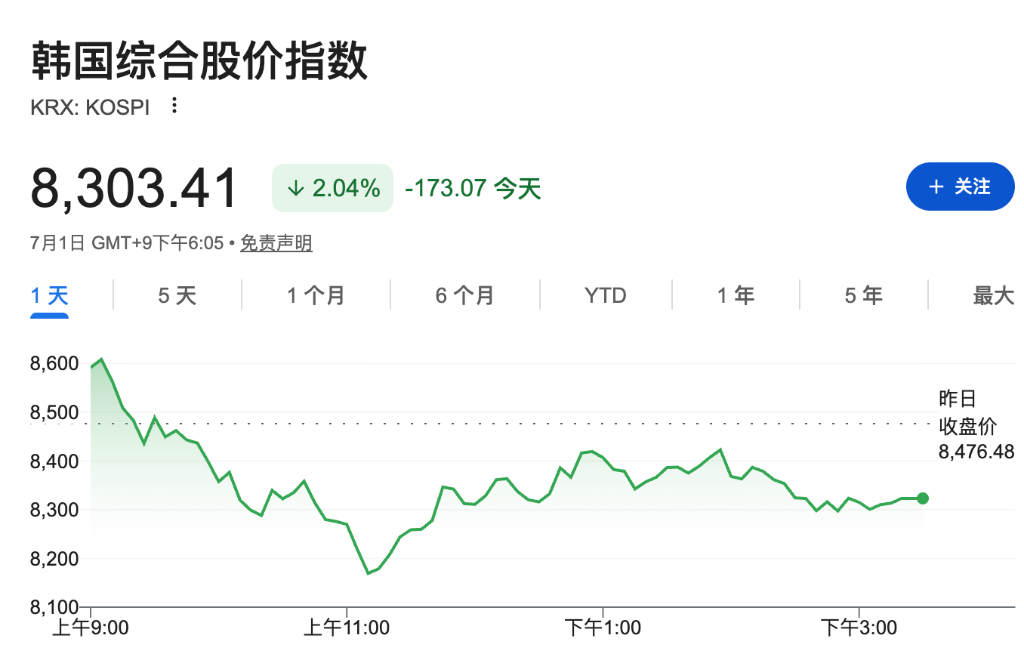
Subsequently, officials came forward urgently to clarify. On July 1, NPS President Kim Sung-joo published an article entitled "The Truth about NPS Rebalancing and the 74 Trillion Won Sell-off ‘Bomb’," stating that the so-called “74.4 trillion won sell-off wave” circulating in the market is “an unfounded claim” and that as a public pension fund, NPS will take a gradual rebalancing approach. By restricting the scale of monthly and daily adjustments, it will minimize the impact on the market as much as possible.
This is not the only "rumor" shaking the Korean stock market. WallstreetCN previously reported that recently there were online rumors that Seoul had sent letters to Samsung Electronics and SK Hynix demanding the establishment of a government-led think tank on profit-sharing, which was also quickly denied by officials.
Analysts believe that NPS rebalancing itself is a routine asset allocation operation, but given that it manages more than $1.2 trillion, making it the world’s third-largest pension fund, any moves to buy or sell are closely watched by the market. In the current environment, with Korean stock valuations already at high levels and market sentiment rather fragile, changes in capital flows have become a key focus for investors.
Korean stocks surge too quickly, pushing NPS positions beyond compliance range
According to NPS’s current asset allocation guidelines, the target proportion for domestic Korean stocks in 2026 is 20.8%, with a permissible floating range of ±8 percentage points, making the upper limit 28.8%.
However, due to the recent sharp rise in Korean stocks, market estimates suggest that NPS’s domestic stock position has climbed to around 30%, clearly exceeding the compliance upper limit.
NPS operates a disciplined rebalancing mechanism, whereby when any asset class weight deviates from target range, the fund will actively sell overweight assets and add to underweight assets, returning to the set allocation structure and controlling overall portfolio risk.
To avoid a short-term market shock, NPS had previously postponed rebalancing operations until the end of June. With the arrival of July, a new round of portfolio adjustment is expected to officially begin.
Up to 74.4 trillion won could be sold; institutional estimates vary greatly
Since NPS has not disclosed the specific execution plan, institutions have a wide range of estimates regarding the potential scale of sell orders.
Shinyoung Securities estimates that if KOSPI rises again to 9000 points, NPS could sell up to 74.4 trillion won of Korean stocks; if the index remains around 8500 points, the selling scale would be about 14.7 trillion to 51.2 trillion won.
Daishin Securities predicts that to bring the domestic equity allocation back within the target range, NPS needs to sell about 20 trillion to 57 trillion won worth of stocks.
Although the “74 trillion won sell-off wave” continues to circulate in the market, most analysts believe that the possibility of a one-off concentrated sell-off is extremely low. Shinyoung Securities analyst Cho Yong-gu expects that NPS will further tighten its annual, monthly, and daily rebalancing quotas, completing the reduction gradually over a longer period, and does not rule out the possibility of raising its annual domestic equity allocation target in the future.
NPS denies “74 trillion won sell-off” rumors, clearly states phased stabilization operations
Amid growing concerns, NPS President Kim Sung-joo has publicly stated that as a public pension fund, NPS will not sell assets in a concentrated manner like profit-maximizing private equity funds, but will instead prioritize maintaining market stability.
According to Korea Economic Daily, Kim Sung-joo said that the so-called “74 trillion won sell-off” is an over-interpretation by the market.
Meanwhile, Korean media revealed that NPS has adjusted its rebalancing execution rules, controlling market impact by reducing the scale of monthly and daily adjustments. The maximum monthly rebalancing scale is now capped at 0.25 percentage points, and daily sales also have an upper limit set, further lowering the risk of a concentrated sell-off.
The market generally expects that this round of rebalancing is more likely to be carried out in phases over several months or even longer, rather than creating a one-time massive sell-off pressure.
Disclaimer: The content of this article solely reflects the author's opinion and does not represent the platform in any capacity. This article is not intended to serve as a reference for making investment decisions.
You may also like
The "Outlier" Investment Art in the New Era of Berky

Chevron (CVX.US) explores alternative hedging for Middle East supply disruptions: targets Argentina and the Mediterranean to drive global LNG growth, seeks deal with India
Chevron is focusing on Argentina and the Mediterranean region, seeking global growth in liquefied natural gas, and plans to reach an agreement with India.

Energy and food price pressures intensify, potentially triggering an inflation rebound! The Bank of England may struggle to remain "calm" as market rate hike bets surge
The upward pressure on energy prices caused by the unresolved Middle East war is mounting. New risks are also approaching, which may keep inflation above the Bank of England’s 2% target for most of next year.

AstraZeneca (AZN.US) Breast Cancer Drug Etcamah Faces Setback in Phase III Clinical Trial, Potentially Impacting Billions in Sales
Bloomberg Intelligence analyst John Murphy stated that the setback in AstraZeneca's breast cancer drug trial could reduce sales in 2035 by $2.6 billion to $3.8 billion.

Crypto prices
More


