
Two Republican senators target on AI security following the GENIUS Act on stablecoins

Barely had the GENIUS Act been adopted to regulate stablecoins, Washington opens a new front. This time, artificial intelligence (AI) technologies are at the heart of the United States’ concerns. Behind this initiative, a broader strategy is emerging: to protect a technological advantage that has become a true power issue.
In brief
- The United States wants to strengthen AI protection against technology transfers to rival powers.
- AI becomes a strategic asset, just like semiconductors and critical infrastructures.
- The debate goes beyond geopolitics: between medical promises and societal fears, AI also raises questions about its own risks.
USA: Two American senators present a bill to secure AI
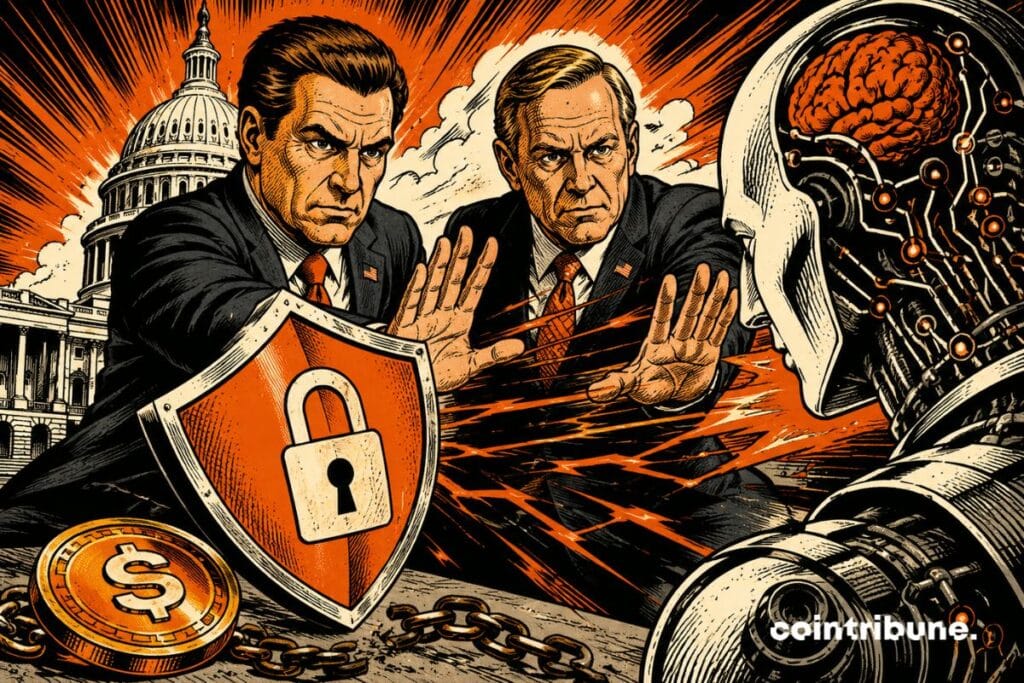
The Trump administration continues its rise in strategic technologies. After participating in the adoption of the GENIUS Act aimed at structuring stablecoins, Republican senators Tim Scott and Bill Hagerty now want to strengthen the protection of American artificial intelligence against “foreign adversaries”. To this end, the bill introduced in the Senate aims to give more powers to the Department of Commerce to control exports of AI technologies, whether models, software, or critical infrastructures.
The goal is to prevent innovations developed in the United States from strengthening the technological capabilities of rival countries like China. This text thus illustrates a profound evolution of American doctrine. Consequently, semiconductors are no longer the only assets considered sensitive! AI models also become sovereignty resources. In this new technological war, algorithms are now treated as critical infrastructures, just like energy networks or defense systems.
The US wants to secure AI, but are they truly aware of what they are creating?
The debate around artificial intelligence now goes beyond simple competition between great powers. In the United States, AI fuels two radically opposing imaginations. For some, it represents a direct threat to employment, capable of automating millions of tasks. For others, it embodies on the contrary a tremendous hope, that of accelerating the discovery of cancer treatments and revolutionizing medicine. This paradox fuels a question: has AI become too powerful?
By precisely seeking to lock access to these technologies to preserve their geopolitical lead, the United States implicitly acknowledges that AI has become an unprecedented power tool. But a technology powerful enough to transform the world can also produce unforeseen effects. Notably:
- Economic dependency;
- Automated disinformation;
- Concentration of technological power.
Securing AI against adversaries is one thing; ensuring it does not itself become a source of vulnerability is another. Would it not be better to bet on crypto and bitcoin in particular?
With this new legislative offensive, the United States shows that artificial intelligence is now a dossier as strategic as stablecoins. Protecting innovation becomes an instrument of power. However, in this race for technological sovereignty, who will really take the time to secure AI… against itself?
Disclaimer: The content of this article solely reflects the author's opinion and does not represent the platform in any capacity. This article is not intended to serve as a reference for making investment decisions.
You may also like
The "Outlier" Investment Art in the New Era of Berky

Chevron (CVX.US) explores alternative hedging for Middle East supply disruptions: targets Argentina and the Mediterranean to drive global LNG growth, seeks deal with India
Chevron is focusing on Argentina and the Mediterranean region, seeking global growth in liquefied natural gas, and plans to reach an agreement with India.

Energy and food price pressures intensify, potentially triggering an inflation rebound! The Bank of England may struggle to remain "calm" as market rate hike bets surge
The upward pressure on energy prices caused by the unresolved Middle East war is mounting. New risks are also approaching, which may keep inflation above the Bank of England’s 2% target for most of next year.

AstraZeneca (AZN.US) Breast Cancer Drug Etcamah Faces Setback in Phase III Clinical Trial, Potentially Impacting Billions in Sales
Bloomberg Intelligence analyst John Murphy stated that the setback in AstraZeneca's breast cancer drug trial could reduce sales in 2035 by $2.6 billion to $3.8 billion.

Crypto prices
More


