
Australian Dollar remains on the front foot vs weaker USD after China Services PMI

The AUD/USD pair turns positive for the second straight day following a modest Asian session downtick to the 0.6910 region amid the emergence of fresh US Dollar (USD) selling. Spot prices stick to gains following the release of the RatingDog China Services PMI and currently trade around the 0.6930 area, just below a one-and-a-half-week top set on Wednesday.
The gauge eased from a three month high of 54.4 to 54.1 in June. The reading, however, pointed to a continuous expansion in China’s services sector and offers some support to the China-proxy Australian Dollar (AUD). The USD, on the other hand, languishes near a two-week low, touched on Thursday, amid receding US Federal Reserve (Fed) rate hike bets. This turns out to be another factor that contributes to the bid tone surrounding the AUD/USD pair.
The closely-watched US Nonfarm Payrolls (NFP), released on Wednesday, showed that the economy added 57K jobs in June, far below the 110K expected. Moreover, the previous month's reading was revised down from 172K to 129K, pointing to softening labor conditions and offsetting a downtick in the Unemployment Rate to 4.2% in June. Nevertheless, the data shifted market expectations from one to two Fed rate increases in 2026 to between zero and one hike.
However, persistent geopolitical uncertainties hold back the USD bears from placing aggressive bets and cap the upside for the AUD/USD pair. In fact, the New York Times reported that US officials feared Israel may be hatching a plan to kill Iran’s senior negotiators, which could derail negotiations and trigger renewed fighting. Furthermore, Iran’s military headquarters warned that any US interference in the Strait of Hormuz will be met with a “decisive and swift response.”
Adding to this, relatively thin liquidity on the back of a holiday in the US makes it prudent to wait for strong follow-through buying before positioning for an extension of the AUD/USD pair's recovery from a three-month low, set earlier this week. Nevertheless, spot prices seem poised to register modest gains for the first time in three weeks and remain at the mercy of USD price dynamics.
Disclaimer: The content of this article solely reflects the author's opinion and does not represent the platform in any capacity. This article is not intended to serve as a reference for making investment decisions.
You may also like
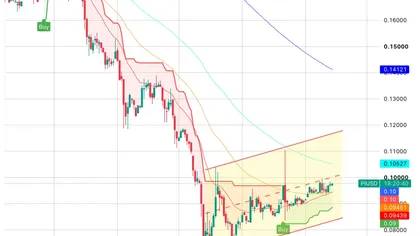
Pi Network Price Prediction: Can PI Hold Its Wedge Breakout Before the Upgrade?
As AI controversies escalate, hedge funds buy tech stocks at the fastest pace in 15 months
Hedge funds have recorded net purchases of US TMT stocks on 10 out of the past 11 trading days, rebuilding tech long positions at the fastest pace in 15 months. However, an AI policy storm has struck at the "worst possible time"—calls by AI giants to slow down development have been rejected, and regulatory uncertainty has directly hit Asian tech stocks such as Softbank. As the tech sector's bullish run coincides with Super Central Bank Week, the sector now faces a severe test.
Apple Pre-sale Tracker: iPhone 18 Pro Series Shows Weak Overseas Demand Signals, Duo Review Positive but Hardware Lags Behind
According to a survey by Jefferies, after the launch of the iPhone 18 Pro, delivery wait times in the four major markets—the US, UK, Germany, and Japan—have shortened by 5 to 11 days compared to last year, with no wait time in the US. Given stable production capacity, this is a clear sign of weak demand. Although the China and Hong Kong markets have performed better against the trend, there are still suspicions of speculative stockpiling. The new foldable Duo has been praised for its software experience, but its $2,000 price tag comes with a 254-gram body and dual-camera setup, leaving its hardware lagging significantly behind Android competitors. Jefferies maintains an "underperform" rating, with a target price implying a 21% downside from the current level.
SUI holds $0.71 support as analysts cite key buy signal, eyes on possible recovery
Crypto prices
More


